Friday, April 29, 2011

You can count on it...


Welcome to the days between Pesach and Shavuot, when the weather turns warmer, and we literally cannot wait until the end of the year (I don't know about you, but my kids are counting down the days until the end of school and the start of summer).


In the Jewish year, we also participate in our own "countdown" known as the Counting of the Omer. Between the two holidays (one celebrating our freedom and the other celebrating our receipt of the Law), we mark each day that passes, ceremonially also marking down the time that passed between Egypt and Sinai for our people.


In my family, we also have a tradition of counting our blessings, taking the time to note the things in our lives for which we are grateful. We sometime conduct our gratitude ritual at the dining room table, or sometimes in the middle of a busy afternoon. We take turns, each counting off and naming something that we appreciate in our lives, sometimes naming people, sometimes events, and sometimes even naming TV shows or movies we have watched recently. We are sometimes playful, serious, or just plain silly, depending on our mood at the time. But no matter what, every time we do this - we stop and acknowledge all the things we have for which we can be grateful - we are always reminded how lucky we truly are.


May you be reminded, in our own people's time of counting, what truly matters in your own life, and may you have the time to count the numerous blessings in your own life. Happy Omer!!


Friday, April 22, 2011

Lessons from Pesach


The following editorial appeared April 18, 2011 on the The Washington Jewish Week website and is reprinted with permission.

As Jews throughout the world gather this week and next to commemorate our deliverance from bondage in Egypt, many of Israel's neighbors (Egypt included) are undergoing populist upheavals that bespeak a yearning for liberation.

What remains to be seen, however, is whether the parallels between the two narratives are simply superficial - or whether the Arab revolutionaries of 2011 can apply some valuable lessons learned through the ancient Israelites' struggle for freedom.

One of those lessons, we believe, is that the Jews were liberated not simply for freedom's sake, not only to remove the whip from the hands of their Egyptian taskmasters, but for the higher purpose of serving God. In effect, they exchanged physical slavery for a different kind of servitude.

And with this "spiritual servitude" came a wealth of responsibilities that are spelled out in the Torah's commandments, many of which are instrumental in creating a just society.

This is a lesson that the leaders of the rebellions in Arab countries would be wise to heed. Getting the authoritarian monkey off their backs - whether it is Hosni Mubarak in Egypt, Moammar Gadhafi in Libya, Bashar Assad in Syria or other dictators - is the first, but not the final, step. It is necessary, but not sufficient to construct a viable alternative to despotism.

Parliamentary democracies are one possible result of these revolutions. Waiting in the wings, however, are other, unsavory outcomes: restoration of the ousted ruling elites, the establishment of military rule, the creation of an Islamist totalitarian regime.

Only by endeavoring to create governments and societies based on justice, the rule of law, basic human rights and good international relations can the rebels realize the essential value of their newfound liberty - and ultimately resist backsliding into tyranny.

As we celebrate our holiday of redemption from slavery, we hope they are able to secure the blessings of true freedom.

Wednesday, March 23, 2011

Texas Hold ‘Em At TBS: Going All In With The Brotherhood

posted by James S. Hirsch


Is there a God?


That question often comes to mind when I’m playing Texas Hold ‘Em and I’ve got a small pocket pair and I’m looking for “trips” – or three of kind – on the flop. Or when I’m drawing to an open-ended straight. Or when I’m down to my final few chips.

In other words, the question often came to mind during the TBS Brotherhood First Annual Texas Hold ‘Em Poker Tournament on March 13. The event in Simon Hall was superbly organized by Rob Braunstein, Jeff Keselman, and Steve Gladstone, and 50 TBS men gathered for spirited play. The buy-in was $36, so we had little to lose but plenty to gain – first place would receive $360 plus a pair of tickets to the Red Sox-Yankees.

The highlight of the evening was Rabbi Todd’s appearance. He didn’t play cards, which is good, because bluffing a rabbi out of a pot would surely violate some Talmudic law. Instead, Rabbi Todd visited each table and blessed the chips.

Poker is actually quite popular in Needham. I know of several quasi-regular games in town, including one that I’m in. Our games are low stakes, and whenever someone loses, we comfort him by saying, “Hey, it was cheaper than taking your wife out.”

Poker requires a sharp mind, nerves of steel, and a little bit of luck. Okay, make that, “a lot of luck,” at least for me. At Foxwoods and at other casinos around the country, I’ve had some good nights, but I’m just as likely to have a bad night. I’m a classic amateur poker player: when I win, I attribute it to my superior skills. When I lose, I blame it on the cards.

And when I need a card to bail me out, I wonder about the existence of the Almighty.

Fine. I know He has more important things to do, but early in the TBS tournament, some divine intervention did appear to come into play. I had pocket queens, a good starting hand; I raised pre-flop, and four players called me. On the flop, three cards lower than a queen turned over, plus two clubs. I figured I was ahead, so I bet, and two players called me. Then on the turn, or fourth card, the king flipped up. Uh-oh. I feared my pocket queens were toast. But everyone checked. The river, or final card, then came up – the queen of clubs.

I now had three queens, but another player may have hit his flush. The player to my right started the betting and put in 1,500 chips, more than half my stack. I thought for sure he had the flush. I agonized for awhile – the professional poker players agonize on TV, so I should as well – and then I called. My opponent turned over his cards: a king and a queen for two pair, but no flush.

Brilliant call! I won the hand with three queens – and a huge pot! – but I was incredibly lucky. On the river, there was only one card left in the deck that could have saved me – the queen – and it came up. Someone was watching out for me.

Once you lose all your chips, you’re gone, and within 20 minutes, players began dropping out. It’s a tough game: you can have a big stack of chips and lose it all in one hand. When you heard a howl from across the room, you knew that someone had just busted out.

Each table sat 10 players, and I just wanted to make it to the final table, because then I could tell my wife that I made it to the final table, and in the long, august history of Temple Beth Shalom, how many Brotherhood men have ever made it to the final table? Damn straight. I wanted that last table. I didn’t really care about the prizes. The top seven players would be “in the money,” with the seventh place winner receiving a $20 gift certificate to Wild Willy’s (which may have argued for the benefits of coming in eighth place).

I won a couple of small pots, but hadn’t lost any big ones, and after three hours I was now part of the final two tables, with about 7,000 in chips (we started, if I’m not mistaken, with 3,500). At this stage, the blinds were at 600-1,200, with a 100 ante, so winning a hand pre-flop yielded a decent pot.

I drew A-J off suit, the best cards I’d seen in awhile. Two players limped in, including Steve Sherry, who had the most chips at the table. “All in,” I said defiantly, expecting everyone to fold. Everyone did . . . except for Steve. My tournament life was at stake! At least that’s what they would say on ESPN. I flipped over my A-J, and Steve showed his cards – K-9 of hearts. Steve put in somewhere between a half and a third of his chips with a middling hand. If ESPN were broadcasting the game, it could post my likelihood of winning, but it had to be at least 60 percent. I was in good shape to double my stack and make it the final table.

The flop came – three blanks but one heart. Next card was an ace – yes! – but then I noticed it was the ace of hearts. Uh oh. Two hearts on board now gave Steve a flush draw. But only nine cards in the deck could beat me – a 17 percent chance.

Last card: eight of hearts.

Now it was my turn to howl. And Steve went on to win the tournament.

So maybe I didn’t get any breaks from a divine power on that last hand, but after an evening of catching up with friends, meeting some new guys, and having some drinks and laughs, I have no doubt there was a higher spirit guiding the tournament, and I felt quite good about going all in with the Brotherhood.

Thursday, March 17, 2011

A knock on my door...

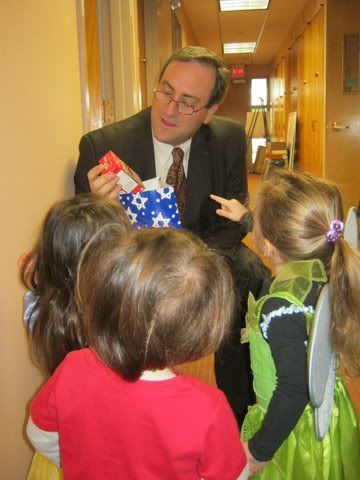
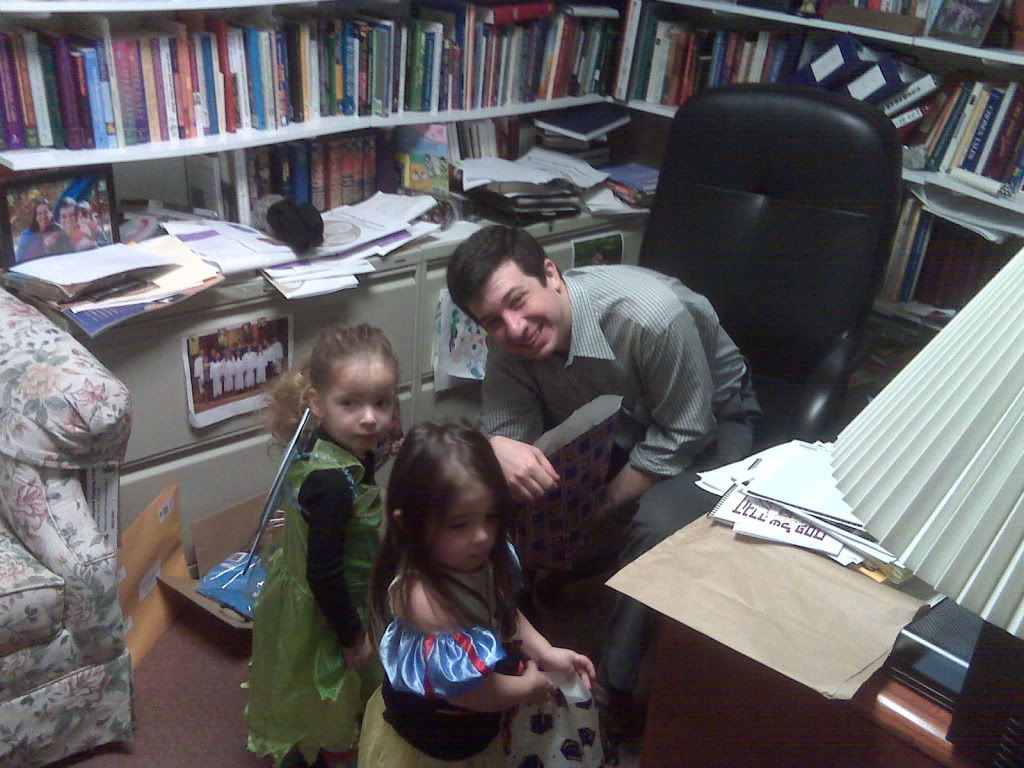
What a lovely surprise this morning! I was greeted by a wonderfully excited and festive group of superheroes, princesses, animals, and a very tall clown who cheerfully passed me one of their Shalach Manot packages filled with Hamantaschen, tea, candy, hand lotion (always needed), and a candle. The presents were nice, but the joy and holiday cheer brought by the children from the TBS Children's Center to my doorstep was the real gift.


Some snapshots below...

A group comes to deliver a package to me:


A crowd assembles in R'Todd's office:


Visitors in the hallway:


Princesses with the Rabbi:


The Rabbi and the Catwoman lead the Purim Parade out of the Sanctuary:

Monday, March 14, 2011

“There’s no place like home, there’s no place like home, there’s no place like home"

Dorothy had it right. While it’s always fun to go away, coming home is one of the greatest gifts, and there truly is no place just like home. This was brought (pardon the use of the pun) “home” to me recently when my family traveled to Stamford for a cousin’s Bar Mitzvah; it was lovely to see the extended family, and it was nice to be in a hotel for a night away, but my body and soul yearned for the return. Maybe I have grown weary of travel.

If I were to adopt the attitude of a Torah scholar, I would say, though, that there is a reason why L. Frank Baum’s character of Dorothy has to state “there’s no place like home” not once, not even twice, but three times. Nothing in the Bible (or one presumes in the Wizard of Oz either) is there by accident. So what are we to glean from this repetition? Some might argue that the meaning can be found in the fact that being at “home” involves first finding peace with yourself, then your family, and finally with your greater community. Some might remind us that the number three is used to remind us of the Hebrew letter gimel which is close to the word gamal which means camel; therefore Baum was introducing a camel into the story of a Tin Woodsman, a Scarecrow and a Lion (OK, maybe I’m reaching here)…

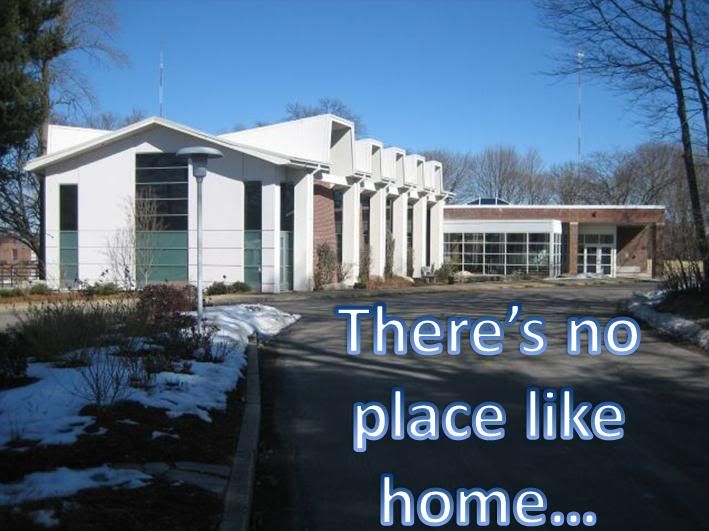
In Hebrew, the word Beit when used in a phrase like Temple Beth Shalom means “home”. My bayit, or my physical home, is where I live, but we are said to come together as a community in a Beit K’nesset (or Home of Meeting), a Beit Tefillah (a Home for Prayer), and a Beit Midrash (or Home of Study), all for the purpose of creating a Beit Shalom (a Home of Peace). So, for me personally, the repetition of “there’s no place like home” speaks to me about these three divisions: my personal home, our communal and spiritual home (our Temple community), and the physical building that houses us.

As many of you know, before joining the Temple staff in January, I had been working in New York City for the last year and 1 half and commuting weekly for work while living in Dedham. The job in the city was terrific, and I miss the friends and colleagues I had developed there, but I do not miss the commute. As a wonderful part of my new opportunity at TBS, I have both rediscovered my own home in Dedham (and, wow, is my family glad to have me back) and found a new “home” in Needham with a community whose very essence is to be welcoming and nurturing.

This essence of home pervades every interaction I have had with members of our community over the past few months. Every Temple member I speak with expresses how the “family” feeling of TBS defines their interaction with others in our community. Sometimes, like all family relationships, there are moments of loss and pain; in those moments, we reach out to each other for support and care. Sometimes there are moments of celebration; at these times, we kvell in each other’s successes and our hearts soar. Sometimes there are moments of quiet reflection where we sit together in silent support, offering comfort in each other’s presence and a knowledge that while one may be “lonely” for a moment in this community, one is never alone.

So the question naturally comes, do we feel at home in our building? How does our physical space help to support and nurture us and our interactions with each other? I now have a home in the administrative wing (a comfortable if modest space), and I encourage you to come visit it; for me, it is a comforting and comfortable space allowing me a “home” to do my work for the community. I have found moments of prayer and contemplation in our sanctuary with its stunning architectural elements of light, air, glass and wood. I have seen moments of casual interaction in our atrium that have supported the knitting of our community fabric. I have borne witness to the educational experiences that happen throughout our learning spaces, from Children Center classroom, to Religious School classroom, to the Garden Club and Community Rooms, to Simon Hall. I have also seen the underpinnings of our physical home, visiting the storage spaces, the elevator shaft, and the boiler room. Our building has some faults, and some areas for improvement. It also has many strengths. Like my comfortable pair of jeans, it may be showing some wear, but I feel so “at home” when I am in the space, and I am sure you do too.

So, what is it about our physical space that most makes you feel “at home”? Are there areas of the building that you think best represent who we are as a community? How does our physical space do work when it is at its best? Where in our building do we need to do the most work in your opinion to help deliver on our promise of a Beit Shalom? What would you like to see happen to our physical home as we move forward as a community?

Saturday, March 12, 2011

Purim is coming!

One of the highlights of my role as the Director of Early Childhood Education at TBS is that I get to watch the anticipation of each holiday as it unfolds.  Purim is still a week away, yet everywhere I look I see signs of preparation for a joyful day of celebration.   

Shalach manot (gifts to friends) packed and ready to distribute.  Children are making them to exchange with each other, to distribute to the elders in the Needham community, and for the people around TBS who help us each day.


Crowns being made.  The classrooms are already filled with every variety of sparkly king, queen, prince, and princess.

Masks lined up, ready to tell the story.  Imaginations are in full swing as the children take on the roles of the evil Haman and Queen Esther the heroine.  This is better than a fairy tale!


Joyful dancing and singing fills the halls.  Parading around the building one day and practicing dance moves the next.


Making noise!  Children are experimenting with how to make enough noise to drown out Haman's name.  The fill various containers with beans, buttons, and bird seed.  Which combination will make the most noise.  Look at that face!  This science experiment is pure joy to a young child.

And trays filled with tasty looking hamentaschen. The sweet scent fills it air.  

Purim is almost here!  Chag Purim Sameach!  Happy Purim!

Monday, March 7, 2011

Rockin' Purim

Over the last few years Purim has become a time for a rock n' roll-themed spiel, thanks to the best rock drummer rabbi this side of anywhere, our own Rabbi Todd Markley. Over the past few years we have celebrated Purim with the music of the Fab Four, the disco-tinged 70's, and the I-don't-know-how-to-describe-it 80's. This year Esther, Mordecai, Haman and the gang will sing slightly revised lyrics to the melodies of Billy Joel and Elton John.

So what should the future hold? A Grateful Dead Purim? A Justin Bieber Purim? It's not to early to generate ideas for Purim 2012. Let's hear your ideas!

Tuesday, February 15, 2011

Change in Egypt/Change for Israel?

The events in Egypt the past few weeks seemingly surprised the entire world. I brought back a poster of President Hosni Mubarak after visiting Egypt - in 1983! Who could have imagined that change would come so quickly.

The question we are all asking, however, is "change to what?" The military suspending the Egyptian constitution this week makes some feel uneasy, as does the presence of the Muslim Brotherhood, which today announced that it will be forming a political party in advance of elections in Egypt.

The implications for Israel are enormous, which has benefited from the security of its stable, if not warm, relationship with Egypt under Mubarak. The future seems quite cloudy as we look out today.

What path do you foresee for Egypt, and what consequences should we anticipate for Israel?

Thursday, January 27, 2011

Two Jews, and how many opinions?

I like the old saying that whenever two Jews come together, you have three points of view. However, I haven’t experienced that process at TBS when it comes to the issue of the Israeli government’s policies on the Palestinian question. My experience has been that it’s difficult and awkward to bring up points that counter official government policies. Perhaps that’s only a reflection of my own insecurities, but I wonder if it may be a more widespread experience.

So I’m writing this blog post to find out how TBS members would feel about hearing other points of view from our various guest speakers and forums. For example, the Israeli media is widely and justifiably praised for presenting all viewpoints on the volatile issue of I/P (settlements, Gaza, statehood, etc.), but it’s rare to hear anything apart from unconditional support for Israel’s policies in the American media. A recent local attempt to host a respected speaker for the so-called peace perspective was cancelled at the last minute (when Newton’s Temple Avodah abruptly disinvited the head of J Street).

That sort of action is very troublesome. I would love to hear the J Street perspective on these issues as a complement to the AIPAC view that we are so often presented with. I’d love to hear a Palestinian or Muslim perspective on current events – for example, this year’s impressive Yom Kippur Colloquy speaker should be invited back to talk about, well, anything he’d like. I’d be curious to know what the spectrum of opinions is among TBS members – a membership survey would be fascinating, asking how many of us support settlement expansion, how many think recent actions might be illegal, how many want to extend the security wall, etc.

After all, at times the world seems nearly united in opposition to Israeli government policies. How divided is American Jewish opinion? What do TBS members think? I’d be surprised if, unlike the proverbial two Jews, we have only one opinion.