
[Originally posted on ReformJudaism.org]
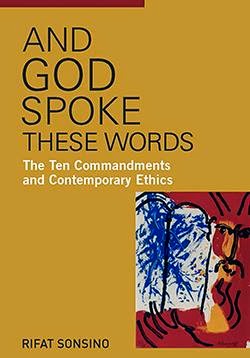
Throughout his long and distinguished career, Rabbi Rifat Sonsino, PhD, has helped thousands of readers find God, and uncovered the truths and legends behind the foundational myths of Judaism. In his newest book, he explores one of the best known – and least understood – texts in the Bible: the Ten Commandments.
The Ten Commandments loom large as ethical and moral guideposts in the Western world. The Bible recounts how, after the Exodus from Egypt, the Children of Israel proceeded to Mount Sinai in the desert. Moses ascended the mountain to meet God, who gave him the Ten Commandments, which were written on two tablets to be delivered to the Children of Israel.
These statutes have informed much of Judaism and Christianity over the past two thousand years, and stand at the center of many modern legal and political debates. However, attention to the remarkable and well-established influence of these words often glosses over the actual text and context of the biblical sources themselves.
In And God Spoke These Words: The Ten Commandments and Contemporary Ethics, Rabbi Sonsino draws on commentators from Maimonides to Mel Brooks to explore how the Ten Commandments have been interpreted – and misinterpreted – for generations. He examines the religious and legal texts of the Israelites' neighbors in the Ancient Near East, surveys centuries of Rabbinic commentary, and engages with contemporary secular and Jewish thought. Sonsino's thorough contextualization and discussion of the Decalogue provide the reader with an understanding of where these iconic commands originate, how they have been understood by Jews throughout the ages, and what moral direction they can still provide in the 21st century.
Stephen Becker, director of sales and marketing at URJ Books and Music, sat down with Rabbi Sonsino to discuss this fascinating new book.
URJ Books and Music: Why did you write this book?
Rabbi Rifat Sonsino: I wrote this book because I became aware of the fact that many people have the wrong information about this famous text. For example, many people think that the Decalogue contains the so-called Golden Rule, "treat others as you want to be treated." In reality, the Golden Rule is based on a saying attributed to Rabbi Hillel who lived in the 1st century C.E. and it is not found in the list of the Ten Commandments.Secondly, I wrote the book because I realized that many people project onto the text their own religious views. For example, those who oppose abortion and pacifists who are against war at all cost argue that the Ten Commandments says, "Do not kill." A linguistic study indicates that this law can easily be translated as "You shall not murder," implying premeditation, changing the scope of the commandment. We simply do not know how the original norm was understood in biblical times. The Bible knows of the death penalty and is not against wars. So, "You shall not kill," is not likely to be the original intention.Finally, I wanted to provide a modern interpretation of the Decalogue, especially stressing its relevance in contemporary ethical situations. For example, in reviewing the norm against stealing, I discuss not only stealing property, but also kidnapping, encroachment, unfair competition, identity theft, copyright issues, Ponzi schemes, and so on.URJBAM: What is the relevance of the Ten Commandments now?
RRS: The Decalogue contains certain basic legal and moral norms that are found at the foundation not only of Judaism but also of Western civilization. For many people the Decalogue simply stands for law and order. It represents our high religious standards. That is why so many judges and religious leaders want to display them in the courts of law.URJBAM: How can this book be used in class?
RRS: I would suggest that students first share their personal information about the Ten Commandments, and then, by studying my text, try to figure out how each one of them can be applied today. I would also suggest that at the end of the sessions, students should attempt to come out with their own set of ten commandments that are reflective of modern life.URJBAM: Why call it "Ten Words," and not "Ten Commandments"?
RRS: The Hebrew text does not refer to the Decalogue as "ten commandments," but only as "ten words." This is also the meaning of the word "Decalogue." In Greek, this means, "ten words." These "words" become "commandments" when they are internalized and attributed to the divine. How these ten norms were revealed is a mystery. We do not have a clear picture of it in the Bible. We are dealing here with a fundamental myth. Obviously, to become effective, each of the ten words needs to be elevated from the level of "legislation" on the books to the level of "commandments," when a person feels that these norms have fundamental value and are addressed to every person.
Rabbi Rifat Sonsino, PhD, is rabbi emeritus of Temple Beth Shalom in Needham, Massachusetts, and adjunct professor of theology at Boston College. Born in Turkey, he received his law degree from the University of Istanbul, his rabbinic ordination from the Hebrew Union College-Jewish Institute of Religion, and his doctorate in Bible and Ancient and Near Eastern Studies from the University of Pennsylvania. Rabbi Sonsino is the author of numerous books, articles, and blog posts.

