Friday, October 3, 2014

Rabbi Sonsino: "Against Extremism; Choosing the Middle Road"

Rabbi Sonsino
In confronting daily struggles, some people remain apathetic and ignore them, hoping the problems will go away; others, confront the issues with full force, at times, even acting blindly and with anger; however, the best way is to take the middle road and resolve them by learning how to live with the ambiguities of life.

Thus, for example, the prophet Ezekiel criticizes those people “who have eyes to see but see not, ears to hear but hear not” (12: 2). Biblical law decries this uncaring attitude and, in fact, states, “You shall not stand (idly) by the blood of your neighbor” (Lev. 19: 16; cf. Rashi based on the Sifra).

At the other extreme, the zealot is characterized in the biblical tradition by the hot-blooded Phineas, the grandson of Aaron, who attacked and killed a non-Jewish woman and her Jewish husband in their tent, presumably because of some idolatrous practice, thus putting an end to a plague. For this act, Phineas received God’s “pact of friendship” (beriti shalom) as well as “a pact of priesthood” (berit kehunat olam) for all time (Num. 25:12). Later rabbinic tradition shows a great deal of ambivalence regarding Phineas, some considering him a hero, while others view him as  a dangerous fanatic who needs to be contained (See, for ex., “Coping with Zeal,” N. Leibowitz, Studies in Bamidbar, 328.ff). I still remember Barry Goldwater’s acceptance speech at the Republican convention of 1964 when he said: “extremism in the defense of liberty is no vice.” I disagree: extremism is always a vice.

Between these two poles, the medieval Jewish philosopher, Maimonides, suggests a third option. He calls it “the middle road,” or “the happy medium” (midah benonit). He says this is the most desirable path, as it requires the individual “to be angry only for a grave cause that rightly calls for indignation, so that the like shall not be done again” (Mishneh Torah, Knowledge: 1: 4).

I admit that the “middle road” is not an easy path, because it requires the individual to learn how to live with lack of precision and within the shades of gray. Some people simply cannot handle it. They want clear and cut answers. It is “yes” or “no.” Life, however, is never “black and white.”  It is not always an uphill road. It meanders; there are low points followed by great achievements. As we become more mature, we all need to learn how to live with uncertainties, with sudden deviations, with momentary greatness, with long range goals and broad perspectives, so that when we look back, we can say, “Not bad; I did all right.”

Apathy is inhuman. Extremism is easy but dangerous; it is even arrogant. The middle road, though far from being smooth, is wholesome. Thus, Maimonides suggests that those who follow it should not be “tight-fisted nor a spendthrift…neither frivolous and given to jesting, not mournful and melancholy” (idem). He ends by saying that those who follow the “middle road” are termed “wise.”

Regrettably in our time, especially in the political scene, many people choose an extreme path. They view themselves as saints and consider others as villains. It is regrettable that the social and political agendas of many societies have now been high jacked by narrow-minded fanatics. Many countries in the world (e.g. the Middle East, Latin America, Eastern Europe) are suffering because of this malaise. This is not helpful. It is simply wrong.

So, don’t be an apathetic person, ignoring what is going on around you. On the other hand, stay away from intolerance, because it only leads to mental blindness. The middle road is the wholesome road.

Rifat Sonsino
Oct. 2014

Monday, September 8, 2014

Rabbi Sonsino: There Is No Perfection

Rabbi Sonsino
Recently I learned that Perfection Valley is a fictional place in Nevada where the ex-silver mining town of Perfection was located. It served as the primary setting for the 1990 film called Tremors. It does not exist—just as perfection itself. Hebrew does not have a good word for perfection. The closest one, shlemut, means “wholeness.”

I have reached a point in my life where I no longer expect or seek perfection in anything or anyone. Salvador Dali, the famous Spanish/Catalan painter once said: “Have no fear of perfection; you’ll never reach it.” Human beings, being fallible, make mistakes, either small or big, and need to learn how to deal with their consequences. I only try to do better, and hope that my errors are rather benign or correctable.

Everything we do and have in life ends up being short of the ideal. Examples:

1. There is no perfect joy. It is always tinged with some shade of darkness. During the Jewish wedding ceremony, it is customary to break a glass. Rabbinic sources provide various interpretations for this act. According to one, this is a reminder that even at the height of our happiness we need to remember the destruction of the Jerusalem Temple in 586 BCE and then in 70 CE. For me, it means that the bride and groom must acknowledge that they will experience moments of joy as well as times of sorrow in their lives. However, the love they have for each other will enable them to meet the future challenges together with optimism and hopefully with success.

2. There is no perfect friend or spouse. What we need in life is not a perfect partner, but a good one; one who has a kind heart and an empathetic soul. One cannot live with someone who claims to be beyond reproach. This would drive you crazy, because you would always feel that you cannot meet that person’s expectations. And that is not a good recipe for friendship. Better accept each other for who you are, and complement each other lovingly.

3. There is no perfect job. I don’t know of anyone who is totally happy with his/her work. Every profession has its highs and lows. We frequently overlook the difficulties in our work because we derive so many other benefits by doing what we love best.

The realization that there is no such a thing as perfection does not mean that we should lower our standards. That is simple laziness and would represent a personal let down. We should acknowledge our limitations, do our best, and make the necessary corrections as we go along.  And if we do that for ourselves, shouldn’t we also tolerate and, at times, even overlook other people’s imperfections?

According to a rabbinic text, everything that was created at the beginning of time needs “fixing,” such as, “The mustard seed needs to be sweetened, the wheat needs to be ground, the lupine needs to be soaked and man needs to be repaired (tzarikh tikun, i.e. circumcised) (Gen. R. 11: 6). The Hebrew Bible tells us that only God’s deeds are perfect (tamim in Hebrew, meaning, wholesome, pure, complete, perfect; cf. Deut. 32: 4; Ps. 18: 30; 19: 8), whereas human beings are limited creatures who can and should improve themselves. That’s all we need to do.

Rifat Sonsino
Sept. 1, 2014

Thursday, July 17, 2014

CJ Kaplan: What My First-Grade Son Taught Me About Art

This post originally appeared on The Good Men Project

After seeing his son’s excitement about Degas, Picasso, and Warhol—CJ Kaplan realizes that teaching is an art form.

My son Eric is a little obsessed. As the youngest of three, he is in a constant struggle to keep pace with his older brother and sister. His efforts have made him hyper-competitive, especially in sports. Where my daughter Samantha considers all athletic endeavors (and I’m quoting here) “stupid” and my son Alex relishes the game more than the result, Eric treats even his Boys U8 soccer matches as a life or death proposition.

Part of this is a consequence of Eric being four years younger than Alex and always having to “play up” and prove himself in any contest involving Alex’s friends. It’s made him a hell of an athlete and a fearless competitor, but it’s also made him place too much weight on the outcome of something as inconsequential as a two-on-two game of hoops in the driveway.

Cohabiting alongside the fierce warrior persona within this little boy there is also a very sensitive soul. Eric has a small army of stuffed animals that he anthropomorphizes through a series of imagined personalities, voices and backstories. (I have a lot to do with the last of these traits since I’ve spent nearly every long car ride of Eric’s childhood making up stories about my kids’ stuffed animals to pass the time. To date, Fuzzy, Foof-Foof and Ring Dog have individually or collectively won the Stanley Cup, the Super Bowl, the World Series of Poker and an episode of Jeopardy!) Because his stuffed animals have inherited these very human characteristics, Eric has also given them feelings. He worries that they miss him while he’s at school and that they might be sad or lonely while he’s away. Often, my wife Lisa or I will place a few chosen dogs and bears in the window next to our front door so that they appear to be waiting for him when he gets home. My son deserves a hero’s welcome at the end of the day.

♦◊♦

Recently, Eric completed his year in first grade in such spectacular fashion that I feel compelled to share it with anyone who will listen. His teachers, Gabrielle Gelinas and Kristen Willand, delved into Eric’s sensitive side and made him care passionately about something other than sports.

For the past several months, Eric’s class has been studying influential artists of the past five centuries. They started with Michelangelo and worked their way up through Dale Chihuly. Along the way, they covered such greats as Monet, Degas, O’Keefe, Calder, Picasso, Pollack and Warhol. Pretty heady stuff for a group that considers Sponge Bob Square Pants high culture, no? Yet the whole class was enthralled, embracing and absorbing each successive artist with a zeal usually reserved for a Disney premiere. And nobody in the class was more captivated than my son the sports nut.

The first time we noticed this phenomenon was when we were discussing a dancer we had seen on TV. I remarked offhandedly that this particular dancer was very small in stature.
“You mean like “The Little Dancer?” Eric piped in.

“Uh…” I began slowly, buying time. “Do you mean “Tiny Dancer,” the Elton John song? (Eric has had a full dose of classic rock in his lifetime.)

“No, I mean like “The Little Dancer” by Edgar Degas,” Eric replied, looking at me like I was as dumb as box of rocks.

“Oh,” I answered, doing nothing to change his opinion of me.

After that, I would go to tuck him in at night and he would regale me with what he learned that day about Cubism or Impressionism or Abstract Expressionism. He lectured me on brush strokes and the use of forced perspective and the inspiration one could find in cow skulls. He talked about these things with the same casual confidence he has when discussing the efficacy of the Bruins’ third line in the playoffs.

“How,” I asked Lisa, “are they getting him so excited about art?”

The answer came in two signature events that culminated the school year.

The first was a trip to the Museum of Fine Arts in Boston. Eric’s class and another first grade class that had been studying these artists went into the city to see real art—live and in person. Ms. Gelinas and Ms. Willand had gone to the MFA earlier in the year and researched what was going to be on exhibit in the spring. So when the children burst into the hallowed halls of the gallery, all the pieces that they had loved and admired in their books and slides were on display before them. Lisa was a chaperone on this field trip and she describes the scene as follows:

“Every time they found a piece that they had studied, they jumped and cheered. Honestly, they could not have been more excited if they found Dustin Pedroia in the museum.”

“The Little Dancer” was there and Eric had his picture taken in front of it. We he told me about the experience, I shared his joy.

“Isn’t it amazing that there is artwork so special that it travels around the world so people can see and enjoy it?” I asked him.

“Yeah,” he said. “There’s only one “Little Dancer” in the world and I got to see it today.”

♦◊♦

The second event that made me understand and appreciate how my son had fallen in love with art occurred on one of the last nights of the school year. We parents were invited to “A Night At The Museum” in the elementary school auditorium

As we sat expectantly in the theatre seats, the first graders filed in and took their places on the stage. The teachers welcomed us to the show and then the children took over. What followed was a retrospective of the entire semesters’ study of art. Each artist was given an introduction by the children without notes or cue cards, followed by a slide show, song or skit that represented the artist’s work.

For Calder, they staged a circus complete with a ringmaster, pantomimed strongmen and acrobats walking imaginary tightropes. For Degas, there was a “history of dance” which included The Twist, The Loco-Motion and The Hustle. For Warhol, they sang a song called “Pop Andy” in reference to his pioneering work in Pop Art. (The subversive part of me hoped they would sing “Venus in Furs” from the album The Velvet Underground and Nico, for which Warhol did the famous banana cover art. Alas, there was no mention of Lou Reed or any of the Factory Superstars.)

As the revue played out, it became evident from the still images in the slideshows why the class was so invested in these artists. Ms. Gelinas and Ms. Willand had taken pictures of the children “becoming” each artist they studied.

To understand what it was like for Michelangelo to paint the Sistine Chapel, they had taped paper to the bottom of their desks and lay on the floor painting upside down. To appreciate the joy and freedom of Pollack, they went outside and splashed paint over a giant canvas (and each other). To mimic Chihuly, the painted the inside of empty plastic water bottles and strung them together in a hanging sculpture.

At a time when interactive has become synonymous with an app or a website, Ms. Gelinas and Ms. Willand made art a living, breathing thing for the children in her class. How could they not help but fall head over heels?

The show was a full hour without interruption and the kids executed it with the precision of a Broadway production. You could see them mouthing each other’s lines as they waited for their cues. Even the dance choreography was flawless.

Afterward, we were invited downstairs to the classrooms to view each child’s own personal “gallery.” When we got there, we discovered that every student had been given a two by six foot section of wall upon which hung their most prized creations from the semester affixed to a giant piece of construction paper. Eric’s “gallery” featured drawings, poetry, sculptures, 3-D art and his reflections on his favorite artists.

I have been fortunate enough to wander through the exhibits at the Louvre and the d’Orsay, but neither could elicit the surge of emotion I felt standing in front of Eric’s collection of work. The entire installment is currently draped across our dining room table while we figure out how to frame or otherwise preserve it.

There is a reason we hold special teachers in our hearts forever. They help us discover something about ourselves that we never would have known otherwise. So, it didn’t surprise me that Eric was ambivalent about the end of the school year.

“I’m happy that school is over for the summer,” he said. “But, I really loved my first grade class.”


Yeah, I thought, so did I.

Monday, July 7, 2014

Remarkable People I Have Known: Ina Glasberg of Needham

Rabbi Sonsino
During my congregational rabbinate, I was fortunate to work with dedicated leaders and board members. However, among them Ina Glasberg occupies a very especial place.

Ina was part of the rabbinic search committee of Temple Beth Shalom, Needham, MA, when I came in 1980. She was a member of the Board of Trustees and then became a vice-president and finally the president of the synagogue. She served with distinction in whatever she undertook as a layperson.

Ina, an eshet hayyil (a “woman of valor”), is married to a wonderful and kind man, Ron. She is a devoted wife, a beloved mother and grandmother. After her presidency, she became a national board member of the Union for Reform Judaism, as well as taking on major roles in many of the social and religious associations of the greater Boston area.

Ina Glasberg
Ina is a presence in our temple. She has functioned in many capacities as a temple leader. She knows how to deal with people with kindness, yet without ignoring the rules and regulations that move the institution.  You cannot get mad at Ina because of the gentle way in which she says things, and because you know she means well and she is right. When Ina chaired a committee, it included more people than necessary, because she wanted to involve temple members in congregational functions as a learning tool.

I was fortunate to be a beneficiary of her wisdom and kindness. In 1991, during her presidency, Ines and I took a three-month Sabbatical in Israel. This was during the Gulf War with Iraq when Saddam Hussein was launching his rockets into Israel. Securely living in Jerusalem, I remember seeing the Scud missiles flying over our heads in the direction of Tel Aviv. Ina was beside herself. She kept calling us making sure we were safe and gently implying that we return. We assured her that we were safe, based on the assumption that Saddam Hussein would not be foolish enough to bomb Jerusalem and accidentally destroy the sacred Muslim shrines.

Presidents and rabbis meet regularly to discuss temple matters and strategies to achieve the goals of the synagogue. It is during these private meetings that Ina could tell me, in a very subtle way, the things that I either overlooked or ignored. She did that out of love and concern for my family and me, and I responded in kind. Ever since, I believe that every Rabbi deserves an Ina, and I was blessed to have her as a dear friend, for which I am eternally grateful.

Rifat Sonsino, Ph.D.
Rabbi Emeritus,
Temple Beth Shalom, MA
July 6, 2014

Thursday, June 12, 2014

Jai Anguita of Barcelona

Rabbi Sonsino
For the last few years, every summer, my wife, Ines, and I went to Barcelona, Spain, spending from two weeks to a month, in order to help out a small but slowly growing progressive Jewish congregation called Bet Shalom, led by a hardworking leader named Jai [i] Anguita, who is a Jew-by-choice and a lawyer by profession. There are two liberal congregations in Barcelona: Atid and Bet Shalom. Both are affiliated with the World Union for Progressive Judaism. Jai was a member of Atid but left in order to establish Bet Shalom.
Though I am retired from the congregational rabbinate and worked with a dozen of wonderful synagogue presidents in the past, I have rarely interacted with someone as charismatic as Jai. He leads Bet Shalom with his sometimes unorthodox style. Along with his partner, Adele, he identifies good workers for the temple, trains them, and gives them responsibilities. He is well connected, extremely focused on his goal and works tirelessly, along with a group of dedicated individuals, in order to advance the cause of liberal Judaism in Spain.

In 2008 I discovered online that Bet Shalom was looking for a Rabbi to spend some time in Barcelona to lead services and coordinate the final stages of a conversion process to Judaism. I volunteered to help out. Jai invited me to come in and spend about a month in his beautiful city. The fact that I could speak Spanish was a great advantage to them. [See my blog posting on this synagogue, dated April 29, 2010]. Since then, Bet Shalom has become affiliated with the European Union of the World Union for Progressive Judaism (located in London), moved from a garage-size synagogue to a larger location, set up a new web page (http://www.betshalom.cat/), and continues to offer regular Shabbat and festival services (every Friday night the service is followed by a pot-luck meal) as well as introduction to Judaism classes ably taught by Jai himself.  It is now looking for a full-time Rabbi to lead this 60-70 family congregation, with great potential for further growth.

Jai was not satisfied with setting up a synagogue in Barcelona, but extended his help to other emerging groups in Galicia, Seville, Madrid and other locations. Jai has become the undisputed leader of the progressive Jews in Spain today, and deserves to be supported by Jews all over the world. It has been my pleasure and honor to work with him, and will continue to do so as long as I can.

Rabbi Rifat Sonsino, Ph.D.
Boston, Ma
June 12, 2014

[i] Pronounced as “chai” or, better “hai”, in Hebrew meaning, “life.”

Sunday, June 1, 2014

Mezuzah Study by the TBS Kindergarten Enrichment Kids


What is a Mezuzah?:
On Monday, Kindergarten Enrichment kicked off a new inquiry: What is a mezuzah? The children shared their initial ideas. Josie explained, "It's something you hang up on your wall and it's made of glass." Evan followed up with, "Is a mezuzah with a little scroll in it? I have two at my house. One's in the front of my mom and dad's room and one's on the side like as we just come in front of my house." They then shouted, "There's one!" as they pointed to a mezuzah hanging right on the doorway of our classroom. This led us into the great Mezuzah hunt through Temple Beth Shalom. The children used their science notebooks to make observational drawings of the different mezuzot we found through out the school and temple. They had lots of ides as they walked around searching and observing:

Evan: They're on every door here (downstairs classrooms)
Noah: The Kohavim room has a mezuzah!
Evan: This one (Room 14) is different then the others.
Josie: I found one! (Mezuzah hanging on Mayim office made of rainbow mosaic glass).
Evan: Someone made it. It's not real.
Talia: There is a slot if you want to put anything in it.
Josie: None in the bathroom.
Evan: None in the elevator.

The children continued walking and found a glass mezuzah they could see inside of:
Evan: This one has a scroll.
Jesse: What do you think is on the scroll?
Evan: Hebrew letters. It must be about a story.
Talia: I think every scroll must be about a different story.

After finding many mezuzot the children were left with many ideas and questions: Why are their mezuzot on some rooms, but not all? What is on the scroll inside the mezuzah? Are some mezuzahs real and some not? Can you make your own mezuzah? Why do some Mezuzahs have the hebrew letter shin on them and some do not? Stay tuned to find out what happens with our Mezuzah investigation over the next few weeks! 

from left to right
Top Row: Mezuzah we observed, Julian's observational drawing, Noah's observational drawing.
Bottom Row: Josie's observational drawing, Talia's drawing, Evan's drawing

Mezuzah Observations:
The kindergartners continued their investigation of mezuzot this week. Today, they made up close observations of a mezuzah Ellen let us borrow. They noticed the mezuzah had a Hebrew letter at the top. Some children realized it was the Hebrew letter, shin. They also noticed some other Hebrew letters. It was the word, Jerusalem in Hebrew. After making detailed drawings, the children noticed their was a scroll inside the mezuzah. They immediately asked if we could take out the scroll to find out what was inside. To read more about what we discovered, check out the blog post, "What's inside a mezuzah?"


What's Inside the Mezuzah?:

The kindergartners were eager to find out what was inside the Mezuzah. We carefully took the scroll out and slowly unrolled the paper. Did you know that the scroll is made of parchment paper, just like what the Torah is made of? We took a close look at some of the writing on the scroll. The children discovered it was Hebrew writing. We examined the first word in the scroll. Josie explained she thought the first word was "Shema." The children were surprised to find they knew the beginning words written in the Mezuzah scroll. Together, we sang the Shema practicing the American Sign Language that Emily had taught us to go along with the prayer. We discovered the answer to our question, "What's inside a mezuzah?" We can't wait to investigate some of our other ideas and questions about Mezuzot.

Writing the Shema:
Do you know what is inside a Mezuzah? Well, your kindergartner does! On Monday, Kindergarten Enrichment practiced writing the Shema in Hebrew. Inside a Mezuzah, the Shema is handwritten in Hebrew by a scribe called a Sofer. The kindergartners became Sofers for the day, writing the Shema in Hebrew. They enjoyed writing in Hebrew so much, they wrote the prayer over and over again!

Thursday, May 29, 2014

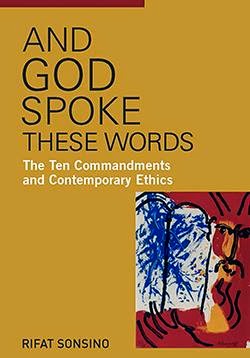
And God Spoke These Words: An Interview with Author Rabbi Rifat Sonsino

[Originally posted on ReformJudaism.org]
Throughout his long and distinguished career, Rabbi Rifat Sonsino, PhD, has helped thousands of readers find God, and uncovered the truths and legends behind the foundational myths of Judaism. In his newest book, he explores one of the best known – and least understood – texts in the Bible: the Ten Commandments.
The Ten Commandments loom large as ethical and moral guideposts in the Western world. The Bible recounts how, after the Exodus from Egypt, the Children of Israel proceeded to Mount Sinai in the desert. Moses ascended the mountain to meet God, who gave him the Ten Commandments, which were written on two tablets to be delivered to the Children of Israel.
These statutes have informed much of Judaism and Christianity over the past two thousand years, and stand at the center of many modern legal and political debates. However, attention to the remarkable and well-established influence of these words often glosses over the actual text and context of the biblical sources themselves.
In And God Spoke These Words: The Ten Commandments and Contemporary Ethics, Rabbi Sonsino draws on commentators from Maimonides to Mel Brooks to explore how the Ten Commandments have been interpreted – and misinterpreted – for generations. He examines the religious and legal texts of the Israelites' neighbors in the Ancient Near East, surveys centuries of Rabbinic commentary, and engages with contemporary secular and Jewish thought. Sonsino's thorough contextualization and discussion of the Decalogue provide the reader with an understanding of where these iconic commands originate, how they have been understood by Jews throughout the ages, and what moral direction they can still provide in the 21st century.
Stephen Becker, director of sales and marketing at URJ Books and Music, sat down with Rabbi Sonsino to discuss this fascinating new book.
URJ Books and Music: Why did you write this book?
Rabbi Rifat Sonsino: I wrote this book because I became aware of the fact that many people have the wrong information about this famous text. For example, many people think that the Decalogue contains the so-called Golden Rule, "treat others as you want to be treated." In reality, the Golden Rule is based on a saying attributed to Rabbi Hillel who lived in the 1st century C.E. and it is not found in the list of the Ten Commandments.
Secondly, I wrote the book because I realized that many people project onto the text their own religious views. For example, those who oppose abortion and pacifists who are against war at all cost argue that the Ten Commandments says, "Do not kill." A linguistic study indicates that this law can easily be translated as "You shall not murder," implying premeditation, changing the scope of the commandment. We simply do not know how the original norm was understood in biblical times. The Bible knows of the death penalty and is not against wars. So, "You shall not kill," is not likely to be the original intention.
Finally, I wanted to provide a modern interpretation of the Decalogue, especially stressing its relevance in contemporary ethical situations. For example, in reviewing the norm against stealing, I discuss not only stealing property, but also kidnapping, encroachment, unfair competition, identity theft, copyright issues, Ponzi schemes, and so on.
URJBAM: What is the relevance of the Ten Commandments now?
RRS: The Decalogue contains certain basic legal and moral norms that are found at the foundation not only of Judaism but also of Western civilization. For many people the Decalogue simply stands for law and order. It represents our high religious standards. That is why so many judges and religious leaders want to display them in the courts of law.
URJBAM: How can this book be used in class?
RRS: I would suggest that students first share their personal information about the Ten Commandments, and then, by studying my text, try to figure out how each one of them can be applied today. I would also suggest that at the end of the sessions, students should attempt to come out with their own set of ten commandments that are reflective of modern life.
URJBAM: Why call it "Ten Words," and not "Ten Commandments"?
RRS: The Hebrew text does not refer to the Decalogue as "ten commandments," but only as "ten words." This is also the meaning of the word "Decalogue." In Greek, this means, "ten words." These "words" become "commandments" when they are internalized and attributed to the divine. How these ten norms were revealed is a mystery. We do not have a clear picture of it in the Bible. We are dealing here with a fundamental myth. Obviously, to become effective, each of the ten words needs to be elevated from the level of "legislation" on the books to the level of "commandments," when a person feels that these norms have fundamental value and are addressed to every person.
Rabbi Rifat Sonsino, PhD, is rabbi emeritus of Temple Beth Shalom in Needham, Massachusetts, and adjunct professor of theology at Boston College. Born in Turkey, he received his law degree from the University of Istanbul, his rabbinic ordination from the Hebrew Union College-Jewish Institute of Religion, and his doctorate in Bible and Ancient and Near Eastern Studies from the University of Pennsylvania. Rabbi Sonsino is the author of numerous books, articles, and blog posts.

Monday, May 26, 2014

Children's Center Teachers Honored

Five TBSCC teachers have received special honors in recent weeks. Their achievements are a sign of the high quality of our faculty.  Please join me in congratulating Sylvia, Jesse, Steve, Sasha and Laura on their accomplishments. A hearty mazel tov goes to...

Sylvia Cohen, Levana teacher, was accepted into the Teaching & Technology Fellowship of Combined Jewish Philanthropies (CJP). This intensive program allows teachers to use new tools to re-envision their roles (inside the classroom, and beyond) and offers the training they need to effectively deliver content, interact with children and their families and shape a positive experience for learners. Sylvia joins Rena Gray Fein, 2nd/3rd grade teacher in the TBS Mayim program on our TBS team. We look forward to learning so many new technology tools from Sylvia!

Jesse Tobin, Kohavim Teacher, was selected as one of only 16 educators nationwide for the prestigious Jewish Early Childhood Education Leadership Institute. She recently returned from four days of study with the program and will continue for the next 18 months. Jesse will focus on Jewish study and leadership development and bring her learning back to the TBSCC community.

Steve Shimshak, Etzim teacher, has been working with CJP and researchers from Brandeis University to study the needs of area Jewish parents with young children. If you got a survey by email about your school choice, you've seen part of Steve's work on this project. As we plan for the new TBS building and our needs as a school community for the future, the data obtained from Steve's work will guide our decision making process.

Sasha Kopp, Levana teacher, was accepted by Hebrew Union College in Los Angeles, where she will pursue a Master of Arts in Jewish Education. Sasha was also accepted to the Wexner Graduate Fellowship, a selective fellowship for outstanding graduate students in Jewish education, Jewish professional leadership, and the rabbinate. We are sorry to see Sasha leave TBS next fall, but we are so proud of her!

Laura Walsh, Etzim teacher, along with co-teacher Steve Shimshak and Lauri Cohen and Gabi Soble, Adamah teachers, has been participating in an on-going study of Social Thinking. Laura's story of the work that has been happening in the Etzim class was recently featured in the newsletter from Gateways: Access to Jewish Education, an area organization that helps children with special needs access Jewish education.  Read the story Laura shared:
Temple Beth Shalom Children's Center, Needham: Preschool teachers of young four-year-olds introduced a strategy begun at the outset of the year in response to finding the 'right' job for a returning student. On a rotating basis, one child takes on the role of the "problem solver" for his/her peers to serve as the support person of the week, whose job it is to help when there is a conflict or problem. The 'problem solver' wears a special necklace with a big 'question mark (?) hanging prominently from it. Whenever two or more children appear to need a neutral third party to help negotiate the sharing or 'mixing' of ideas, the problem solver steps forward and 'listens' diligently to each child and then together they work out the solution to the problem. At first this process required a lot of the teachers' attention. However, the children quickly began to use the social thinking skills of thinking thoughts and feeling feelings. The problem solver asked each participant: "What's in your thought bubble?" and the work of problem solving began. Children continued to cultivate the important skills of perspective taking, size of the problem, and dealt with what happens when unexpected situations emerge. They progressed to making a group plan where none existed.

Sunday, May 25, 2014

Torah Study by the TBS Kindergarten Enrichment Kids


Torah web: Over the course of the year, we have been following the Kindergartners' interest into a deeper investigation of Torah. We have learned the reasoning behind each cover of our five Torah's kept in the sanctuary's ark, we have read stories from the Torah, and have explored our own classroom Torah. On Friday, the kindergartners made a web of all of their ideas they know or think they know about Torah and what they are wondering about. In the web, the children's thoughts are written in orange and their questions are written in purple. Below are some of their ideas and questions. Children's Ideas about Torah: 
It has lots of Stories like Noah's Ark, Passover Story, and Adam and Eve.
It lives in the Ark and on the doors there is a picture of fire and hebrew letters.
The torah has lot of different parts. There is a cover and it is made of special paper that they think comes from animal skin.
You can't touch the words, but can use something to point at the words.
Rabbi Jay took a Torah to London for a party. It was a Torah that almost got destroyed.
The Torah has all Hebrew words.
If you drop a Torah you can't eat for 40 days.
I have a small Torah at home.

Questions about Torah:
Why is the Torah so special?
Can we make a Torah?
Who makes a Torah?
How do you make a Torah's cover?
Why is it called "torah"?
Where did the Torah come from?

It is amazing how much the children already know about Torah and how much they want to learn.


Scientists of the Torah: After creating a web of our many ideas and questions about Torah, Brett S., Brett E., and Adam headed to the sanctuary to conduct some close-up observations. They carefully worked together to open the Ark revealing Temple Beth Shalom's five beautiful Torahs. They observed each Torah cover. You can notice the detail in Adam's observational drawing of the five Torahs above. As they worked, Brett S. exclaimed, "We are like scientists of the Torah!"

While observing, we recalled which story each cover represented and have learned about. (from left to right) The first Torah displays an image of Shabbat Candles and a Kiddush cup which reminds us of Shabbat and when God created the world on the 7th day God rested. The second Torah shows the parting of the seas, a spectacular moment from the story of Passover. The torah in the middle shows the burning bush which is when God spoke to Moses. The next torah shows a tent and part of the rainbow from the story of Noah's ark. The last Torah (far right) illustrates the olive branch and rainbow from Noah's ark. Each cover represents moments of stories from the Torah in which God was present.


The Beginning of Our Torah: Together, we decided to create our very own Torah. The children are working in pairs or small groups to represent different stories we have learned about from the Torah. Brett S. and Zack are working together to paint the creation story. They are using seven canvases to represent each day of creation. Above, you can see Brett S. painting the first day when there was darkness and God created light. Together, the painted the second day when got created the sea and the sky. You can also see the painting Zack made to represent the day God made the land, grass, plants, and trees. Through creativity and interpretation, Zack and Brett are creating the the creation story! 

Torah with Emily: This past Friday, the sanctuary was being used so we met with Emily in the community room. Upon entering the community room, we were surprised to find a surprise waiting for us. The Torah was waiting covered by two tallit. We sang prayers and songs and then discovered something new about the Torah. All year, we have been discussing the Torah covers of our five Torahs at Temple Beth Shalom, but Emily was about to teach us something new! We knew that this particular torah cover (shown above) had candles and a kiddish cup which we believed represented Shabbat from the creation story, but Emily drew our attention to the brown strips of fabric behind the candle and cup. The children noticed that the brown illustrated something tall and began guessing what it could be. Together they determined it was a mountain and that maybe it was Mount. Sinai. They were exactly right! What a wonderful discovery! We know that the Torah covers represent stories from the Torah in which God was present. Mount Sinai is when God gave moses the Torah! After learning this, the children decided we would have to include this story in the Torah we were making as a class. 

Sculpting a mountain: After learning that Mount Sinai was represented on the Torah covers, the kindergartners insisted we include this story in the Torah we were creating. Adam decided he would begin work on representing this story. He followed a recipe to create three batches of play dough. Each batch was a slightly different shade of brown and gold. He is planning to use the play dough to sculpt Mount Sinai. We will continue our study of Shavuot and how Moses received the Torah from God upon Mount Sinai next week. It is amazing to see how each kindergartener is working to interpret and represent these stories from the Torah in their own unique way.

by Jesse Tobin, Kindergarten Enrichment Teacher

Tuesday, May 20, 2014

Erdogan Calls A Protester “Israeli Scum”

Rabbi Sonsino
On May 13, 2014 there was a terrible explosion in a Turkish mine, 8 miles away from Soma (popl. c. 25,000), a small town in the district of Manisa in the Aegean region of Turkey. It was one of the worst tragedies in modern Turkey that claimed the life of 302 individuals. When the Turkish prime-minister Recep Tayyib Erdogan visited the area, he was confronted by an angry mob. During the melee, the PM confronted someone in the group, and reportedly said something like “What the f. do you think you are running to? O Israeli scum (“İsrail Dölü”).” Except that the word translated here as “scum” in English has a vulgar sexual connotation in Turkish. This is the same Erdogan who, during the 2009 World Economic Forum at Davos, Switzerland, gave a short talk accusing Israel of indiscriminately murdering Palestinian children, and walked out of the dais, leaving behind a totally surprised Shimon Peres, the President of Israel, as well as other members of the panel.

The scandal of Soma affected Turkish citizens deeply; they are demanding whether or not there was a cover up for criminal negligence on the part of mine’s owner and manager. It also shocked the dwindling Jewish population (now at c. 17,000) in Turkey, fearing that this could be the beginning of a new anti-Jewish wave by other Turks.

The Turkish friends with whom I am in touch are terribly upset. Some stated that they need to apologize to their Jewish neighbors for this unacceptable slur.  Can you imagine any Western political leader saying something similar, and getting away with it? No way! He/she would be out of a job the next day! This time Erdogan showed his real face when he uttered those despicable words.

There are anti-semites everywhere, but I do not consider all Turks anti-Jewish or anti-Israel. I did not experience anti-Jewish attacks when I was in law school or when I was in the Turkish military (I was an officer in the tank corps and a member of military court). I still have dear friends there who are Muslim. Does that mean that Turkey is devoid of prejudice? No. I remember when I was child, my mother and I were on a boat crossing the Bosphorus, and as usual we were speaking among ourselves in Ladino, when an obnoxious guy approached us and yelled, “Jew, speak Turkish!” I was in shock. But I also recall that during Easter we never went by a Greek Orthodox Church for fear that Greek thugs would come out to beat us kids because “we killed Christ.”

The Turkish government has started an investigation of this tragic event. I hope they will discover the real cause of the fire, take precautions so that it does not happen again, punish the culprits, and learn how to confront people, especially the mourners, with dignity and respect.

As to Erdogan, I hope this is the end of the rope for him. He must apologize and perhaps leave politics to those who are better than him. Will this happen? I don’t know.  He is still very popular among many people….

Rifat Sonsino, Ph.D.

May 2014