Thursday, June 12, 2014

Jai Anguita of Barcelona

Rabbi Sonsino
For the last few years, every summer, my wife, Ines, and I went to Barcelona, Spain, spending from two weeks to a month, in order to help out a small but slowly growing progressive Jewish congregation called Bet Shalom, led by a hardworking leader named Jai [i] Anguita, who is a Jew-by-choice and a lawyer by profession. There are two liberal congregations in Barcelona: Atid and Bet Shalom. Both are affiliated with the World Union for Progressive Judaism. Jai was a member of Atid but left in order to establish Bet Shalom.
Though I am retired from the congregational rabbinate and worked with a dozen of wonderful synagogue presidents in the past, I have rarely interacted with someone as charismatic as Jai. He leads Bet Shalom with his sometimes unorthodox style. Along with his partner, Adele, he identifies good workers for the temple, trains them, and gives them responsibilities. He is well connected, extremely focused on his goal and works tirelessly, along with a group of dedicated individuals, in order to advance the cause of liberal Judaism in Spain.

In 2008 I discovered online that Bet Shalom was looking for a Rabbi to spend some time in Barcelona to lead services and coordinate the final stages of a conversion process to Judaism. I volunteered to help out. Jai invited me to come in and spend about a month in his beautiful city. The fact that I could speak Spanish was a great advantage to them. [See my blog posting on this synagogue, dated April 29, 2010]. Since then, Bet Shalom has become affiliated with the European Union of the World Union for Progressive Judaism (located in London), moved from a garage-size synagogue to a larger location, set up a new web page (http://www.betshalom.cat/), and continues to offer regular Shabbat and festival services (every Friday night the service is followed by a pot-luck meal) as well as introduction to Judaism classes ably taught by Jai himself.  It is now looking for a full-time Rabbi to lead this 60-70 family congregation, with great potential for further growth.

Jai was not satisfied with setting up a synagogue in Barcelona, but extended his help to other emerging groups in Galicia, Seville, Madrid and other locations. Jai has become the undisputed leader of the progressive Jews in Spain today, and deserves to be supported by Jews all over the world. It has been my pleasure and honor to work with him, and will continue to do so as long as I can.

Rabbi Rifat Sonsino, Ph.D.
Boston, Ma
June 12, 2014

[i] Pronounced as “chai” or, better “hai”, in Hebrew meaning, “life.”

Sunday, June 1, 2014

Mezuzah Study by the TBS Kindergarten Enrichment Kids


What is a Mezuzah?:
On Monday, Kindergarten Enrichment kicked off a new inquiry: What is a mezuzah? The children shared their initial ideas. Josie explained, "It's something you hang up on your wall and it's made of glass." Evan followed up with, "Is a mezuzah with a little scroll in it? I have two at my house. One's in the front of my mom and dad's room and one's on the side like as we just come in front of my house." They then shouted, "There's one!" as they pointed to a mezuzah hanging right on the doorway of our classroom. This led us into the great Mezuzah hunt through Temple Beth Shalom. The children used their science notebooks to make observational drawings of the different mezuzot we found through out the school and temple. They had lots of ides as they walked around searching and observing:

Evan: They're on every door here (downstairs classrooms)
Noah: The Kohavim room has a mezuzah!
Evan: This one (Room 14) is different then the others.
Josie: I found one! (Mezuzah hanging on Mayim office made of rainbow mosaic glass).
Evan: Someone made it. It's not real.
Talia: There is a slot if you want to put anything in it.
Josie: None in the bathroom.
Evan: None in the elevator.

The children continued walking and found a glass mezuzah they could see inside of:
Evan: This one has a scroll.
Jesse: What do you think is on the scroll?
Evan: Hebrew letters. It must be about a story.
Talia: I think every scroll must be about a different story.

After finding many mezuzot the children were left with many ideas and questions: Why are their mezuzot on some rooms, but not all? What is on the scroll inside the mezuzah? Are some mezuzahs real and some not? Can you make your own mezuzah? Why do some Mezuzahs have the hebrew letter shin on them and some do not? Stay tuned to find out what happens with our Mezuzah investigation over the next few weeks! 

from left to right
Top Row: Mezuzah we observed, Julian's observational drawing, Noah's observational drawing.
Bottom Row: Josie's observational drawing, Talia's drawing, Evan's drawing

Mezuzah Observations:
The kindergartners continued their investigation of mezuzot this week. Today, they made up close observations of a mezuzah Ellen let us borrow. They noticed the mezuzah had a Hebrew letter at the top. Some children realized it was the Hebrew letter, shin. They also noticed some other Hebrew letters. It was the word, Jerusalem in Hebrew. After making detailed drawings, the children noticed their was a scroll inside the mezuzah. They immediately asked if we could take out the scroll to find out what was inside. To read more about what we discovered, check out the blog post, "What's inside a mezuzah?"


What's Inside the Mezuzah?:

The kindergartners were eager to find out what was inside the Mezuzah. We carefully took the scroll out and slowly unrolled the paper. Did you know that the scroll is made of parchment paper, just like what the Torah is made of? We took a close look at some of the writing on the scroll. The children discovered it was Hebrew writing. We examined the first word in the scroll. Josie explained she thought the first word was "Shema." The children were surprised to find they knew the beginning words written in the Mezuzah scroll. Together, we sang the Shema practicing the American Sign Language that Emily had taught us to go along with the prayer. We discovered the answer to our question, "What's inside a mezuzah?" We can't wait to investigate some of our other ideas and questions about Mezuzot.

Writing the Shema:
Do you know what is inside a Mezuzah? Well, your kindergartner does! On Monday, Kindergarten Enrichment practiced writing the Shema in Hebrew. Inside a Mezuzah, the Shema is handwritten in Hebrew by a scribe called a Sofer. The kindergartners became Sofers for the day, writing the Shema in Hebrew. They enjoyed writing in Hebrew so much, they wrote the prayer over and over again!

Thursday, May 29, 2014

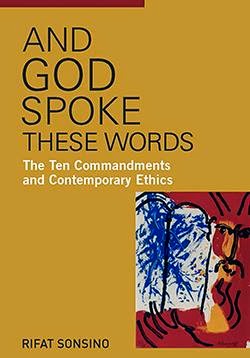
And God Spoke These Words: An Interview with Author Rabbi Rifat Sonsino

[Originally posted on ReformJudaism.org]
Throughout his long and distinguished career, Rabbi Rifat Sonsino, PhD, has helped thousands of readers find God, and uncovered the truths and legends behind the foundational myths of Judaism. In his newest book, he explores one of the best known – and least understood – texts in the Bible: the Ten Commandments.
The Ten Commandments loom large as ethical and moral guideposts in the Western world. The Bible recounts how, after the Exodus from Egypt, the Children of Israel proceeded to Mount Sinai in the desert. Moses ascended the mountain to meet God, who gave him the Ten Commandments, which were written on two tablets to be delivered to the Children of Israel.
These statutes have informed much of Judaism and Christianity over the past two thousand years, and stand at the center of many modern legal and political debates. However, attention to the remarkable and well-established influence of these words often glosses over the actual text and context of the biblical sources themselves.
In And God Spoke These Words: The Ten Commandments and Contemporary Ethics, Rabbi Sonsino draws on commentators from Maimonides to Mel Brooks to explore how the Ten Commandments have been interpreted – and misinterpreted – for generations. He examines the religious and legal texts of the Israelites' neighbors in the Ancient Near East, surveys centuries of Rabbinic commentary, and engages with contemporary secular and Jewish thought. Sonsino's thorough contextualization and discussion of the Decalogue provide the reader with an understanding of where these iconic commands originate, how they have been understood by Jews throughout the ages, and what moral direction they can still provide in the 21st century.
Stephen Becker, director of sales and marketing at URJ Books and Music, sat down with Rabbi Sonsino to discuss this fascinating new book.
URJ Books and Music: Why did you write this book?
Rabbi Rifat Sonsino: I wrote this book because I became aware of the fact that many people have the wrong information about this famous text. For example, many people think that the Decalogue contains the so-called Golden Rule, "treat others as you want to be treated." In reality, the Golden Rule is based on a saying attributed to Rabbi Hillel who lived in the 1st century C.E. and it is not found in the list of the Ten Commandments.
Secondly, I wrote the book because I realized that many people project onto the text their own religious views. For example, those who oppose abortion and pacifists who are against war at all cost argue that the Ten Commandments says, "Do not kill." A linguistic study indicates that this law can easily be translated as "You shall not murder," implying premeditation, changing the scope of the commandment. We simply do not know how the original norm was understood in biblical times. The Bible knows of the death penalty and is not against wars. So, "You shall not kill," is not likely to be the original intention.
Finally, I wanted to provide a modern interpretation of the Decalogue, especially stressing its relevance in contemporary ethical situations. For example, in reviewing the norm against stealing, I discuss not only stealing property, but also kidnapping, encroachment, unfair competition, identity theft, copyright issues, Ponzi schemes, and so on.
URJBAM: What is the relevance of the Ten Commandments now?
RRS: The Decalogue contains certain basic legal and moral norms that are found at the foundation not only of Judaism but also of Western civilization. For many people the Decalogue simply stands for law and order. It represents our high religious standards. That is why so many judges and religious leaders want to display them in the courts of law.
URJBAM: How can this book be used in class?
RRS: I would suggest that students first share their personal information about the Ten Commandments, and then, by studying my text, try to figure out how each one of them can be applied today. I would also suggest that at the end of the sessions, students should attempt to come out with their own set of ten commandments that are reflective of modern life.
URJBAM: Why call it "Ten Words," and not "Ten Commandments"?
RRS: The Hebrew text does not refer to the Decalogue as "ten commandments," but only as "ten words." This is also the meaning of the word "Decalogue." In Greek, this means, "ten words." These "words" become "commandments" when they are internalized and attributed to the divine. How these ten norms were revealed is a mystery. We do not have a clear picture of it in the Bible. We are dealing here with a fundamental myth. Obviously, to become effective, each of the ten words needs to be elevated from the level of "legislation" on the books to the level of "commandments," when a person feels that these norms have fundamental value and are addressed to every person.
Rabbi Rifat Sonsino, PhD, is rabbi emeritus of Temple Beth Shalom in Needham, Massachusetts, and adjunct professor of theology at Boston College. Born in Turkey, he received his law degree from the University of Istanbul, his rabbinic ordination from the Hebrew Union College-Jewish Institute of Religion, and his doctorate in Bible and Ancient and Near Eastern Studies from the University of Pennsylvania. Rabbi Sonsino is the author of numerous books, articles, and blog posts.

Monday, May 26, 2014

Children's Center Teachers Honored

Five TBSCC teachers have received special honors in recent weeks. Their achievements are a sign of the high quality of our faculty.  Please join me in congratulating Sylvia, Jesse, Steve, Sasha and Laura on their accomplishments. A hearty mazel tov goes to...

Sylvia Cohen, Levana teacher, was accepted into the Teaching & Technology Fellowship of Combined Jewish Philanthropies (CJP). This intensive program allows teachers to use new tools to re-envision their roles (inside the classroom, and beyond) and offers the training they need to effectively deliver content, interact with children and their families and shape a positive experience for learners. Sylvia joins Rena Gray Fein, 2nd/3rd grade teacher in the TBS Mayim program on our TBS team. We look forward to learning so many new technology tools from Sylvia!

Jesse Tobin, Kohavim Teacher, was selected as one of only 16 educators nationwide for the prestigious Jewish Early Childhood Education Leadership Institute. She recently returned from four days of study with the program and will continue for the next 18 months. Jesse will focus on Jewish study and leadership development and bring her learning back to the TBSCC community.

Steve Shimshak, Etzim teacher, has been working with CJP and researchers from Brandeis University to study the needs of area Jewish parents with young children. If you got a survey by email about your school choice, you've seen part of Steve's work on this project. As we plan for the new TBS building and our needs as a school community for the future, the data obtained from Steve's work will guide our decision making process.

Sasha Kopp, Levana teacher, was accepted by Hebrew Union College in Los Angeles, where she will pursue a Master of Arts in Jewish Education. Sasha was also accepted to the Wexner Graduate Fellowship, a selective fellowship for outstanding graduate students in Jewish education, Jewish professional leadership, and the rabbinate. We are sorry to see Sasha leave TBS next fall, but we are so proud of her!

Laura Walsh, Etzim teacher, along with co-teacher Steve Shimshak and Lauri Cohen and Gabi Soble, Adamah teachers, has been participating in an on-going study of Social Thinking. Laura's story of the work that has been happening in the Etzim class was recently featured in the newsletter from Gateways: Access to Jewish Education, an area organization that helps children with special needs access Jewish education.  Read the story Laura shared:
Temple Beth Shalom Children's Center, Needham: Preschool teachers of young four-year-olds introduced a strategy begun at the outset of the year in response to finding the 'right' job for a returning student. On a rotating basis, one child takes on the role of the "problem solver" for his/her peers to serve as the support person of the week, whose job it is to help when there is a conflict or problem. The 'problem solver' wears a special necklace with a big 'question mark (?) hanging prominently from it. Whenever two or more children appear to need a neutral third party to help negotiate the sharing or 'mixing' of ideas, the problem solver steps forward and 'listens' diligently to each child and then together they work out the solution to the problem. At first this process required a lot of the teachers' attention. However, the children quickly began to use the social thinking skills of thinking thoughts and feeling feelings. The problem solver asked each participant: "What's in your thought bubble?" and the work of problem solving began. Children continued to cultivate the important skills of perspective taking, size of the problem, and dealt with what happens when unexpected situations emerge. They progressed to making a group plan where none existed.

Sunday, May 25, 2014

Torah Study by the TBS Kindergarten Enrichment Kids


Torah web: Over the course of the year, we have been following the Kindergartners' interest into a deeper investigation of Torah. We have learned the reasoning behind each cover of our five Torah's kept in the sanctuary's ark, we have read stories from the Torah, and have explored our own classroom Torah. On Friday, the kindergartners made a web of all of their ideas they know or think they know about Torah and what they are wondering about. In the web, the children's thoughts are written in orange and their questions are written in purple. Below are some of their ideas and questions. Children's Ideas about Torah: 
It has lots of Stories like Noah's Ark, Passover Story, and Adam and Eve.
It lives in the Ark and on the doors there is a picture of fire and hebrew letters.
The torah has lot of different parts. There is a cover and it is made of special paper that they think comes from animal skin.
You can't touch the words, but can use something to point at the words.
Rabbi Jay took a Torah to London for a party. It was a Torah that almost got destroyed.
The Torah has all Hebrew words.
If you drop a Torah you can't eat for 40 days.
I have a small Torah at home.

Questions about Torah:
Why is the Torah so special?
Can we make a Torah?
Who makes a Torah?
How do you make a Torah's cover?
Why is it called "torah"?
Where did the Torah come from?

It is amazing how much the children already know about Torah and how much they want to learn.


Scientists of the Torah: After creating a web of our many ideas and questions about Torah, Brett S., Brett E., and Adam headed to the sanctuary to conduct some close-up observations. They carefully worked together to open the Ark revealing Temple Beth Shalom's five beautiful Torahs. They observed each Torah cover. You can notice the detail in Adam's observational drawing of the five Torahs above. As they worked, Brett S. exclaimed, "We are like scientists of the Torah!"

While observing, we recalled which story each cover represented and have learned about. (from left to right) The first Torah displays an image of Shabbat Candles and a Kiddush cup which reminds us of Shabbat and when God created the world on the 7th day God rested. The second Torah shows the parting of the seas, a spectacular moment from the story of Passover. The torah in the middle shows the burning bush which is when God spoke to Moses. The next torah shows a tent and part of the rainbow from the story of Noah's ark. The last Torah (far right) illustrates the olive branch and rainbow from Noah's ark. Each cover represents moments of stories from the Torah in which God was present.


The Beginning of Our Torah: Together, we decided to create our very own Torah. The children are working in pairs or small groups to represent different stories we have learned about from the Torah. Brett S. and Zack are working together to paint the creation story. They are using seven canvases to represent each day of creation. Above, you can see Brett S. painting the first day when there was darkness and God created light. Together, the painted the second day when got created the sea and the sky. You can also see the painting Zack made to represent the day God made the land, grass, plants, and trees. Through creativity and interpretation, Zack and Brett are creating the the creation story! 

Torah with Emily: This past Friday, the sanctuary was being used so we met with Emily in the community room. Upon entering the community room, we were surprised to find a surprise waiting for us. The Torah was waiting covered by two tallit. We sang prayers and songs and then discovered something new about the Torah. All year, we have been discussing the Torah covers of our five Torahs at Temple Beth Shalom, but Emily was about to teach us something new! We knew that this particular torah cover (shown above) had candles and a kiddish cup which we believed represented Shabbat from the creation story, but Emily drew our attention to the brown strips of fabric behind the candle and cup. The children noticed that the brown illustrated something tall and began guessing what it could be. Together they determined it was a mountain and that maybe it was Mount. Sinai. They were exactly right! What a wonderful discovery! We know that the Torah covers represent stories from the Torah in which God was present. Mount Sinai is when God gave moses the Torah! After learning this, the children decided we would have to include this story in the Torah we were making as a class. 

Sculpting a mountain: After learning that Mount Sinai was represented on the Torah covers, the kindergartners insisted we include this story in the Torah we were creating. Adam decided he would begin work on representing this story. He followed a recipe to create three batches of play dough. Each batch was a slightly different shade of brown and gold. He is planning to use the play dough to sculpt Mount Sinai. We will continue our study of Shavuot and how Moses received the Torah from God upon Mount Sinai next week. It is amazing to see how each kindergartener is working to interpret and represent these stories from the Torah in their own unique way.

by Jesse Tobin, Kindergarten Enrichment Teacher

Tuesday, May 20, 2014

Erdogan Calls A Protester “Israeli Scum”

Rabbi Sonsino
On May 13, 2014 there was a terrible explosion in a Turkish mine, 8 miles away from Soma (popl. c. 25,000), a small town in the district of Manisa in the Aegean region of Turkey. It was one of the worst tragedies in modern Turkey that claimed the life of 302 individuals. When the Turkish prime-minister Recep Tayyib Erdogan visited the area, he was confronted by an angry mob. During the melee, the PM confronted someone in the group, and reportedly said something like “What the f. do you think you are running to? O Israeli scum (“İsrail Dölü”).” Except that the word translated here as “scum” in English has a vulgar sexual connotation in Turkish. This is the same Erdogan who, during the 2009 World Economic Forum at Davos, Switzerland, gave a short talk accusing Israel of indiscriminately murdering Palestinian children, and walked out of the dais, leaving behind a totally surprised Shimon Peres, the President of Israel, as well as other members of the panel.

The scandal of Soma affected Turkish citizens deeply; they are demanding whether or not there was a cover up for criminal negligence on the part of mine’s owner and manager. It also shocked the dwindling Jewish population (now at c. 17,000) in Turkey, fearing that this could be the beginning of a new anti-Jewish wave by other Turks.

The Turkish friends with whom I am in touch are terribly upset. Some stated that they need to apologize to their Jewish neighbors for this unacceptable slur.  Can you imagine any Western political leader saying something similar, and getting away with it? No way! He/she would be out of a job the next day! This time Erdogan showed his real face when he uttered those despicable words.

There are anti-semites everywhere, but I do not consider all Turks anti-Jewish or anti-Israel. I did not experience anti-Jewish attacks when I was in law school or when I was in the Turkish military (I was an officer in the tank corps and a member of military court). I still have dear friends there who are Muslim. Does that mean that Turkey is devoid of prejudice? No. I remember when I was child, my mother and I were on a boat crossing the Bosphorus, and as usual we were speaking among ourselves in Ladino, when an obnoxious guy approached us and yelled, “Jew, speak Turkish!” I was in shock. But I also recall that during Easter we never went by a Greek Orthodox Church for fear that Greek thugs would come out to beat us kids because “we killed Christ.”

The Turkish government has started an investigation of this tragic event. I hope they will discover the real cause of the fire, take precautions so that it does not happen again, punish the culprits, and learn how to confront people, especially the mourners, with dignity and respect.

As to Erdogan, I hope this is the end of the rope for him. He must apologize and perhaps leave politics to those who are better than him. Will this happen? I don’t know.  He is still very popular among many people….

Rifat Sonsino, Ph.D.

May 2014

Friday, April 4, 2014

Discovering Reform Judaism and Getting Lost in It

Rabbi Sonsino
My religious training began in Istanbul, in an Orthodox Jewish synagogue to which my parents belonged. I excelled in my studies and became not only a shohet (ritual slaughter for chickens only) but also the hazzan kavua (the main liturgical leader) of my temple. My teacher, I now realize, was a well-intentioned but narrow-minded individual.  In law school, when I discovered Reform Judaism, he quickly dismissed me from the pulpit. I was no longer kosher for him.

For me, however, finding a liberal expression of Judaism was liberating. I could now, in good conscience, become a religious and observant Jew. During my military service in Turkey, I applied and was accepted by the Reform rabbinic seminary (the Hebrew Union College) in Cincinnati. After six months in Paris, where I studied at the Institut International d’Etudes Hebraiques, the now defunct French-Jewish rabbinic school associated with the World Union for Progressive Judaism, I came to the States in late August of 1961. I was in heaven!

In the 60’s, Reform Judaism had a distinct style and philosophy. Even though there were differences of opinions among us—we are Jews after all—we all had a general idea of what Reform Judaism stood for: We supported progressive revelation; we believed in the immortality of the soul; we had a common liturgical style and prayerbook etc. Now things are different. At times, I don’t know where Reform Judaism stands.

I realize that it is in the nature of Reform to be progressive and diverse. After all, the Centenary Perspective of the Reform Rabbinate (CCAR, 1976) clearly states that, “Reform Judaism does more than tolerate diversity; it engenders it.” Today, however, we have more theological discord among ourselves. For example, we cannot even agree whether we support tehiyyat hametim (resurrection) or immortality of the soul, and our new prayerbook, Mishkan Tefillah, has to include both options. We espouse different perceptions of the divinity; and we are all over the map with regard to ritual practices.

The only continuity we have is the particular rabbi’s style of worship and philosophy in his/her congregation. When I was a congregational rabbi, I, too, influenced my synagogue with my style of worship and thinking pattern. Being a religious naturalist, my services certainly reflected my philosophy, even though I tried not to impose it on others. Every rabbi does this in his/her temple. I understand that, and congregants do too. As a rabbi who has been on the pulpit close to 50 years and a shaliah tzibbur (prayer leader) for almost 60 years, I would suggest that once in a while, rabbis and cantors review their prayer practices, and vary them as necessary. Not all services have to start with, “Let us take a big breath.”  After a while, it is boring.

Rabbi Rifat Sonsino, Ph.D.

April, 2014

Tuesday, April 1, 2014

Eating Rice on Passover

Rabbi Sonsino
According to Jewish tradition, it is not permitted to eat fermented grain products (called hametz) during the entire Passover week. The Mishnah specifically mentions wheat (hittim), barley (seorim), spelt [also known as farro] (kusmin), rye (shifon) and oats (shibolet shual) (M. Pes. 2: 5). [Danby translates kusmin as “goat-grass”]. Ashkenazic Jews add to this list of prohibited food items rice, millet, corn, beans and other legumes (called kitniyot) in Hebrew. Most Sephardic Jews do not follow this custom and eat rice and other legumes during Passover.

What is the reason for this prohibition that emerged among Jews of Eastern European background?  Apparently, the custom originated in France in the 13th century and from there it spread to other Jewish communities in Europe. According to some sources, the reason is that these legumes resemble grain. Some point out that rice also “rises” when cooked in water. Others argue that some people could become confused and actually resort to making flour out of them.

In 1988, a prominent conservative Rabbi in Israel, David Golinkin, wrote a responsum on this subject and stated that the actual reason for this custom is unknown, and in fact contradicts an explicit statement in the Talmud (BT Pes. 114b). He also quoted another medieval Rabbi, Rabbi Yeruham, who called it “a foolish custom.” [See a longer article online by Jeffrey Spitzer, “Kitniyot, Not Quite Hametz” in My Jewish Learning].

Similarly, the CCAR, in its 1996 responsum on this subject, indicated that the early Reform Jews in Europe found this custom unnecessary and burdensome, and abolished it. It also stated that the “Reform practice, following the standard of the Talmud, permits the eating of rice and legumes during Passover,” but added that some observant Reform Jews may continue to follow the Ashkenazic tradition, if they wish.

I think it is time to eliminate this unnecessary burden on our congregants. As a Sephardic Jew, I will continue to eat rice and other legumes, without any sense of guilt.

Rabbi Rifat Sonsino, Ph.D.
April 2014.

Wednesday, March 26, 2014

The Soncinos Move to the Ottoman Empire

Rabbi Sonsino
In 1454, Symon Ebreus, a descendent of Moses of Speyer (14th cent.) in Germany, came to Soncino, in northern Italy. In 1483, his grandson, Rabbi Israel Nathan, along with his two sons, Joshua and Moses, established the world-famous printing press that became known after the town itself. However, in 1490, just seven years after, he and his family were expelled from Soncino, because of the religious persecutions that took place during the rule of Ludovico Maria Sforza (1452-1508), the Duke of Milan. Family members spread to different places of Italy (e.g., Casal Maggiore, Naples, Brescia, Fano, Pesaro etc.) and continued to publish books, both Jewish and non-Jewish. In 1527/8, Rabbi Gershom, the son of Moses Soncino and grandson of Israel Nathan, moved first to Salonika and from there to Constantinople, today, Istanbul. He, too, continued in the tradition of his family and published many Jewish books. His son, Eleazar b. Gershom Soncino also became a prominent publisher.

Other members of the Soncino family took residence in different parts of the Ottoman Empire, still continuing with the publishing trade. We find Gershom b. Eliezer Soncino in Cairo (in 1557); Moses Joshua Soncino in Smyrna (c. 1715); some members even immigrated to Safed. One of the latest in the business was Joshua, son of Moses Soncino who lived in the first half of the 18th century (c. 1737).

In his collection of studies on Turkish Jewry[i], the historian Avram Galante, mentions Rabbi Eliezer Soncino who was the rabbi of the Italian community in Constantinople (late 1500’s) as well as a certain Moises Sonsin, who lived in the late 1700’s. Galante also states that the city of Smyrna had a neighborhood known as “Sonsino.” During my youth in Turkey, I had heard that there were other Sonsinos in the country, but I never met them.

A word about the spelling of our name: In Italian, the letter “c” in Soncino is pronounced as “tch,” like the “c” in “Chile” or “cheetah.” In Hebrew, the same letter “c” was rendered by “tzadi,” and pronounced as “Sontz/sino.” However, Turkish or Spanish does not have a letter that is equivalent to the Hebrew “tzadi.” Besides, in Turkish, “c” would have been pronounced as “dj.” I surmise that is the reason why the spelling of our family name was moved from SonCino to SonSino, in line with the French and Spanish pronunciation.

Today, the Sonsinos are spread all over the world. From our Sonsino page in Facebook I know that there are Sonsinos in Latin America, in Israel, in the States and other parts of the globe. The family is no longer engaged in the printing businesses. The name was taken over by a Jewish-English publishing company in 1929 (the “Soncino Press”) to honor the famous printers of the past.

Today Sonsinos are found in many professions. However, to my knowledge, I am the only one in the world who is a Rabbi. At least there is one more now.

Rabbi Rifat Sonsino, Ph.D.
March 2014

[i] Avram Galante, Histoire des Juifs de Turquie. Isis, vol. 1-9.

Tuesday, March 25, 2014

Visiting the Town of Soncino

Rabbi Sonsino
This year marks the 560th year of the arrival of a German-Jewish family to Soncino, a little town in northern Italy, and their success in establishing a world-famous printing business in medieval Jewish life.

In 1454, Franceszo Sforza, the then duke of Milan, whose jurisdiction extended to include Soncino, authorized Symon Ebreus (Simeon, the Hebrew) to settle in Soncino, along with his family and friends, and practice “artem feneratoriam” (namely, to give money in interest). However, when town officials set up a public loan office and made private banking almost impossible, Israel Nathan, the son of Simeon and a wealthy physician, along with his sons, Joshua and Moses, decided to open the printing press that called itself after the name of the town. Soon, they began to publish many Jewish books, and became so famous that of them it was written, “From Zion shall go forth Torah, and the word of the Lord from Soncino” (Based on Isa. 2: 3).

In March of 1961, I visited the town of Soncino. It was still a small rural town, with a large castle called Rocca Sforzesca. The town people were not accustomed to foreigners. I remember seeing a number of women doing the laundry in a small river. When they noticed my travelling companion and me, they suddenly stopped their work and set their puzzled eyes on us, asking each other, “Who are these people?” Once they found who we were, and especially that I was a descendant of the Jewish family that printed books in their town, they became quite friendly. I then realized that I was the only Sonsino in Soncino! We then met the local priest, Monsignor Pietro de Micheli, who graciously gave me a copy of his book, Soncino; Memorie e Notizie (1956).

We stayed only one night in town. The next morning, we hired a guide who took us around. We visited the famous castle of Soncino. Our guide also took us to two interesting streets. One of them was called, “Via della Stampa” (“The Street of the Printing House”) and the other “Via degli Stampatori” (The Street of the printers), a clear indication of the location where the family lived. The town is very proud of the fact that its name is now famous throughout the world.

And so am I.

Rifat Sonsino, Ph.D.
March, 2014