Showing posts with label Rabbi Sonsino. Show all posts

Friday, January 16, 2015

Rabbi Sonsino: "Religious" vs. "Observant"

Rabbi Sonsino
Many people say “I am not religious” when they actually mean, “I am not observant.” What is the difference between the two?

The way I see it, “religious” refers to beliefs and values, whereas “observant” involves ritual practices and carrying out daily Mitzvot (“commandments”). Most people who are religious are also observant, but there are many, like me, a liberal rabbi of non-theistic persuasion, a religious naturalist by self-definition, who is not as observant as many Orthodox Jews. It is said that the famous Jewish philosopher Martin Buber (1878-1965) was “a non-observant Jew” (Merriam-Webster).

The difference between “religious” and “observant” is relatively new. Traditional sources do not seem to be aware of any tension between them.

The Bible often refers to individuals who “fear God/the Lord.” This “fear” is more than reverence; God was then viewed as a mysterium tremendum who could reveal His awesome power and even punish people who strayed from the expected path. Thus, for example, Abraham “feared God” (y’re Elohim) (Gen. 22: 12); so did the midwives in the story of the Exodus from Egypt (Ex. 1: 21). The prophet Malachi speaks of those who “feared the Lord” (yire Adonay). In the Apocrypha, Susanna “feared the Lord” (1:2). No distinction is made between “fear God” and “fear the Lord.” Often, “fear of God/theLord” is used in warning Israelites against idolatry (e.g., Ex. 20: 17), but also as a means to encourage them to “walk in God’s ways” (Deut. 10:12-13), namely, to put into practice the many biblical teachings. Even though we do not know how “observant” biblical Jews were, and there are many indications that they did not always follow the teachings of their prophets and leaders, in the literature itself, “fear God” and fear the Lord” refer to the power of the divine but also to religious beliefs, personal piety and traditional practices.

In the late biblical period and in the early Persian times, the Hebrew term dat appears in classical texts. This word often refers to laws, customs and royal decrees. For example, in the book of Esther, the term dat often means the law of the king (Est. 4: 16; 11, 16) and is only secondarily applied to religion and religious practices. Similarly, the expression dat Moshe means both “Mosaic ritual law” as well as “Jewish faith.” (In Deut. 33:2, the term dat is corrupt). Religion and observance are here closely related.

In the modern period, one who is pious as well as religiously observant is called a dati. However, there is no modern Hebrew term for someone who is religious but not observant. In Jewish life today there are many who fall in this category and are often  referred to as “cultural Jews.” It needs to be stressed that devout Orthodox Jews are not the only ones who are religious as well as observant. Many liberal Jews are also practicing Jews in line with their Reform Jewish tradition/s.

What am I? I am not a dati, as a Hasidic rebbe, yet, as a Reform Rabbi, I am seriously observant, in my own way, based on the critical study of tradition and my own theological outlook. Someone suggested the Hebrew term dati reformi, namely, observant a la Reform Judaism.

Most Jewish people I know are religious, i.e., they hold values and beliefs, theistic or not, that are derived from the Jewish tradition and nurtured by our own culture. Our task is to encourage them to set up a discipline of religious practices that are compatible with their personal views, thus ensuring the continuity of our traditions and culture. This job belongs to dedicated parents, insightful teachers, and great role models. Are you one of them?

Rabbi Rifat Sonsino, Ph.D.
rsonsino.blogspot.com
Jan, 2015

Friday, December 12, 2014

Hanukah Was No Miracle

The traditional explanation of why the festival of Hanukah is celebrated for eight days is based on a Talmudic passage: Oil for one day, miraculously lasted eight. (See below). However, this is a late development. Early texts do not mention this so-called miracle. It is time we give up this irrational explanation and find a better one. And that historical explanation does exist.

The history behind Hanukah is, briefly, this: In the second cent. BCE, Antiochus IV, the Syrian king, set out to conquer Egypt. While he was fighting there, Jason, who was deposed from his position as the Jewish High Priest in Jerusalem, left the Ammonites with whom he had taken refuge, and attacked Menelaus, his brother in Jerusalem, in order to regain the High Priesthood. A civil war broke out between the two, and Jason successfully entered Jerusalem. King Antiochus was furious. On his way back from Egypt, the king attacked Jerusalem, imposed restrictions on Judea, and eventually desecrated the Temple. In reaction, a priest by the name of Mattathias, and his sons (called the Maccabees), fought against the Syrians, and were able to clean and rededicate the temple of Jerusalem to the worship of one God in the year 165 BCE. This rededication is called Hanukah (“dedication” in Hebrew). 

The First Book of Maccabees (c.mid-2nd cent. BCE), states that Hanukah ought to be celebrated for eight days but does not indicate the reason for it (see, 4:59). It is in the Second Book of Maccabees (c.125 BCE) that we find a rational explanation: It happened that on the same day on which the sanctuary had been profaned by the foreigners, the purification of the sanctuary took place, that is, on the twenty-fifth day of the same month, which was Kislev.  And they celebrated it for eight days with rejoicing, in the manner of the feast of booths [Sukkot], remembering how not long before, during the feast of booths, they had been wandering in the mountains and caves like wild animals. (10: 6). So, Hanukah was really like a delayed Sukkot that lasts seven days plus Atzeret, a one day festival (See, Lev. 23: 33-36; cf. v.39).

The first reference to the lights of Hanukah appears in the writings of Josephus (1sr cent. CE) who calls the festival “Lights” by saying: I suppose the reason was this liberty beyond our hopes appeared to us and that hence the name given to that festival. (Antiquities, 7:7). 

In it only in the Talmud, which was edited in the 5-6th centuries CE in Babylonia that the so-called “miracle” makes its appearance (under Persian influence?): What is [the reason of] Hanukah? For our Rabbis taught: On the twenty-fifth of Kislew [commence] the days of Hanukah, which are eight on which a lamentation for the dead and fasting are forbidden.  For when the Greeks entered the Temple, they defiled all the oils therein, and when the Hasmonean dynasty (i.e. the Maccabees) prevailed against and defeated them, they made search and found only one cruse of oil which lay with the seal of the High Priest, but which contained sufficient for one day’s lighting only; yet a miracle was wrought therein and they lit [the lamp] therewith for eight days. The following year these [days] were appointed a Festival with [the recital of] Hallel and thanksgiving. (BT Shab. 21b, Soncino). 

Later on a midrashic text (c. 9th cent.) provides another explanation: When the Hasmoneans defeated the Greeks, they entered the temple and found there eight iron spears. They stuck candles on these spears and kindled them. (Pesikta Rabbati 2: 5). 

It is clear that the explanation of why Hanukah was celebrated for eight days changed over the years, some legendary, and some more historical. The festival today proclaims many important values, such as courage, dedication, thanksgiving, and, above all, the right to be different. These are the values we need to stress, and not the miracle of oil which is not rational, historical or even believable in our time.

Rabbi Rifat Sonsino, Ph.D

Monday, November 3, 2014

The Lies My Religious School Teacher Told Me

Rabbi Sonsino
In the mid 70s, a Canadian-Jewish movie called “The Lies my Father Told Me” became popular. It dealt with the relationship between a kid and his father and grandfather at the turn of the century and about what he learned from them-most of them not true.

Inspired by this movie, I submit that we are still teaching a bunch of lies to our children and students. Here are three examples:

1.    How did the Israelites get out of Egypt?

According to an old Jewish joke, a youngster tells his mother that after the Israelites walked safely through the Red Sea on pontoon bridges, the Egyptians followed, and Moses used his cell phone to radio for air cover! His mother asked: “Now, did your teacher really teach you that? “No,” said the kid, “but if I were to tell you the way he said it, you would never believe it!”

Biblical scholars tell us that the Israelites did not cross the “Red” Sea but, perhaps, the “Reed (suf in Hebrew) Sea.” Besides, we are told that the family of Jacob came down to Egypt with 70 people (Deut. 10:22), and after 430 (some say 400) years of captivity (Ex. 12: 40) the Israelites left with 600,000 men plus women, children and others who joined them (about 2 million) (Ex. 12: 37). This is impossible! Some critics today argue that not all the Israelites went down and left Egypt, maybe the Levites were the only ones. It appears that, years after, as the Israelites remembered the freedom they gained when some of their ancestors departed from Egypt, the whole “story” of their liberation was projected back into ancient times, and greatly exaggerated.

2.    Is the Story of Noah historical?

Very often the story of Noah, with all the animals saved on a single ship, is taught as if it were historically accurate. In reality, the Bible contains two different (but parallel and integrated) Noah stories. Besides, as most scholars recognize, the legend of Noah was taken into the Bible from a popular ancient Near Eastern literary source, where the hero is called “Gilgamesh” in Akkadian or “Ziusudra” in Sumerian. At most, it may have been based on a local flood that was magnified many times over.

3.    Hanukah “the miracle of oil.” Really?

Most school texts state that the reason why Hanukah lasts eight days is because of the so-called “miracle of oil” (found in the Talmud. Shab. 21b) when the oil that was sufficient to light the Hanukah candles only one night miraculously lasted eight days. In reality, ancient Jewish texts are not unanimous on why Hanukah was celebrated for eight days. One rabbinic source states that “upon entering the Temple, they (Maccabees) found there eight rods of iron which they grooved out and then kindled wicks in the oil which they poured into the grooves” (Pesikta Rabbati 2: 1). On the other hand, the Second Book of Maccabees (10: 6-8) says, more plausibly perhaps, that Hanukah “was celebrated for eight days…in the manner of the Feast of Tabernacles” (that is, seven days of Sukot plus Atzeret on the 8th; see Lev. 23: 33-36).  Why then do we need to center the holiday on an unbelievable “miracle” when there are other, more realistic, interpretations?

Lessons to be learned:

a.    The fact that a story is popular does not mean it is historically correct.
b.    Texts that mention miracles often stress certain religious values, and are not concerned with historical truth. In the examples cited above, the Exodus teaches us, among others, about the importance of freedom; Noah reminds us that life is precious and, like Noah, we too must save lives whenever possible; and Hanukkah teaches us the values of Jewish pride and loyalty.
c.     We should not teach anything that will need to be unlearned later on. When I discovered the historical background of the stories mentioned above, I felt as if my religious foundation was cracking up, and I lost all trust in my religious school teachers.
d.    Where can you find reliable information? Not in the daily press or in popular books but only in serious studies and encyclopedias that are written from an historical/critical point of view.

We need to teach our children and students self-reliance through critical thinking and not dependence on “bubbe meises” (i.e., Yiddish for old wives’ tales!!!).

Rabbi Rifat Sonsino, Ph.D.
Nov. 2014

Wednesday, October 22, 2014

What Prayer Can and Cannot Do

Rabbi Sonsino
Many people turn away from prayer because they realize that it can rarely produce concrete results. Therefore, it is important to understand what prayer can do and what it cannot accomplish. For me, this is the scope of prayer:

1.    One should not pray for the impossible. Nature will not respond just because we pray with reverence. Our rabbinic sages already knew that “to cry over the past is to utter a vain prayer” (Ber. 9: 3). They even give a few examples: for instance, a person whose wife is pregnant should not say, “May it be Your will that my wife should have a boy” (idem). Such a prayer is “vain,” they add, because the sex of the child was already determined at the time of conception, and no prayer, however sincere and heartfelt, will change it. Similarly, they taught that if a person, coming home from a journey, hears cries of distress in his town, he should not say, “(God) grant that this not be in my house,” for this, too, is a vain prayer (idem), here for two reasons: a) if the problem is in his house, it is too late for this type of prayer; b) then, the prayer implies that the distress should be in someone else’s house; and that is unethical.  

2.    Prayer alone does not modify the course of nature. It can, however, affect the worshiping individuals. It can give them a new insight; it can deepen their understanding of how the world operates; and both can prepare them to face the world with courage and clarity of mind.

3.    We often worry about the acceptance of our prayers when we should be more concerned about our ability the express them with a certain sense of realism. Mordecai Kaplan once wrote: “Religious prayer is the utterance of those thoughts that imply either the actual awareness of God, or the desire to attain such awareness” (The Meaning of God, 1962, 33). The key word here is “utterance.” High expectations can lead to disappointment. By expressing our hopes and aspirations properly and within reason, we can take the first step towards their realization. Every prayer becomes a program of action, motivating us to work towards its fulfillment.

4.    We must remember that the main goal of public worship is to strengthen the bonds that unite the community engaged in prayer. When we get together for worship, even though some of us may not be in the mood, we are still given the opportunity to identify with the hopes, aspirations and goals of the congregation. By joining the worshiping community, we strengthen the group as we strengthen ourselves.

5.    We have come a long way from the ancient days when worship in the ancient Near East meant taking care of the individual needs of the gods. The challenge today is not only to ground the prayers in an acceptable rationale but also to formulate them in such an equivocal language that they will reflect the different theologies of the praying individuals, and thus unite us in our endeavors to create a society in which everyone has the maximum opportunity for self-realization. Regrettably, we are not there yet.

Rabbi Dr. Rifat Sonsino
Oct. 2014

PS. For more and other details on prayer, see my 6 Jewish Spiritual Paths (Woodstock, VM: Jewish Lights), 2002, 72-92.

Friday, October 3, 2014

Rabbi Sonsino: "Against Extremism; Choosing the Middle Road"

Rabbi Sonsino
In confronting daily struggles, some people remain apathetic and ignore them, hoping the problems will go away; others, confront the issues with full force, at times, even acting blindly and with anger; however, the best way is to take the middle road and resolve them by learning how to live with the ambiguities of life.

Thus, for example, the prophet Ezekiel criticizes those people “who have eyes to see but see not, ears to hear but hear not” (12: 2). Biblical law decries this uncaring attitude and, in fact, states, “You shall not stand (idly) by the blood of your neighbor” (Lev. 19: 16; cf. Rashi based on the Sifra).

At the other extreme, the zealot is characterized in the biblical tradition by the hot-blooded Phineas, the grandson of Aaron, who attacked and killed a non-Jewish woman and her Jewish husband in their tent, presumably because of some idolatrous practice, thus putting an end to a plague. For this act, Phineas received God’s “pact of friendship” (beriti shalom) as well as “a pact of priesthood” (berit kehunat olam) for all time (Num. 25:12). Later rabbinic tradition shows a great deal of ambivalence regarding Phineas, some considering him a hero, while others view him as  a dangerous fanatic who needs to be contained (See, for ex., “Coping with Zeal,” N. Leibowitz, Studies in Bamidbar, 328.ff). I still remember Barry Goldwater’s acceptance speech at the Republican convention of 1964 when he said: “extremism in the defense of liberty is no vice.” I disagree: extremism is always a vice.

Between these two poles, the medieval Jewish philosopher, Maimonides, suggests a third option. He calls it “the middle road,” or “the happy medium” (midah benonit). He says this is the most desirable path, as it requires the individual “to be angry only for a grave cause that rightly calls for indignation, so that the like shall not be done again” (Mishneh Torah, Knowledge: 1: 4).

I admit that the “middle road” is not an easy path, because it requires the individual to learn how to live with lack of precision and within the shades of gray. Some people simply cannot handle it. They want clear and cut answers. It is “yes” or “no.” Life, however, is never “black and white.”  It is not always an uphill road. It meanders; there are low points followed by great achievements. As we become more mature, we all need to learn how to live with uncertainties, with sudden deviations, with momentary greatness, with long range goals and broad perspectives, so that when we look back, we can say, “Not bad; I did all right.”

Apathy is inhuman. Extremism is easy but dangerous; it is even arrogant. The middle road, though far from being smooth, is wholesome. Thus, Maimonides suggests that those who follow it should not be “tight-fisted nor a spendthrift…neither frivolous and given to jesting, not mournful and melancholy” (idem). He ends by saying that those who follow the “middle road” are termed “wise.”

Regrettably in our time, especially in the political scene, many people choose an extreme path. They view themselves as saints and consider others as villains. It is regrettable that the social and political agendas of many societies have now been high jacked by narrow-minded fanatics. Many countries in the world (e.g. the Middle East, Latin America, Eastern Europe) are suffering because of this malaise. This is not helpful. It is simply wrong.

So, don’t be an apathetic person, ignoring what is going on around you. On the other hand, stay away from intolerance, because it only leads to mental blindness. The middle road is the wholesome road.

Rifat Sonsino
Oct. 2014

Monday, September 8, 2014

Rabbi Sonsino: There Is No Perfection

Rabbi Sonsino
Recently I learned that Perfection Valley is a fictional place in Nevada where the ex-silver mining town of Perfection was located. It served as the primary setting for the 1990 film called Tremors. It does not exist—just as perfection itself. Hebrew does not have a good word for perfection. The closest one, shlemut, means “wholeness.”

I have reached a point in my life where I no longer expect or seek perfection in anything or anyone. Salvador Dali, the famous Spanish/Catalan painter once said: “Have no fear of perfection; you’ll never reach it.” Human beings, being fallible, make mistakes, either small or big, and need to learn how to deal with their consequences. I only try to do better, and hope that my errors are rather benign or correctable.

Everything we do and have in life ends up being short of the ideal. Examples:

1. There is no perfect joy. It is always tinged with some shade of darkness. During the Jewish wedding ceremony, it is customary to break a glass. Rabbinic sources provide various interpretations for this act. According to one, this is a reminder that even at the height of our happiness we need to remember the destruction of the Jerusalem Temple in 586 BCE and then in 70 CE. For me, it means that the bride and groom must acknowledge that they will experience moments of joy as well as times of sorrow in their lives. However, the love they have for each other will enable them to meet the future challenges together with optimism and hopefully with success.

2. There is no perfect friend or spouse. What we need in life is not a perfect partner, but a good one; one who has a kind heart and an empathetic soul. One cannot live with someone who claims to be beyond reproach. This would drive you crazy, because you would always feel that you cannot meet that person’s expectations. And that is not a good recipe for friendship. Better accept each other for who you are, and complement each other lovingly.

3. There is no perfect job. I don’t know of anyone who is totally happy with his/her work. Every profession has its highs and lows. We frequently overlook the difficulties in our work because we derive so many other benefits by doing what we love best.

The realization that there is no such a thing as perfection does not mean that we should lower our standards. That is simple laziness and would represent a personal let down. We should acknowledge our limitations, do our best, and make the necessary corrections as we go along.  And if we do that for ourselves, shouldn’t we also tolerate and, at times, even overlook other people’s imperfections?

According to a rabbinic text, everything that was created at the beginning of time needs “fixing,” such as, “The mustard seed needs to be sweetened, the wheat needs to be ground, the lupine needs to be soaked and man needs to be repaired (tzarikh tikun, i.e. circumcised) (Gen. R. 11: 6). The Hebrew Bible tells us that only God’s deeds are perfect (tamim in Hebrew, meaning, wholesome, pure, complete, perfect; cf. Deut. 32: 4; Ps. 18: 30; 19: 8), whereas human beings are limited creatures who can and should improve themselves. That’s all we need to do.

Rifat Sonsino
Sept. 1, 2014

Monday, July 7, 2014

Remarkable People I Have Known: Ina Glasberg of Needham

Rabbi Sonsino
During my congregational rabbinate, I was fortunate to work with dedicated leaders and board members. However, among them Ina Glasberg occupies a very especial place.

Ina was part of the rabbinic search committee of Temple Beth Shalom, Needham, MA, when I came in 1980. She was a member of the Board of Trustees and then became a vice-president and finally the president of the synagogue. She served with distinction in whatever she undertook as a layperson.

Ina, an eshet hayyil (a “woman of valor”), is married to a wonderful and kind man, Ron. She is a devoted wife, a beloved mother and grandmother. After her presidency, she became a national board member of the Union for Reform Judaism, as well as taking on major roles in many of the social and religious associations of the greater Boston area.

Ina Glasberg
Ina is a presence in our temple. She has functioned in many capacities as a temple leader. She knows how to deal with people with kindness, yet without ignoring the rules and regulations that move the institution.  You cannot get mad at Ina because of the gentle way in which she says things, and because you know she means well and she is right. When Ina chaired a committee, it included more people than necessary, because she wanted to involve temple members in congregational functions as a learning tool.

I was fortunate to be a beneficiary of her wisdom and kindness. In 1991, during her presidency, Ines and I took a three-month Sabbatical in Israel. This was during the Gulf War with Iraq when Saddam Hussein was launching his rockets into Israel. Securely living in Jerusalem, I remember seeing the Scud missiles flying over our heads in the direction of Tel Aviv. Ina was beside herself. She kept calling us making sure we were safe and gently implying that we return. We assured her that we were safe, based on the assumption that Saddam Hussein would not be foolish enough to bomb Jerusalem and accidentally destroy the sacred Muslim shrines.

Presidents and rabbis meet regularly to discuss temple matters and strategies to achieve the goals of the synagogue. It is during these private meetings that Ina could tell me, in a very subtle way, the things that I either overlooked or ignored. She did that out of love and concern for my family and me, and I responded in kind. Ever since, I believe that every Rabbi deserves an Ina, and I was blessed to have her as a dear friend, for which I am eternally grateful.

Rifat Sonsino, Ph.D.
Rabbi Emeritus,
Temple Beth Shalom, MA
July 6, 2014

Thursday, June 12, 2014

Jai Anguita of Barcelona

Rabbi Sonsino
For the last few years, every summer, my wife, Ines, and I went to Barcelona, Spain, spending from two weeks to a month, in order to help out a small but slowly growing progressive Jewish congregation called Bet Shalom, led by a hardworking leader named Jai [i] Anguita, who is a Jew-by-choice and a lawyer by profession. There are two liberal congregations in Barcelona: Atid and Bet Shalom. Both are affiliated with the World Union for Progressive Judaism. Jai was a member of Atid but left in order to establish Bet Shalom.
Though I am retired from the congregational rabbinate and worked with a dozen of wonderful synagogue presidents in the past, I have rarely interacted with someone as charismatic as Jai. He leads Bet Shalom with his sometimes unorthodox style. Along with his partner, Adele, he identifies good workers for the temple, trains them, and gives them responsibilities. He is well connected, extremely focused on his goal and works tirelessly, along with a group of dedicated individuals, in order to advance the cause of liberal Judaism in Spain.

In 2008 I discovered online that Bet Shalom was looking for a Rabbi to spend some time in Barcelona to lead services and coordinate the final stages of a conversion process to Judaism. I volunteered to help out. Jai invited me to come in and spend about a month in his beautiful city. The fact that I could speak Spanish was a great advantage to them. [See my blog posting on this synagogue, dated April 29, 2010]. Since then, Bet Shalom has become affiliated with the European Union of the World Union for Progressive Judaism (located in London), moved from a garage-size synagogue to a larger location, set up a new web page (http://www.betshalom.cat/), and continues to offer regular Shabbat and festival services (every Friday night the service is followed by a pot-luck meal) as well as introduction to Judaism classes ably taught by Jai himself.  It is now looking for a full-time Rabbi to lead this 60-70 family congregation, with great potential for further growth.

Jai was not satisfied with setting up a synagogue in Barcelona, but extended his help to other emerging groups in Galicia, Seville, Madrid and other locations. Jai has become the undisputed leader of the progressive Jews in Spain today, and deserves to be supported by Jews all over the world. It has been my pleasure and honor to work with him, and will continue to do so as long as I can.

Rabbi Rifat Sonsino, Ph.D.
Boston, Ma
June 12, 2014

[i] Pronounced as “chai” or, better “hai”, in Hebrew meaning, “life.”

Thursday, May 29, 2014

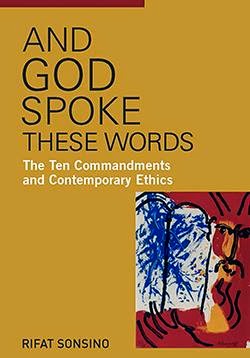
And God Spoke These Words: An Interview with Author Rabbi Rifat Sonsino

[Originally posted on ReformJudaism.org]
Throughout his long and distinguished career, Rabbi Rifat Sonsino, PhD, has helped thousands of readers find God, and uncovered the truths and legends behind the foundational myths of Judaism. In his newest book, he explores one of the best known – and least understood – texts in the Bible: the Ten Commandments.
The Ten Commandments loom large as ethical and moral guideposts in the Western world. The Bible recounts how, after the Exodus from Egypt, the Children of Israel proceeded to Mount Sinai in the desert. Moses ascended the mountain to meet God, who gave him the Ten Commandments, which were written on two tablets to be delivered to the Children of Israel.
These statutes have informed much of Judaism and Christianity over the past two thousand years, and stand at the center of many modern legal and political debates. However, attention to the remarkable and well-established influence of these words often glosses over the actual text and context of the biblical sources themselves.
In And God Spoke These Words: The Ten Commandments and Contemporary Ethics, Rabbi Sonsino draws on commentators from Maimonides to Mel Brooks to explore how the Ten Commandments have been interpreted – and misinterpreted – for generations. He examines the religious and legal texts of the Israelites' neighbors in the Ancient Near East, surveys centuries of Rabbinic commentary, and engages with contemporary secular and Jewish thought. Sonsino's thorough contextualization and discussion of the Decalogue provide the reader with an understanding of where these iconic commands originate, how they have been understood by Jews throughout the ages, and what moral direction they can still provide in the 21st century.
Stephen Becker, director of sales and marketing at URJ Books and Music, sat down with Rabbi Sonsino to discuss this fascinating new book.
URJ Books and Music: Why did you write this book?
Rabbi Rifat Sonsino: I wrote this book because I became aware of the fact that many people have the wrong information about this famous text. For example, many people think that the Decalogue contains the so-called Golden Rule, "treat others as you want to be treated." In reality, the Golden Rule is based on a saying attributed to Rabbi Hillel who lived in the 1st century C.E. and it is not found in the list of the Ten Commandments.
Secondly, I wrote the book because I realized that many people project onto the text their own religious views. For example, those who oppose abortion and pacifists who are against war at all cost argue that the Ten Commandments says, "Do not kill." A linguistic study indicates that this law can easily be translated as "You shall not murder," implying premeditation, changing the scope of the commandment. We simply do not know how the original norm was understood in biblical times. The Bible knows of the death penalty and is not against wars. So, "You shall not kill," is not likely to be the original intention.
Finally, I wanted to provide a modern interpretation of the Decalogue, especially stressing its relevance in contemporary ethical situations. For example, in reviewing the norm against stealing, I discuss not only stealing property, but also kidnapping, encroachment, unfair competition, identity theft, copyright issues, Ponzi schemes, and so on.
URJBAM: What is the relevance of the Ten Commandments now?
RRS: The Decalogue contains certain basic legal and moral norms that are found at the foundation not only of Judaism but also of Western civilization. For many people the Decalogue simply stands for law and order. It represents our high religious standards. That is why so many judges and religious leaders want to display them in the courts of law.
URJBAM: How can this book be used in class?
RRS: I would suggest that students first share their personal information about the Ten Commandments, and then, by studying my text, try to figure out how each one of them can be applied today. I would also suggest that at the end of the sessions, students should attempt to come out with their own set of ten commandments that are reflective of modern life.
URJBAM: Why call it "Ten Words," and not "Ten Commandments"?
RRS: The Hebrew text does not refer to the Decalogue as "ten commandments," but only as "ten words." This is also the meaning of the word "Decalogue." In Greek, this means, "ten words." These "words" become "commandments" when they are internalized and attributed to the divine. How these ten norms were revealed is a mystery. We do not have a clear picture of it in the Bible. We are dealing here with a fundamental myth. Obviously, to become effective, each of the ten words needs to be elevated from the level of "legislation" on the books to the level of "commandments," when a person feels that these norms have fundamental value and are addressed to every person.
Rabbi Rifat Sonsino, PhD, is rabbi emeritus of Temple Beth Shalom in Needham, Massachusetts, and adjunct professor of theology at Boston College. Born in Turkey, he received his law degree from the University of Istanbul, his rabbinic ordination from the Hebrew Union College-Jewish Institute of Religion, and his doctorate in Bible and Ancient and Near Eastern Studies from the University of Pennsylvania. Rabbi Sonsino is the author of numerous books, articles, and blog posts.

Tuesday, May 20, 2014

Erdogan Calls A Protester “Israeli Scum”

Rabbi Sonsino
On May 13, 2014 there was a terrible explosion in a Turkish mine, 8 miles away from Soma (popl. c. 25,000), a small town in the district of Manisa in the Aegean region of Turkey. It was one of the worst tragedies in modern Turkey that claimed the life of 302 individuals. When the Turkish prime-minister Recep Tayyib Erdogan visited the area, he was confronted by an angry mob. During the melee, the PM confronted someone in the group, and reportedly said something like “What the f. do you think you are running to? O Israeli scum (“İsrail Dölü”).” Except that the word translated here as “scum” in English has a vulgar sexual connotation in Turkish. This is the same Erdogan who, during the 2009 World Economic Forum at Davos, Switzerland, gave a short talk accusing Israel of indiscriminately murdering Palestinian children, and walked out of the dais, leaving behind a totally surprised Shimon Peres, the President of Israel, as well as other members of the panel.

The scandal of Soma affected Turkish citizens deeply; they are demanding whether or not there was a cover up for criminal negligence on the part of mine’s owner and manager. It also shocked the dwindling Jewish population (now at c. 17,000) in Turkey, fearing that this could be the beginning of a new anti-Jewish wave by other Turks.

The Turkish friends with whom I am in touch are terribly upset. Some stated that they need to apologize to their Jewish neighbors for this unacceptable slur.  Can you imagine any Western political leader saying something similar, and getting away with it? No way! He/she would be out of a job the next day! This time Erdogan showed his real face when he uttered those despicable words.

There are anti-semites everywhere, but I do not consider all Turks anti-Jewish or anti-Israel. I did not experience anti-Jewish attacks when I was in law school or when I was in the Turkish military (I was an officer in the tank corps and a member of military court). I still have dear friends there who are Muslim. Does that mean that Turkey is devoid of prejudice? No. I remember when I was child, my mother and I were on a boat crossing the Bosphorus, and as usual we were speaking among ourselves in Ladino, when an obnoxious guy approached us and yelled, “Jew, speak Turkish!” I was in shock. But I also recall that during Easter we never went by a Greek Orthodox Church for fear that Greek thugs would come out to beat us kids because “we killed Christ.”

The Turkish government has started an investigation of this tragic event. I hope they will discover the real cause of the fire, take precautions so that it does not happen again, punish the culprits, and learn how to confront people, especially the mourners, with dignity and respect.

As to Erdogan, I hope this is the end of the rope for him. He must apologize and perhaps leave politics to those who are better than him. Will this happen? I don’t know.  He is still very popular among many people….

Rifat Sonsino, Ph.D.

May 2014

Friday, April 4, 2014

Discovering Reform Judaism and Getting Lost in It

Rabbi Sonsino
My religious training began in Istanbul, in an Orthodox Jewish synagogue to which my parents belonged. I excelled in my studies and became not only a shohet (ritual slaughter for chickens only) but also the hazzan kavua (the main liturgical leader) of my temple. My teacher, I now realize, was a well-intentioned but narrow-minded individual.  In law school, when I discovered Reform Judaism, he quickly dismissed me from the pulpit. I was no longer kosher for him.

For me, however, finding a liberal expression of Judaism was liberating. I could now, in good conscience, become a religious and observant Jew. During my military service in Turkey, I applied and was accepted by the Reform rabbinic seminary (the Hebrew Union College) in Cincinnati. After six months in Paris, where I studied at the Institut International d’Etudes Hebraiques, the now defunct French-Jewish rabbinic school associated with the World Union for Progressive Judaism, I came to the States in late August of 1961. I was in heaven!

In the 60’s, Reform Judaism had a distinct style and philosophy. Even though there were differences of opinions among us—we are Jews after all—we all had a general idea of what Reform Judaism stood for: We supported progressive revelation; we believed in the immortality of the soul; we had a common liturgical style and prayerbook etc. Now things are different. At times, I don’t know where Reform Judaism stands.

I realize that it is in the nature of Reform to be progressive and diverse. After all, the Centenary Perspective of the Reform Rabbinate (CCAR, 1976) clearly states that, “Reform Judaism does more than tolerate diversity; it engenders it.” Today, however, we have more theological discord among ourselves. For example, we cannot even agree whether we support tehiyyat hametim (resurrection) or immortality of the soul, and our new prayerbook, Mishkan Tefillah, has to include both options. We espouse different perceptions of the divinity; and we are all over the map with regard to ritual practices.

The only continuity we have is the particular rabbi’s style of worship and philosophy in his/her congregation. When I was a congregational rabbi, I, too, influenced my synagogue with my style of worship and thinking pattern. Being a religious naturalist, my services certainly reflected my philosophy, even though I tried not to impose it on others. Every rabbi does this in his/her temple. I understand that, and congregants do too. As a rabbi who has been on the pulpit close to 50 years and a shaliah tzibbur (prayer leader) for almost 60 years, I would suggest that once in a while, rabbis and cantors review their prayer practices, and vary them as necessary. Not all services have to start with, “Let us take a big breath.”  After a while, it is boring.

Rabbi Rifat Sonsino, Ph.D.

April, 2014

Tuesday, April 1, 2014

Eating Rice on Passover

Rabbi Sonsino
According to Jewish tradition, it is not permitted to eat fermented grain products (called hametz) during the entire Passover week. The Mishnah specifically mentions wheat (hittim), barley (seorim), spelt [also known as farro] (kusmin), rye (shifon) and oats (shibolet shual) (M. Pes. 2: 5). [Danby translates kusmin as “goat-grass”]. Ashkenazic Jews add to this list of prohibited food items rice, millet, corn, beans and other legumes (called kitniyot) in Hebrew. Most Sephardic Jews do not follow this custom and eat rice and other legumes during Passover.

What is the reason for this prohibition that emerged among Jews of Eastern European background?  Apparently, the custom originated in France in the 13th century and from there it spread to other Jewish communities in Europe. According to some sources, the reason is that these legumes resemble grain. Some point out that rice also “rises” when cooked in water. Others argue that some people could become confused and actually resort to making flour out of them.

In 1988, a prominent conservative Rabbi in Israel, David Golinkin, wrote a responsum on this subject and stated that the actual reason for this custom is unknown, and in fact contradicts an explicit statement in the Talmud (BT Pes. 114b). He also quoted another medieval Rabbi, Rabbi Yeruham, who called it “a foolish custom.” [See a longer article online by Jeffrey Spitzer, “Kitniyot, Not Quite Hametz” in My Jewish Learning].

Similarly, the CCAR, in its 1996 responsum on this subject, indicated that the early Reform Jews in Europe found this custom unnecessary and burdensome, and abolished it. It also stated that the “Reform practice, following the standard of the Talmud, permits the eating of rice and legumes during Passover,” but added that some observant Reform Jews may continue to follow the Ashkenazic tradition, if they wish.

I think it is time to eliminate this unnecessary burden on our congregants. As a Sephardic Jew, I will continue to eat rice and other legumes, without any sense of guilt.

Rabbi Rifat Sonsino, Ph.D.
April 2014.

Wednesday, March 26, 2014

The Soncinos Move to the Ottoman Empire

Rabbi Sonsino
In 1454, Symon Ebreus, a descendent of Moses of Speyer (14th cent.) in Germany, came to Soncino, in northern Italy. In 1483, his grandson, Rabbi Israel Nathan, along with his two sons, Joshua and Moses, established the world-famous printing press that became known after the town itself. However, in 1490, just seven years after, he and his family were expelled from Soncino, because of the religious persecutions that took place during the rule of Ludovico Maria Sforza (1452-1508), the Duke of Milan. Family members spread to different places of Italy (e.g., Casal Maggiore, Naples, Brescia, Fano, Pesaro etc.) and continued to publish books, both Jewish and non-Jewish. In 1527/8, Rabbi Gershom, the son of Moses Soncino and grandson of Israel Nathan, moved first to Salonika and from there to Constantinople, today, Istanbul. He, too, continued in the tradition of his family and published many Jewish books. His son, Eleazar b. Gershom Soncino also became a prominent publisher.

Other members of the Soncino family took residence in different parts of the Ottoman Empire, still continuing with the publishing trade. We find Gershom b. Eliezer Soncino in Cairo (in 1557); Moses Joshua Soncino in Smyrna (c. 1715); some members even immigrated to Safed. One of the latest in the business was Joshua, son of Moses Soncino who lived in the first half of the 18th century (c. 1737).

In his collection of studies on Turkish Jewry[i], the historian Avram Galante, mentions Rabbi Eliezer Soncino who was the rabbi of the Italian community in Constantinople (late 1500’s) as well as a certain Moises Sonsin, who lived in the late 1700’s. Galante also states that the city of Smyrna had a neighborhood known as “Sonsino.” During my youth in Turkey, I had heard that there were other Sonsinos in the country, but I never met them.

A word about the spelling of our name: In Italian, the letter “c” in Soncino is pronounced as “tch,” like the “c” in “Chile” or “cheetah.” In Hebrew, the same letter “c” was rendered by “tzadi,” and pronounced as “Sontz/sino.” However, Turkish or Spanish does not have a letter that is equivalent to the Hebrew “tzadi.” Besides, in Turkish, “c” would have been pronounced as “dj.” I surmise that is the reason why the spelling of our family name was moved from SonCino to SonSino, in line with the French and Spanish pronunciation.

Today, the Sonsinos are spread all over the world. From our Sonsino page in Facebook I know that there are Sonsinos in Latin America, in Israel, in the States and other parts of the globe. The family is no longer engaged in the printing businesses. The name was taken over by a Jewish-English publishing company in 1929 (the “Soncino Press”) to honor the famous printers of the past.

Today Sonsinos are found in many professions. However, to my knowledge, I am the only one in the world who is a Rabbi. At least there is one more now.

Rabbi Rifat Sonsino, Ph.D.
March 2014

[i] Avram Galante, Histoire des Juifs de Turquie. Isis, vol. 1-9.

Tuesday, March 25, 2014

Visiting the Town of Soncino

Rabbi Sonsino
This year marks the 560th year of the arrival of a German-Jewish family to Soncino, a little town in northern Italy, and their success in establishing a world-famous printing business in medieval Jewish life.

In 1454, Franceszo Sforza, the then duke of Milan, whose jurisdiction extended to include Soncino, authorized Symon Ebreus (Simeon, the Hebrew) to settle in Soncino, along with his family and friends, and practice “artem feneratoriam” (namely, to give money in interest). However, when town officials set up a public loan office and made private banking almost impossible, Israel Nathan, the son of Simeon and a wealthy physician, along with his sons, Joshua and Moses, decided to open the printing press that called itself after the name of the town. Soon, they began to publish many Jewish books, and became so famous that of them it was written, “From Zion shall go forth Torah, and the word of the Lord from Soncino” (Based on Isa. 2: 3).

In March of 1961, I visited the town of Soncino. It was still a small rural town, with a large castle called Rocca Sforzesca. The town people were not accustomed to foreigners. I remember seeing a number of women doing the laundry in a small river. When they noticed my travelling companion and me, they suddenly stopped their work and set their puzzled eyes on us, asking each other, “Who are these people?” Once they found who we were, and especially that I was a descendant of the Jewish family that printed books in their town, they became quite friendly. I then realized that I was the only Sonsino in Soncino! We then met the local priest, Monsignor Pietro de Micheli, who graciously gave me a copy of his book, Soncino; Memorie e Notizie (1956).

We stayed only one night in town. The next morning, we hired a guide who took us around. We visited the famous castle of Soncino. Our guide also took us to two interesting streets. One of them was called, “Via della Stampa” (“The Street of the Printing House”) and the other “Via degli Stampatori” (The Street of the printers), a clear indication of the location where the family lived. The town is very proud of the fact that its name is now famous throughout the world.

And so am I.

Rifat Sonsino, Ph.D.
March, 2014

Monday, March 24, 2014

Reconnecting with Childhood Friends

Rabbi Sonsino
In the Apocrypha, the sage Ben-Sira writes, “Whoever finds a faithful friend, finds a treasure” (6:14). Childhood friends constitute part of the building blocks of our life that shape our character and enable us to become who we are. Because of the vicissitudes of existence, we eventually lose contact with most of them and they are stored away in our memories. But if we want to know ourselves better, we need to reconnect with them, to find out what they are up to, and to share happy and sad stories.

Like many of you, I too lost contact with most of my elementary, high school and college friends. I left Turkey in 1961, studied abroad, traveled extensively, moved often, and finally settled in the Boston area where I have lived for the last 30 plus years. I am now ready and eager to make contact again with those who influenced me in my youth. And I have been successful up to a point. Some of my friends sadly passed away, and I am sorry I did not communicate with them while they were alive. Others simply disappeared from the radar and I cannot locate them. But a few precious ones have surfaced, and I was able to reconnect.

First, I attempted to locate some of my elementary and high school friends. I had already been in touch with just a few, but now many more appeared in Facebook and elsewhere. We are now in the process of exchanging class pictures and family episodes. My high school in Istanbul (“The Jewish High School”), a private educational institution that was led for many years by my father, organizes every year a get together in March, and graduates flock from Israel, Europe and other places. One year I plan to attend as well.

I have been able to keep in touch with a few friends in Law School (Istanbul) and Rabbinic Seminary (HUC-JIR), but recently I have attempted to locate my colleagues in graduate school at the University of Pennsylvania, but have had very little success. But this past week, I hit the correct button. I heard that there will be a gathering in Philadelphia of some of my classmates at the house of my Arabic professor, but regrettably I cannot attend this time. Maybe, in the future.

A few days ago I found my American pen pal whom I had met in Turkey, about 50 years ago. While serving in the Turkish army, I wrote to SE often, inquiring about life in America. She represented for me my ultimate goal of coming to the States. In fact, when I came to Cincinnati, I met SE again, even attended her wedding. But after ordination, I went one way, she another. But this week, I located her in Facebook and contacted her. I learned she became a prominent physician, has three daughters and is still active, though retired from her profession. It was wonderful closing the gap again.

Have you tried to reconnect with your childhood friends? The book of Proverbs calls a good friend an oheb, a loving person; that is one “who sticks closer than a brother” (18: 24). Good friends are part of our life, and you should never forget them. I did not, and I am glad for it.

Rifat Sonsino
March, 2014

Tuesday, January 28, 2014

Great People - Great Legends

Rabbi Sonsino
In human history great leaders attract great legends.  The details of their lives, often irretrievable, remain with us as the creation of an imaginative mind, either to destroy these leaders or to elevate them to new heights. For the Romans, Attila, the Hun (5th cent. CE), was a “scourge of god,” a symbol of cruelty. On the other hand, Moses, in the Western world, stands for law and wisdom.

Recently I was reading about the famous-- or maybe infamous--Russian queen, the great Catherine II (1729-1796), who was the subject of unbelievable legends that circulated for years in literary circles. Born a minor German princess, Catherine, at the age of 15, was married to the grand Duke, Peter of Russia. When she turned 33, she overthrew her insane husband in a bloodless coup, and established herself as the Empress of Russia. During her reign, the country expanded, prospered, schools were opened, laws enacted, and many wars won, including the defeat of  the Ottoman Empire by Russian forces in 1768. After her death however, a number of incredible legends began to circulate: that she had an excessive appetite for sex, that she had a sexual intercourse with a stallion, that she was the illegitimate mother of Eva, the daughter of a false Jewish-Messiah Jacob Frank, that she died on the toilet when her seat broke, etc.

In human history she is not the only one. The Bible tells us that, though king David began his life as a country thug (I Sam 22), he quickly became a national hero, by defeating the valiant Goliath, the Philistine (I Sam. 17) (but in another passage, the Bible says, it was not David, but Elhanan who killed Goliath; cf. II Sam. 21: 19) and by unifying both Judah and Israel. Eventually, he was viewed as the messianic figure that will come at the end of time to save humanity (Isa. 11; Jer. 23). In Jewish life, all messianic contenders, from Jesus to Rabbi Sabbatai Zevi of Turkey (17th cent.), have claimed to be of Davidic line.

And what do we know of Moses? The Bible tells us that he was the great liberator of the Jews in Egypt, the legislator to whom God revealed the entire Torah on Mt. Sinai, and, according to the sages later on, even all the teachings of the rabbis who lived centuries after him (Shemot Rabba, 28: 6). In reality, the story of Moses’ birth seems to have developed very much like the birth of the Assyrian king, Sargon the great (3rd millennium BCE), including the detail of how he was placed in a basket and found in a river by a young woman (See text, ANET, 119).

The observation that great leaders attract great legends does not, in my opinion, deny the reality that these important leaders of the past (like, Moses, David, Solomon, Jesus and others) lived but it highlights the fact that the details of their lives cannot be verified. The kernel of truth we have about them cannot be taken as historically reliable. Their descendants saw greatness in them and attributed to them fundamental teachings that still govern our lives.

Rifat Sonsino, Ph.D.

Jan. 2014.

Friday, November 22, 2013

Do You Know the Ten Commandments?

Rabbi Sonsino
The Decalogue (lit. “Ten Words”) is often viewed as embodying some of the high values of the Western civilization. It appears in the Bible in two parallel but conflicting versions, Exodus 20 and Deuteronomy 5. Yet, it is amazing to read what many people think the Ten Commandments say or include. Here below I wish to identify some of the most popular erroneous assumptions about this famous text:

1: Everyone agrees on the number of injunctions in the Decalogue. This is wrong because the text contains more than ten instructions formulated in the imperatives (that is, Do this…Do not do that). In order to arrive at “ten,” some injunctions need to be combined. In the Bible, ”ten” most likely represents a quorum (cf. “ten” judges in Ruth 4:2). Someone suggested that we have “ten” commandments, because we have “ten” fingers with which to count! Who knows?

2: Everyone agrees on the division of the Ten Commandments. This too is wrong, because the traditional Jewish division is different from the many Christian divisions. Thus, for example, whereas in the Jewish tradition the very first statement, “I am the Lord your God…” is considered as the first commandment, in many Christian traditions, this is viewed only as an introduction to the following commandment that reads, “You shall not have other gods…”

3: The meaning of the Ten Commandments is clear. This is also not true, because there is an ongoing scholarly dispute on the correct understanding of many of the injunctions. For example, it is not clear whether the original Hebrew meant, “You shall not kill” or “You shall not murder.”

4: The Ten Commandments are the essence of Judaism. This is not correct either, because, even though the Decalogue is considered important in Jewish lore, the Rabbis of old purposely removed them from the liturgy when “heretics” (early Christians?) claimed that only these commandments were revealed by God (BT Ber. 12a). Most Sephardic Jews do not even stand up when the Ten Commandments are recited. Many Reform Jews do.

5. The Decalogue represents ten “commandments.” This is not so clear. The word “commandment” (mitzvah) does not appear in the text. In the Bible they are simply called aseret ha-diberot, “ten words” (Deut. 10: 4; cf. Ex. 34: 28). The Rabbis referred to them as aseret ha-debarim  (“ten words.”). In time, they were viewed as commandments because the term dibber became a technical term for divine speech (see, Jer. 5: 13). If God said them, they must be commandments!

6: Because many people assume the Decalogue is important in the Judeo-Christian tradition, they attribute to it injunctions that do not appear in the text, such as “You shall not lie,” or “Do not do to others what you don’t want them to do to you.”  Sorry, these are not part of the Ten Commandments.

These major popular but misleading claims led to me to do an in-depth study of the Ten Commandments for many years, which culminates in the publication of my new book, And God Spoke These Words; the Ten Commandments and Contemporary Ethics, by the Union for Reform Judaism (URJ) Press. Please check it out for other details to see how the Decalogue was interpreted historically and how it is applied to modern ethical situations. The link is:

http://www.urjbooksandmusic.com/product.php?productid=12549&cat=0&page=1&featured.

Rifat Sonsino, PhD
Nov. 2013

Monday, October 28, 2013

Rabbi Sonsino: My Granddaughter's Bat Mitzvah

Rabbi Sonsino
Mid October, my granddaughter, Ariella, became a Bat Mitzvah in California, and made us very proud and happy.

There are moments in life which define us. There is a before and an after that particular event. In the present Jewish practice, a Bar or Bat Mitzvah is one of those cutting moments. A thirteen year old boy (a Bar Mitzvah) or a girl (a Bat Mitzvah) marks a significant transitional period in life by celebrating it with family and friends during a religious ceremony and often with a big party afterwards.

In Hebrew the expression Bar/Bat Mitzvah, usually translated as “son/daughter of the Mitzvah,” really means youngsters who are now “responsible for the performance of the Mitzvot (commandments/good deeds).” It takes about two years to get a date from the synagogue and six months to learn how to lead the service in Hebrew and English. In most Reform synagogues in the USA, during a Sabbath morning service, which often includes the celebration of a Bar/Bat Mitzvah, the high point is reached when the candidate chants a section of the Torah portion of the week taken from the Pentateuch and part of the prophetic portion (Haftarah) that follows it. Also, a Bar/Bat Mitzvah usually reads a short commentary of the biblical passages and a message of gratitude to parents, relatives and friends. Ariella did all that. She was nervous but went through the whole thing with poise and a great smile. We were delighted.

In my granddaughter’s temple, they have a lovely custom of invoking God’s blessings upon the Bar/Bat Mitzvah while standing under a prayer shawl (tallit) held by close friends. As a grandfather, it was my pleasure and honor to recite the priestly blessing there as I prayed for Ariella to have a good and long life, contentment and peace.

However, what moved me the most was a moment just before the Torah service when the Rabbi asked us to pass the Torah scroll from one generation to another, as a reminder that we, as Jews, are all connected by tradition, cultural as well as ethnic ties, from our ancestors in biblical times to the present generation and beyond. As I handed the scroll to my wife, and as she passed it on to my son and daughter-in-law, and they gave it to Ariella, I thought of my own Bar Mitzvah in Istanbul in 1951, of my deceased parents and grandparents, and forward to my son and his daughter, with a sense of gratitude and connectedness that can only be described as magical. I was overwhelmed by emotions, my eyes became teary and I had a hard time breathing. Yes, our Jewish tradition is being handed down to a new generation, and I hope they will be proud of it, keep it and enrich it with their own creativity. 

Ines and I still have the Bar/Bat Mitzvah of three more grandchildren to go, and I hope God will grant us the opportunity to witness their own celebration.

Rabbi Rifat Sonsino, PhD
Oct. 2013

Friday, October 4, 2013

Rabbi Sonsino: "Can You Trust Anyone?"

Rabbi Sonsino
Many people read consumer reports before buying an article, such as a car or a TV, and even about a restaurant. I often do. However, recently I was shocked to read that some individuals are getting paid to write favorable reviews for products in respectable periodicals. That is outrageous. Can you trust anyone today?

Our religious literature cautions us not to put our faith in someone else. The model is set by the patriarch Abraham: “Because he put his trust in the Eternal, He reckoned it to his merit” (Gen. 15: 6). The prophet Jeremiah says, “Blessed is the man who trusts in God and who makes God his refuge” (17: 7), and, conversely, “Cursed is he who trusts in man” (17: 5). Similarly, the psalmists states, “Happy is the man who makes the Lord his trust” (40: 5), and “Do not put your trust…in mortal man who cannot save” (146:3). In the early rabbinic period, Hillel is reported to have warned people against overconfidence: “Do not trust yourself until the day of your death” (Pirke Avot, 2: 5; the Talmud gives a few examples in Ber.29a). In medieval times, the Jewish philosopher, Bahya ibn Pakuda (11th cent., Spain) spent an entire chapter on the idea of trust (see, his chapter 7, in The Duties of the Heart), and, even though he thought that it was possible to trust human beings who have compassion, empathy and love, he added that these qualities are often wanting in everyone except God. He then concluded by saying that “whoever trusts in what is other than God, God removes His providence from him and leaves him in the hands of whatever he trusted in.”

Non-Jewish literature on this subject is not more comforting either. The Roman philosopher Seneca (I cent CE) put forward a balanced viewpoint: “It is a vice to trust all, and equally a vice to trust none.” Most writers were more cautious. Thus, for instance, Shakespeare stated, “Love all, trust a few” (All’s Well That Ends Well). Ronald Reagan insisted, “Trust but verify.” Some thinkers even said that we need to put our faith only in ourselves, not on others. And Joseph Stalin went to the other extreme allegedly saying, “I do not trust anyone, not even myself.”

I maintain otherwise. I am not naïve but I do tend to be a trusting individual. I often take people at their word. Before a purchase, I do read one or two reviews and then proceed. How can you live in a society where no one relies on another? A student trusts his/her teacher. Children trust their parents, and vice-versa. We rely on a variety of experts. Personal friendship or a good marriage is possible only when there is mutual trust. When we read a book, a research paper, a magazine article etc., unless the claim is preposterous, we all tend to accept the facts cited in them as reliable and true.

Yes, some people do lie; some people cheat. And it is getting more difficult to trust others. One needs to be skeptical of unusual, strange and outrageous claims. But I don’t think the dishonest are in the majority. I will continue to rely on my guts and depend on others. That is what we need to work on, and make individuals responsible for what they say and do. Society cannot survive on falsehood and suspicion.

As for me, I will start to read many more reviews than before buying anything, and then decide. What a shame!

Rabbi Rifat Sonsino, PhD
October, 2013

Monday, July 22, 2013

Does Fasting Make Sense Today?

Rabbi Sonsino
When was the last time you fasted?

There are various reasons for which people fast. Some do it for medical purposes, like to get thinner. Others resort to it for a political or social cause, like a hunger strike in jail. And others do it with a religious motive, like many Jews on the Day of Atonement or Muslims during Ramadan or Catholics on Ash Wednesday. The question for me is whether or not religious fasting makes sense today. It is my impression that in the Jewish community the number of people who fast for religious reasons is progressively diminishing. I agree with their skepticism.

The custom of fasting as a religious ritual was well known in the ancient Near East. In fact, fasting and then consuming special foods were part of the Mesopotamian New Year Festival (Akitu). According to some scholars, fasting survived as a remnant of the ancient cult of the dead because of its connection with weeping and mourning.

Like many other religions, Judaism too knows about fasting, and mandates both major and minor fasts. A major fast goes from sunset to nightfall the next day and a minor fast is held from sunrise to sunset. The two major fast days of the Jewish calendar are The Day of Atonement (Yom Kippur) and Tisha Beav (9th of Av, usually in July), which commemorates the destruction of the First and Second Temples as well as other calamities that befell the Jewish people throughout the centuries.

The Bible mentions various fast days (each one called a tzom) that were observed either by individuals (e.g., King David fasted before the death of his child, II Sam. 12: 16), or the Jewish people at large (e.g., Ezra’s fast, 8: 21, before his return to Judah). Rabbinic law added a number of minor fasts (each one referred to as taanit), like the Fast of Esther (Taanit Esther, just before Purim) and the Fast of the First Born (Taanit bekhorot), observed just before Passover by firstborn males, commemorating the fact that they were saved from the plague of the firstborn in Egypt (Ex. 11:4-6).

Why do people turn to religious fasting? Our tradition provides various answers:  as a humbling experience (e.g., Ps. 35: 13); as an expression of mourning (e.g., Tisha Beav); as a way to propitiate the divine (e.g., Jonah 3:7); for atonement of sins (e.g., Yom Kippur), and even as a technique of divination (e.g., Moses at Mount Sinai, cf. BT Yoma 4b). None of these rationales works for me today.

The only thing that fasting accomplishes is hurting the body. This is self-punishment which does not benefit anyone. One cannot “afflict the soul”-another biblical expression for fasting (Lev. 23: 27)- without damaging the body. In fact, the ancient Rabbis forbade people from fasting if they are under age, or pregnant and even if they have a medical condition against it.

If the feelings I have during a fast day are pains and headaches due to the lack of food or drink, then the religious value of the occasion is severely diminished. I might as well concentrate on the message of the spiritual moment by keeping myself hydrated and nourished.

In the past, I never fasted on Tisha Beav, and do not expect to do it in the future,  even when this ancient memorial day progressively assumes a new and more acceptable meaning in our time, namely, the atonement due to vain hatred of the other. The destruction of the temple in Jerusalem took place in ancient antiquity and, even though I mourn the loss of life in ancient Judea, I do not pray for the rebuilding of the temple that would reestablish the sacrificial rituals, give legitimacy to the cast system that was prevalent then in the Jewish community by giving priority to priests over lay Israelites or by separating men from women. (We already have enough problems with the Haredim in Jerusalem who wish to deny women access to the Wall).

Would I continue to fast on Yom Kippur? In the past I always did. I expect that I will do it again in the future as long as I can tolerate it. But isn’t this a contradiction of what I have just been saying? Yes, of course. Then why would I continue to fast? You never heard the song, “tradition, tradition???!!!!.”

Rabbi R. Sonsino, Ph.D

July 21, 2013


PS. If you wish to follow my postings, you can sign up at rsonsino.blogspot.com