Tuesday, October 11, 2011

The Jewish Future is Now - a Repost from eJewish Philanthropy's Blog

The following post has been cross-posted to the TBS blog from eJewish Philanthropy, a daily enewsletter about trends in Jewish Philanthropy. The author, Dr. Jonathan Woocher, Chief Ideas Officer and the Director of the Lippman Kanfer Institute, a part of the Jewish Education Service of North America, speaks about the Jewish Futures Conference, an opportunity for all of us together to define the future of Judaism. Special thanks to the author for permission to repost this entry.

by Dr. Jonathan Woocher

Jews have a thing about the future. We gave the world the Messianic concept, the vision of a future in which the world is perfected and peace and justice reign. But, we’re also perennially anxious about the future. An updated version of the old telegram joke might go: “What’s a Jewish tweet? ‘Start worrying; Facebook update follows.’” Historian and philosopher Simon Rawidowicz called Jews “the ever-dying people” because of our persistent penchant for fearing that each generation of Jews might be the last. In our own time, we have lived through the era of “Jewish continuity,” determined and sometimes feverish efforts to secure the Jewish future against the perceived threat of intermarriage and assimilation.

When we launched the Jewish Futures Conference a year ago, we took a different tack toward the future, one more in keeping with computer scientist Alan Kay’s advice: “The best way to predict the future is to invent it.” We saw evidence all around us that Jews are indeed inventing an exciting, vibrant future. Yes, there are real challenges: The world is changing very rapidly around us, and Jews are changing with it. But, the raw material out of which to create a future that, while hardly Messianic, is one that we can anticipate with enthusiasm, is at hand. The question is whether we are ready to embrace fully the possibilities that exist today for reshaping Jewish life so that we can thrive as individuals, as a community, and as a people in the new environment we inhabit.

The goal of the Jewish Futures Conferences, the second of which will be held in a few weeks at the Jewish Federations of North America’s General Assembly in Denver, Colorado, is to stimulate conversation among the diverse groups that will determine our future – everyone from high level federation leaders to teenagers – about the visions and values that should guide our ongoing journey. As has been the case throughout our history, learning – Jewish education – will play a pivotal role in shaping both the content of these visions and whether, how and for whom they will become integral to living a meaningful, purposeful, fulfilling life. The second Jewish Futures Conference, like the first, will bring diverse and fresh, even unexpected, voices to this conversation in order to challenge and inspire us to seize the potential of this moment and to imagine where it can carry us.

The theme for the upcoming Conference is “the Jewish learner as ‘prosumer.’” The concept of ‘prosumers’ – people who are at once consumers and producers of the ideas, experiences, and cultural products that give shape and substance to their lives – aptly describes a growing number of today’s Jewish learners.

Increasingly, Jews of all ages are stepping forward to become “co-producers” of their Jewish lives. They are no longer content simply to absorb what others, figures in authority, have prescribed as the way things are to be done. They want to have an active share in the doing, the interpreting, the applying, and they want to do so together with others – Jews and non- Jews – similarly energized to learn and to teach.

Today’s technology makes prosumerism more widely achievable than ever before; it empowers and connects in unprecedented ways. But, in fact the prosumerist idea is not a new one. It is built into the fabric of Judaism itself, where Jewish learning is not limited to an elite caste, and the chain of tradition asks each of us to create new links, new midrash. The ideal of a globally interconnected learning and creating community is perhaps more realizable today than ever before in Jewish history.

What kind of a future can emerge from taking up this opportunity and unleashing the prosumerist potential of the present moment? We don’t know precisely, which, of course, is exactly the point. We will be creating it – together. We can hope, though, that it will be one in which many more Jews are engaging in a wide range of activity motivated and shaped by a passionate and expansive sense of what it means to be Jewish in the 21st century – activity that will expand Jewish learning and culture, strengthen Jewish connections, repair society and the world, and enrich their own and others’ lives.

At the Jewish Futures Conference we will experience for a few hours what such a future might look and feel like. Three keynoters coming from different vantage points – Chris Lehmann, educator extraordinaire; Tiffany Shlain, prize-winning film maker; and Lisa Colton, social media guru – will encourage us to unleash the creative power that we collectively possess to shape new realities. Covenant Award winner Shai Held will use Jewish text to provoke us to think more deeply about how we use this power. New voices – two winners of a world-wide video competition and two teenagers – will share their visions of what we might create, exemplars in their own right of how empowered prosumers are already coming to the fore as creative forces in Jewish life.

William Gibson, the science fiction writer who gave us the term “cyberspace,” argued that “the future is already here; it’s just not evenly distributed.” The Jewish Futures Conference organizers heartily agree. Jews may never put their anxiety about the future entirely behind them (and perhaps never should, at least till we reach that Messianic era). But, we have also never let that stop us from seeking to draw on the wisdom of the past and the possibilities of the present to create a better future. That work continues today, and the Jewish Futures Conference is ready to celebrate it and to ask us all: how can we be part of this historic venture?

The Jewish Futures Conference is presented by JESNA’s Lippman Kanfer Institute and the Jewish Education Project, with support from a growing number of collaborating organizations and sponsors. Read more at jewishfutures.net. Register to the GA at generalassembly.org.

Thursday, October 6, 2011

Pride Not Prejudice

A healthy and happy new year to everyone! This year, just in between the final blast of the shofar and the beginning of Sukkot, is October 11th. We all know about September 11th, especially as we commemorated its 1oth anniversary together at Memorial Field, but October 11th is also known as National Coming Out Day.

While not often talked about, NCOD is an internationally observed civil awareness day for coming out and the discussion about the LGBTQ community, rights, issues, and awareness. One of the many blessings of the Temple Beth Shalom community has been our openness and acceptance of our LGBTQ friends and family, and yet most of it has happened somewhat silently. How does it happen? It usually happens when I least expect it. Sudbury Farms, Trader Joe's, at the oneg on a Friday night, right before a young person becomes Bar or Bat Mitzvah, or prior to a funeral. Rabbi, I want to let you know about my ______ (fill in familiar relationship here)... He and his partner are ... She and her wife are... Did I ever share with you that ...

I have to admit that I love hearing these stories and expanding what I know about you and your family, and I think it is time that more people in your temple community can share these stories, experiences, and simchas. Many of you already know about our TBS Keshet group.

Keshet is the Hebrew word for rainbow and this group is comprised of lesbians, gays, and straight allies. Keshet is also a national organization started here in Boston whose mission is "to ensure that gay, lesbian, bisexual and transgender Jews are fully included in all parts of the Jewish community." Continuing to grow and expand their own programming, Keshet has started the Keshet Parent and Family Connection as an opportunity to speak to other Jewish parents with LGBTQ children.

What I would like to ask, is that in honor of National Coming Out Day 2011, you email me and share with me some of the LGBTQ history in your own family. Talk to me about your cousin, your daughter, your son, your ex-spouse or even yourself. Be proud of who your family members are and if this is a challenge, let's talk about that too. No judgement.

I know that closet doors still exist for a variety of reasons and I am not asking you to "out" someone who is not ready to come out, but rather I invite you to open the door a bit wider so that together we can remind them that Temple Beth Shalom is welcoming and safe place.

Wednesday, October 5, 2011

Rosh Hashanah, Blessings, Blogs, and a new Web Site...


Welcome to 5772! In the spirit of the New Year, and in the spirit of taking stock of our lives at this important time of the year, there are many exciting and new things happening with TBS online which I thought I would highlight here.

First, we have launched our newly updated web page. You can still find us at www.tbsneedham.org but when you log in, you will notice that the site has a slightly new look and feel. The calendar of events is now firmly linked in to all of our subpages, and we have several exciting new features which will be debuting in the coming weeks (and, in fact, later in this email).

To access much of the customized content, we have moved away from the model of a single user password for the entire congregation. Instead, you will have an individual user identity and password. If you have not already registered for a username and password, please do so by clicking here, and following the instuctions below:
  • Fill out the form to register for an Online username and password.

  • Enter key information: First Name, Last Name, Password and confirmation, Email, and Display Name

  • Enter required information on the Custom Tab: Timezone.

  • Enter optional information: Address, Avatar / Profile photo, Tags tab (to indicate your interests or affiliations), Custom tab (for privacy settings), and Activity tab (settings for how you want to be notified about activities within the Community Area).

You will be sent an email with a confirmation that your account has been established once you have been approved. Login information is per user, so everyone in your family can (and should) create their own username on our new page.

Also on the new page (as you begin to explore) you will find that we have updated the section including the Rabbi's sermons to feature the two sermons delivered on Rosh Hashanah. Rabbi Todd's erev Rosh Hashanah sermon entitled "Opening our Eyes to Blessings" can be found here and the list of blessings mentioned in his sermon can be found here. Rabbi Jay's Rosh Hashanah sermon entitled "Israel: Seeking Hope, Inspiration, and Courage to Act" can be found here. After Yom Kippur, we will update their respective pages with copies of this year's sermons.

Another new feature of our relaunched website are two new blogs for our K-5 and 6-12 learning programs. Following the incredible success last year of our pre-school blog, we have launched two fully interactive blogs with posts from your children's teachers, pictures from the classrooms, information about learning and curriculum, and lots of opportunities for ongoing conversation. We welcome you to come view how exciting learning at TBS is! The Elementary Learning (grades K-5) blog can be found here and the Teen Programs blog (grades 6-12) can be found here. Please note you must be logged into the Temple web site to access these pages. (If you would like to have a family member who is not a member of the Temple [i.e. grandparent, aunt, uncle, etc.] be able to access the blog, please note that they can also register for a username and password using the instructions above although their access to the webpage as a whole may be limited).

As a final reminder and update, we are in the middle of our Annual Shofar Appeal. This is time of year when we reach out to you asking for your support as we begin the year ahead. A pledge card was sent home to all members, and if you prefer to make a contribution online feel free to click here (you will be able to use Paypal to make a contribution by credit card).

We hope you enjoy the start of the New Year as well as the new ways in which we are using technology at the Temple. May the year to come bring you and yours many blessings!

Friday, September 16, 2011

Still Smiling...

Have you ever smiled so much that your cheeks hurt? That’s how I felt yesterday as we celebrated with Ida Kublin as she became a Bat Mitzvah at 83! I just could not stop smiling and I think it was contagious! In attendance were her children and grandchildren, family and friends. We all came together to witness an important moment in Ida’s life and it became an important moment in the lives of all of us who were present. For months Ida and I had studied her Torah portion together, debating whether she would use the Sephardic or Ashkenazic pronunciation of the Hebrew text before her. As we studied, she shared stories of her youth with me and how she excelled in Hebrew school, but never had the chance to become a Bat Mitzvah. After months of studying and years of imagining what it might be like to read from the Torah, the day had finally arrived and she knew that her parents of blessed memory would be so very proud.

When we first met, I learned that she had wanted to celebrate this special Bat Mitzvah close to her birthday and together we chose the date not paying attention at the time to this week’s Torah portion, but rather to the availability at the temple and the upcoming Holy Days. Little did we know, that we picked the perfect day.

There is a saying that you get the Torah portion that you were meant to get, and that was so true in Ida’s case. When I initially picked the verses that she would read, I knew it would fit because it spoke about food, and I knew that Ida and her beloved Abe of blessed memory used to have a deli, but I had no idea at the time that the verses I had chosen for her to read, would actually be a wonderful statement of her theology, her philosophy and her practice.

Ida is proud to say that she believes in bashert, it was meant to be, and this match of Ida and her Torah portion was indeed bashert. She spoke beautifully about the importance of family and as she spoke those words, I looked out into the congregation and amid the tears of joy were the smiles on the faces of her family members and friends. She spoke about her belief in God and gave profound thanks to God, and I proclaimed yesterday to be Thanksgiving Day, as we were all grateful to witness this RIGHT of passage. Young women of her generation did not celebrate the rite of passage we know as Bat Mitzvah, and yesterday as she received the Torah from the generations of her family who have followed her, the Torah was in Ida’s loving arms, reclaiming it as her own. Seeing her pure love of life, family and God was captivating. I don’t think there was a dry eye in the house.

Ida’s last verse of Torah was perhaps the most fitting as it reads: Baruch ata b’tzetecha u’varuch ata b’voecha. Blessed shall you be in your comings and blessed shall you be in your goings. (Dt. 28:6). It was when we studied this verse together that Ida revealed to me that whenever someone in her family goes on a trip it has long been her practice to say, “Go well and come well”, words right out of her portion. Truly Ida got the Torah portion that was meant for her, and she is indeed a blessing to us all.

Friday, September 2, 2011

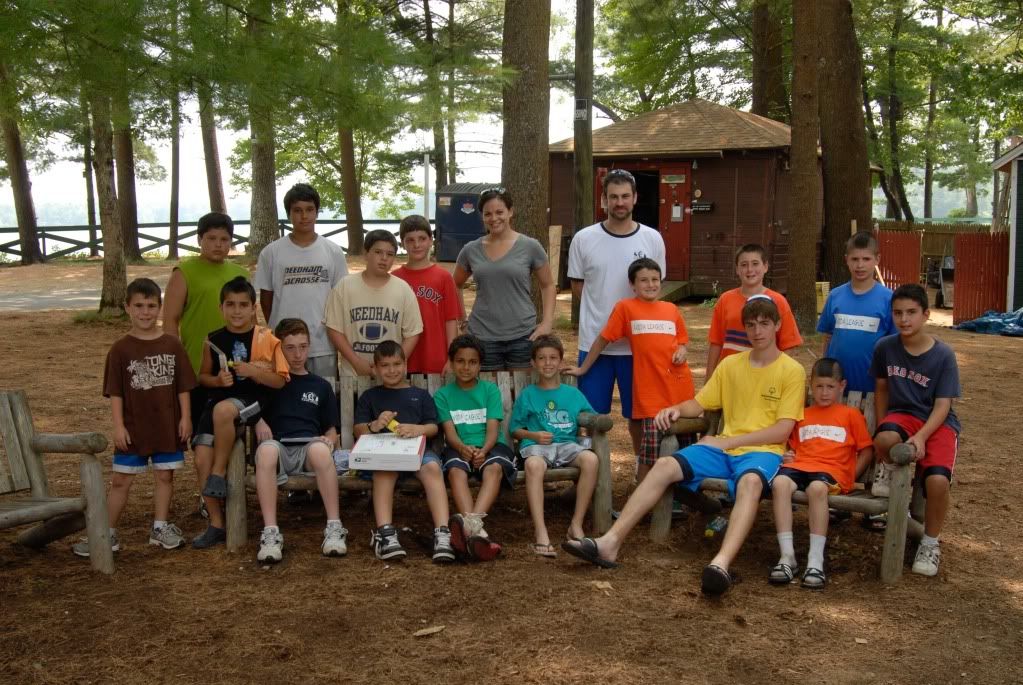
Next Friday night, September 9, 2011, celebrate summer overnight camping with us!

As a preparation for our Shabbat in celebration of our campers, we invite you to submit your own favorite camp memory below as a comment to this post.

We are so thrilled that hundreds of our Temple Beth Shalom children attended overnight camp this summer. We would like to celebrate them and the wonderful experiences they had next week at our Friday evening services. This will be our first Simchat Shabbat service of the year, an evening filled with spirit, joy, and plenty of "camp music," as we welcome all of our temple kids home from their summer experiences.

So bring the whole family along to services at 7:15 PM on Friday, September 9th, and be sure to wear all of your camp gear to celebrate the place where summer memories were made.

Our oneg following services will feature camp-themed tasty treats.

We would also like to share photos of our temple kids off at camp, so please e-mail Rabbi Todd with high resolution pictures from your child(ren)'s summer at camp. Your child's 4 or 5 favorites would be great!

We hope to see you there so we can see the smiling faces of those who've recently returned home and to hear all about incredible summers at camp!

Tuesday, August 23, 2011

Getting to the Heart of Yom Kippur by Rabbi Vicki Tuckman

Ed. Note: This cross-post comes from the URJ's email series entitled "Ten Minutes of Torah". The email comes daily and provides a one-page e-mail on a topic of Jewish interest. To sign up for the daily email, visit the URJ's web page.

Rabbi Tuckman has given TBS permission to repost her email on a new ritual her family has created for Yom Kippur on our blog. Rabbi Tuckman is Assistant Director / Director of Jewish Life for the URJ's Camp Harlam. You can read more about Rabbi Tuckman on Camp Harlam's web page.


Last year I introduced a new ritual into my family’s observance of Yom Kippur. I was determined to observe this most holy of days in a meaningful and active way. Yom Kippur is a long and challenging day, even for the seasoned Jew who spends the month of Elul and the “days of awe” in preparation. The normative Yom Kippur rituals (i.e. fasting, prayer, personal and communal atonement) are not necessarily engaging or developmentally-appropriate for children or pre-teens. Even teenagers (and adults) can be overwhelmed by the length of services and miss the point of fasting if they do not understand the true intent.

With that said, there is no doubt that the message and teachings of Yom Kippur are appropriate for all. All people – from preschool on up – ought to be practicing reflection, atonement and forgiveness. At each stage of our lives we can and should seek to fulfill the sacred duties of this day.

Rabbi Gunther Plaut writes the following about “The Day of Atonement” in his Torah commentary:

It is impossible to exaggerate the importance of Yom Kippur in the life of the Jewish People. Even the religiously indifferent respond to its call and crowd the synagogues...It speaks to each human being and seeks to bring each person into harmony with others and with God. (The Torah: A Modern Commentary, page 858)


Rabbi Plaut goes on to explain that when reading the original Torah text from chapter 16 in the Book of Leviticus, with follow-up passages in chapter 23, we learn about an animal sacrifice system meant to connect humankind to God. In biblical times Yom Kippur was observed as a well-choreographed ceremony by those highest in power, with the Israelite people primarily observing the day as “passive spectators.” The modern Jew, however, is left searching for a more inspiring message and not a discussion regarding “a complicated sacrificial service performed by the High Priest.” (Plaut, page 858)

It was for this reason that a different Torah passage was chosen by the leaders of the Reform Movement; one that would fulfill the ultimate charge of the day - that being a sacred call for each person to take responsibility for one’s words, actions and behaviors. In Deuteronomy each and every member of the community is called forth. No one is exempt from standing before God and our fellow peers in judgment, as well as forgiveness.

“You stand this day, all of you, before Adonai your God – your tribal heads, your elders and your officials, all the men of Israel, your children, your wives, even the stranger within your camp, from the woodchopper to the waterdrawer – to enter into the covenant of Adonai your God.” (Deuteronomy. 29:9-11)


This article began with a reference to a “new ritual” that I started with my family this year, cognizant of a Yom Kippur teaching I wish my own children to imbibe. After a beautiful morning t’filah at our synagogue, we ended our day not in front of the Aron HaKodesh for Neilah, but simply the 5 of us standing in a circle in the woods near our house. With an ode towards the tashlich ceremony of Rosh Hashanah, we stood by a pond and read parts of the Neilah liturgy. Even though our prayers told us the “gates of Heaven were closing” - we discussed the importance of keeping our hearts open. Open to growth, open to forgiveness, and open to change. And whether one is 6 or 60 – living in ancient Jerusalem or modern America – this message has remained constant since our ancient words were eternalized in our Torah. As we will read on the morning of Yom Kippur in Reform synagogues in North America and around the world:

“This Instruction… is not too baffling, nor is it beyond reach. It is not in the heavens, neither is it beyond the sea… No, the thing is very close to you, in your mouth and in your heart, to observe it.” (Deuteronomy 30:11-14)

Friday, August 19, 2011

My New Passport


By Cantor Marcie Jonas

(Photo Credit: M. Jonas, Grand Tetons taken from the Snake River)

This summer, I was given a new passport. Not the kind that you need for international travel; rather this passport is solely for travel within our country and only to specific locales. It is my Passport to Our National Parks. This passport book, created by the National Parks Service, is divided into nine geographic travel regions throughout the country. Whenever I visit a National park, I have my passport stamped with a cancellation mark. Each cancellation mark records the name of the park and the date of my visit. It is a keepsake of our domestic travels.

This summer, through our family travels in Wyoming, we received a few cancellation marks in our passports. For me, there is no question that the National Parks in the great state of Wyoming contain some of the most breathtaking views. The Grand Tetons, and Yellowstone, are host to bears, bison, elk and moose, as well as the famous Old Faithful Geyser (and some of it’s less-reliable cousins nearby, which we also got to see erupt, however, sporadically). I’ve heard many describe this part of our nation as “G-d’s country.” It is breathtakingly beautiful, with nothing to obstruct the 360-degree view of mountains, lakes and streams.

Even on our flight and the approach to land in Jackson Hole Wyoming, the conversations on our airplane turned to the gorgeous land below. Even those passengers, who call Jackson Hole home, were awestruck as our pilot navigated through the Grand Tetons, and flew over Jenny Lake. The snow-capped mountains set against the deepest blue sky took our breath away.

I knew that experiencing the terrain of this part of the country would be a gift for our family.

There are moments in our busy lives where we forget to stop and look around us, at the beauty of our natural resources. Driving through the state of Wyoming, there was nothing to see except our natural resources, and this new perspective really helped to restore balance in my life. Our senses were heightened while in Wyoming, taking in the views of the glorious landscape, the smells of pine, the feel of the crisp morning air, and the sounds of the rushing Snake River. This is not to say that these beautiful vistas don’t exist here, for they certainly do, only that sometimes we need to look a little harder to see them.

After a week out west, we returned home. As we drove home from the airport we noticed how the foliage in the state of Massachusetts is different from that of Wyoming. We noticed how it has changed even from a week or two earlier primarily due to imbalance of rain and sun. The familiarity was beautiful. Coming home always feels good.

Sometimes we need to step away from what we know so well, in order to see it and embrace its beauty. I was reminded of this one day on our trip. I was getting ready to photograph the Grand Tetons off in the distance but what struck me as most beautiful was in the foreground of my viewfinder…my family.

I am reminded of a stanza from a song from the musical group Lonestar. It’s called My Front Porch Looking In. A section of the song lyrics state:

I've traveled here and everywhere
Following my job
I've seen the paintings from the air
Brushed by the hand of God
The mountains and the canyons reach from sea to shining sea
But I can't wait to get back home
To the one He made for me
It's anywhere I'll ever go and everywhere I've been

Nothing takes my breath away
Like my front porch looking in


As the summer winds down, my wish is that we still find moments for front-porch-sitting, and vista viewing. But also know that the view looking in can be more beautiful than the view looking out.

[This post originally appeared in the August 19, 2011 Shabbat Shalom email]

Monday, August 15, 2011

Shayna Reed's Sinai Statement: Celebrating Confirmation and An Individual Relationship with G-d

Ed Note: The fourth in our series of our Confirmand's Sinai Statements comes from Shayna Reed. Shayna writes about her individual relationship with God and how her learning in the Confirmation Year has encouraged her to find her own personal relationship with belief as part of the ongoing Jewish journey.

I’ve been going to Religious School for a really really long time, and in the process I have formed many opinions on all sort of topics like prayer, the Jewish relationship with Israel, and the best kind of hamentashen filling (definitely poppy seed). However, one topic that has been harder for me to process and form opinions on is my individual relationship with G-d. I went into this year only knowing what I don’t believe about G-d. I do not believe G-d controls our world and our destinies completely. I do not think G-d is wholly uninvolved in our lives. I don’t believe G-d is so involved as to keep records of our every action and rewards or punishes accordingly, and I do not believe that G-d is our conscience. As a biology geek I tend towards believing that G-d is the order found through science because I see something majestic in the way our world is organized; however, I don’t think that science encompasses the entire nature of G-d or how we lowly humans can relate to G-d. As beautiful as science is to me because it explains our world, some things simply cannot be explained and therefore suggest divine presence.

Obviously, judging from the hardly comprehensive list of ideas I have already rejected, G-d is different for everyone. The one conclusion that I can draw about my own views from our G-d discussions is that I greatly respect the Jewish faith’s command to constantly question G-d in serious ways. As the people Yisrael, even our name reflects our constant struggle with G-d as it literally means “one who will struggle with G-d.” This struggle means that we must constantly re-evaluate what we have learned and always seek more knowledge and reflect on our experiences and the teachings of others. I feel comfortable with Judaism because I am not forced to believe in one ideology, and my understanding of G-d can change as my understanding of life does. I don’t agree with everything our religion tells us but I love the discussions and insights that are stimulated by questioning it. G-d is confusing and ultimately unknowable. However, I know that I will always struggle with G-d, as Jacob and all the Jews before me have.

by Shayna Reed

Tuesday, August 9, 2011

Social Justice in the Social Media Age - A Crosspost from eJewish Philanthropy


Ed. Note: Today we feature a cross-post from eJewish Philanthropy, a daily newsletter focused on the Jewish Philanthropic world.

This post, written by Florence Broder, Chief Operations Officer for israelgives.org, explores how the use of social media is shaped by your community. She uses the backdrop of the current protests in Israel as a case study on the successful use of social media.

What do you think about the challenge the article lays out for us? In what way can our community at TBS embrace the vision of using social media "to reawaken the complacent into action"?

Special thanks to Florence Broder for permission to cross-post her article to the Temple Beth Shalom blog.


When Allison Fine was in Israel in May, she said Israelis have so much to say, it can’t fit into 140 characters. Yet Israelis are a population that live for text messaging – it’s even how they pay their parking meter. I constantly try to make sense of the disparity between the two Israels: one being the hi-tech center of the world; the other, a country not that can’t use the tools to communicate. During June’s Israeli Presidential Conference, everyone applauded the great coverage on Twitter, but I couldn’t help but ask why was it all in English? Where were all the Israeli Hebrew tweeters?

However, the developing protests in Israel paint a different picture. The need to communicate has made tweets a catalyst for change and a revolutionary spirit. Empowered by social media, the Israeli public has been galvanized in the quest for social justice, the mantra of the movement. The Tent Protesters quickly launched a WordPress site designed by Code Patuach that has the elements that we all want – a social, interactive site, with a clear call-to- action, and consistent branding.

The site homepage offers you photos, videos and blogs. If it’s community you are looking for, there is a Hebrew and English Twitter feed and you can follow the #J14 hashtag. (In case you were wondering, it’s J14 because the movement began on July 14th, which is also Bastille Day.) There is a Facebook page which allows fans to identify with the movement by offering them badges and other opportunities to get involved. Want to leave a comment about a newspaper article? You can do it right from the homepage. There is even a live chat feature so you can talk to protesters right on the spot! And if you want to support the movement financially, the is a clearly labeled donate button.

The protesters have been so successful because they have been strategic in how they have empowered the public to get involved. They have created clear and consistent messaging to propel the public forward. They have leveraged social media to give a voice to people who thought they were voiceless. They have created community for people who felt alone in their plight. As the movement grows, so does the reawakening of the Israeli public who are starting to actually believe that they can effect change and re-envision a different future for Israel.

As you consider issues in your own community, reflect on the success of social media in bringing together Israelis from all walks of life. Think about how the tools can do the same for your community. Take a fresh look at your organization’s website and think about how you too can integrate social media into your website to reawaken the complacent into action.

By Florence Broder

Wednesday, August 3, 2011

Sam Moller's Sinai Statement: Celebrating Confirmation and Tikkun Olam

Ed. Note: The third in our series of our Confirmand's Sinai Statements comes from Sam Moller. Sam talks about his views on Tikkun Olam and how his trip to the RAC during his confirmation year has helped shape these views.

Throughout my life I have always been drawn to perform Tikkun Olam, the Jewish principle of repairing our world through acts of social justice. Throughout my time at The Rashi School, I was under the impression that most of the people in our society were involved in social justice projects. After my trip to the Religious Action Center this winter my impression of Tikkun Olam completely changed. I realized from my trip to the RAC that very few people participate in social justice projects or have a clue about the injustices in our world. The trip also showed me that people should give back to their community and the people who have given to them. As Judaism says “Love thy neighbor as thyself”.

On the trip we covered many different social issues that have a great effect on this country, such as poverty, LGBT rights, America’s relationship with the State of Israel, family abuse, global warming and many more. By going into deeper learning around these topics I realized that there are more than one or two common views on these matters. There are hundreds. The phrase, “Two Jews, Three Opinions”, came into play on the trip countless times.

After I returned from our time at the Religious Action Center, I reflected on my experience and I realized that besides the friends that I made, I discovered a strong passion for the social justice projects that we worked on during the trip. I then came to the conclusion that I want to pursue a career in bringing greater justice to our world. Some people have come up to me since the trip and have asked what I want to be when I get older, and I have responded to them that I want to work in social justice. Some have said that, that it is very commendable, however the majority of the people have responded in saying that, my thought about my career is foolish because there is no money involved. Yes it is true that working in social justice is not a “get rich quick” occupation, however the enjoyment that I get from doing good is priceless.

--Sam Moller