
Please click on any chart below to open a larger version for ease of viewing.
All year we write and talk with you about the sacred goings on in our building – about our innovative programming, as well as the exciting ventures of our transforming professional staff. While we are blessed with a rich and ever-growing community, we need always to ensure its sustainability and development.
Because all of our members are sacred partners in the building of our community, it is important that everyone understand clearly the fiscal realities which sustain us as we continue to grow and thrive. It is our intention that this article will become an annual tradition of June reports on the financial health of our congregation.
Our Composition:
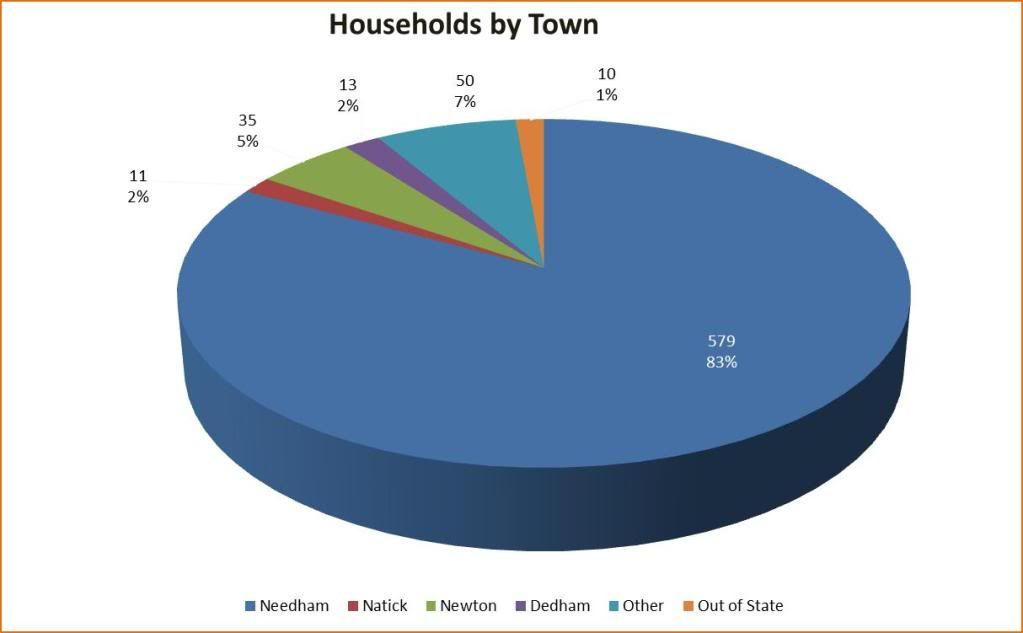
We celebrate the diversity of our community in all of its aspects. While our membership is certainly primarily based in Needham, (83% of our households), the remaining 17% of our households come from Natick, Newton, Dedham, Dover, and other neighboring communities, as well as from out-of -state.
We also have a diverse population by age (of oldest family member): 50% of our households have an oldest family member between 40 and 55 years old, 7% have an oldest family member in the 30 - 39 year old age range, and 43% have an oldest family member in the 55 years of age and older.
As a complete picture of our membership, we have grown from a congregation of 540 households eight years ago to one of over 700 households today. When we utilize comparative data from the Synagogue Council of Massachusetts, we sit in the category of synagogues with the largest number of members (500 and above) regardless of denomination (from the Union for Reform Judaism, URJ, we sit in the next-to-largest category of congregations, 500 to 1000 households).
We should be proud of how our congregation has grown in size while maintaining its warm and welcoming nature. We continue to celebrate our diversity in all of its aspects, from gender and sexual orientation to religious upbringing and ritual observance.
Our Sources of Financial Support:

Our TBS Vision reads: “Membership in our congregation and education for our children are accessible to all, regardless of financial circumstance.” It is our belief in this community that each household will contribute towards dues the amount they are able. Of the total amount of dues assessed in 2010-11, 84% were collected. The remainder of the dues was subsidized by the operating budget. This financial support is a fundamental lifeline for families who would not otherwise have sufficient resources to become or remain a part of our congregation. This fiscal reality also requires that we grow other income sources as we cannot simply forgo revenue and continue to provide excellent programming and services to our members.

The total amount of net dues accounts for 49% of the Temple’s annual operating budget. Our next largest income source stems from Teen Programs, Religious School, and Children’s Center tuitions, which amount, collectively, to 37% of all income. Additionally, we secure 4% of our annual operating income from fundraising (Taste of the Town, our Golf and Tennis Fundraiser, Elijah’s Table, High Holy Day Pledges, Fund donations), 1% from house rental, and 9% from all other sources combined (Scroll advertising, Membership Directory advertising, grant income, program fees, etc.).
Our Operating Expenses:

The largest portion of our operating expense is the 64% which funds salary for all of our staff, including clergy, professional and support staff (both full and part-time), as well as employee benefits. Building and Operations (which includes custodial services, building and outdoor maintenance, utilities, etc.) comprises 9% of operating expenses. Programming accounts for 7% of our annual operating expenses, whether fully funding or subsidizing costs for events such as our Scholar-in-Residence Weekend, Teen Programming, Oneg receptions following services, and Shabbat dinners. Other expense categories are organizational dues (a required cost in support of our parent URJ organization) at 6%, interest on our mortgage debt at 3%, contractors (consulting or contributing outside educators and musicians) at 2%, telecommunications (technology and phone costs) at 1%, and finally 8% of other miscellaneous expenses, including advertising, office supplies, printing, books, professional development, equipment, insurance and legal fees, among others.
Sustainability and Financial Implications:
In order for us to move forward as an organization, we need to not only benchmark where we are, but also to complete our analysis of what financial resources will be required to move us toward our TBS Vision, adopted last year. As our Strategic Planning work is underway, we have begun to review the information outlined above, and to create big picture assessments of the gaps between our existing structures and our vision for ourselves. So too we are actively determining strategies to help us to bridge our gaps.
To that end, we will continue to help congregants thoughtfully grow and refine their giving relationships with Temple Beth Shalom. As part of this effort, within the next months we will be unveiling a cyclical calendar of giving. These regular giving opportunities have been designed to afford people ample chance throughout the year to share their gifts and blessings. We share this calendar with you now so that you can best anticipate the ways and times at which you want to offer support:
- Summer membership renewal will include opportunities to give the gift of sustaining membership for those undergoing financial hardship.
- Celebrate the start of our school year in the fall by contributing to scholarship funds for our Education Programs through our Golf and Tennis Fundraiser.
- During the Days of Awe, our High Holy Day appeal will allow us to practice tzedakah… a most fitting way to start a new year together.
- At Chanukah, we will offer an opportunity to pledge to our scholarship endowment as we celebrate our teachers and educators who bring enlightenment to our students.
- At Pesach, we will revitalize Elijah’s Table to spiritually provide sustenance through Temple membership for those who hunger for, yet require assistance with, the associated costs.
- Finally we will spring forward into the hope of new visions for our youth funded by our Taste of the Town evening of fun and celebration, which help defray the operating costs for all our learning programs.
Invitation:
With this information in front of you, we invite you to offer feedback on this blog post that can then be utilized in our strategic planning assessment and goal-setting. As well, please mark your calendars to join us at the Annual Congregational Celebration on Wednesday, June 15th at 7:30 pm for a comprehensive Annual Report, an election of the slate of nominees for the Board of Trustees, a vote to approve our 2011-12 budget, and a celebration (with refreshments and music) of the year’s work. AND for the first time, this evening will include a ritual of welcome to our new temple leadership: we will be installing our new officers and trustees in the sanctuary at 8:45 pm. We look forward to seeing you there and we thank you for your ongoing partnership in building a sacred community of which we can all be proud, and within which we can all find our spiritual home.
Rabbi Todd Markley
Beth Pinals
Daniel Barkowitz

%2002%20Color.JPG.opt153x164o0,0s153x164.JPG)
