Showing posts with label Temple Beth Shalom. Show all posts

Wednesday, February 1, 2012

A SUPER Congregational Connection that will BOWL you over...


vs.


Making a SUPER Congregational Connection


Temple Beth Shalom of Needham, MA and Larchmont Temple of Larchmont, NY have made a very friendly Super Bowl ‘reverse wager’.


If the New England Patriots win the 2012 Super Bowl, Larchmont Temple agrees to display in its front foyer one (1) appropriately colorful sign that reads: “Mazel Tov (!! מזל טוב) to the New England Patriots and Temple Beth Shalom of Needham, MA on winning the 2012 Super Bowl!!” A digital photograph of this display will be sent to Rabbi Jay Perlman for publication in the “Scroll.” This display will remain in the foyer for one (1) week. 


Also, should the New England Patriots win, Temple Beth Shalom agrees to send Larchmont Temple (c/o Rabbi Jeff Sirkman) one (1) case (12 packs) of New England famous NECCO Wafers and 2 dozen chocolate chip cookies from the Chipyard in Quincy Market, Boston. 


As well, Rabbi Jay Perlman and Rabbi Todd Markley agree to wear New York Giants jerseys for a day while at Beth Shalom.


If the New York Giants win the 2012 Super Bowl, Temple Beth Shalom agrees to display in its atrium one (1) appropriately colorful sign that reads: “Mazel Tov (!! מזל טוב) to the New York Giants and Larchmont Temple of Larchmont, NY on winning the 2012 Super Bowl!!” A digital photograph of this display will be sent to Rabbi Jeffrey Sirkman for publication in the Larchmont Temple Bulletin. This display will remain in the foyer for one (1) week.


Also, should the NY Giants win, Larchmont Temple agrees to send Temple Beth Shalom (c/o Rabbi Jay Perlman and Rabbi Todd Markley) one (1) crate of GUSS’ Pickles and one (1) NY famous Junior’s Cheesecake.


As well, Rabbi Jeffrey Sirkman agrees to wear a New England Patriots jersey for a day while at Larchmont Temple.


This SUPER contract has been entered into under Temple Beth Shalom and Larchmont Temple rabbinic supervision – via e-mail - in the spirit of fun and friendship.


הכל שריר וקים


With much anticipation for a phenomenal Super Bowl, all of this is valid and binding.


Temple Beth Shalom

670 Highland Avenue

Needham, MA


Larchmont Temple

75 Larchmont Avenue

Larchmont, NY


Thursday, June 16, 2011

Needham 300 and Temple Beth Shalom 55

The Town of Needham is celebrating it's 300th birthday in 2011. Last Saturday night my wife Julie and I had the pleasure of attending Needham 300 Night at the Pops. Symphony Hall was full with 2500 Needhamites (and only Needhamites!) who had journeyed into Boston. As I sat in the balcony and looked at the many animated faces before the concert started, I noted the many Temple Beth Shalom members who were present.

Needham has been an exceptionally good home for Temple Beth Shalom for our 55 years in the town. We are blessed to have it as our congregational home. It is a good community of citizens who are actively involved in town government and other town activities. So too has our community been good for the Town of Needham. Our members populate the Board of Selectmen, Town Meeting and many, many community organizations.

As Needham celebrates its birthday this year, let's pause and reflect with gratitude on this long-standing and wonderful relationship that we share with our broader community.

Friday, June 10, 2011

In Preparation for the Annual Congregational Meeting: A Review of the Temple Finances

Ed. Note: This article appeared in this month's Scroll and is repeated here with color charts for ease of review. As we approach the upcoming congregational meeting on June 15th, we would like to ensure that every member of the congregation has an understanding of the Temple's financial position. This article invites your feedback and ideas. We also hope to see you on June 15th at 7:30 for our Congregational celebration.

Please click on any chart below to open a larger version for ease of viewing.

Dear Temple Beth Shalom Family

All year we write and talk with you about the sacred goings on in our building – about our innovative programming, as well as the exciting ventures of our transforming professional staff. While we are blessed with a rich and ever-growing community, we need always to ensure its sustainability and development.

Because all of our members are sacred partners in the building of our community, it is important that everyone understand clearly the fiscal realities which sustain us as we continue to grow and thrive. It is our intention that this article will become an annual tradition of June reports on the financial health of our congregation.

Our Composition:


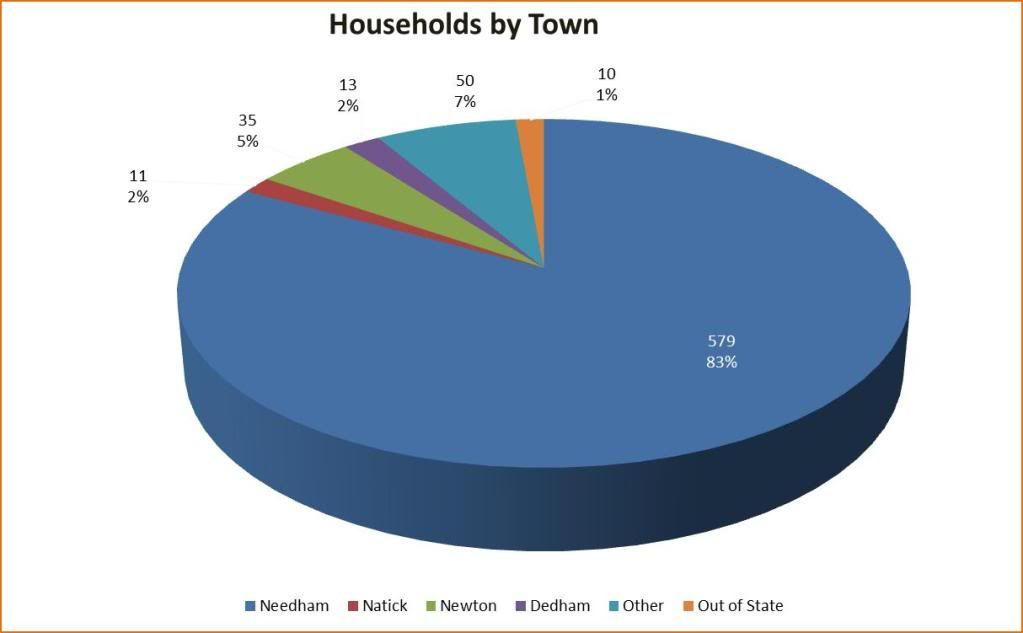
We celebrate the diversity of our community in all of its aspects. While our membership is certainly primarily based in Needham, (83% of our households), the remaining 17% of our households come from Natick, Newton, Dedham, Dover, and other neighboring communities, as well as from out-of -state.

We also have a diverse population by age (of oldest family member): 50% of our households have an oldest family member between 40 and 55 years old, 7% have an oldest family member in the 30 - 39 year old age range, and 43% have an oldest family member in the 55 years of age and older.

As a complete picture of our membership, we have grown from a congregation of 540 households eight years ago to one of over 700 households today. When we utilize comparative data from the Synagogue Council of Massachusetts, we sit in the category of synagogues with the largest number of members (500 and above) regardless of denomination (from the Union for Reform Judaism, URJ, we sit in the next-to-largest category of congregations, 500 to 1000 households).

We should be proud of how our congregation has grown in size while maintaining its warm and welcoming nature. We continue to celebrate our diversity in all of its aspects, from gender and sexual orientation to religious upbringing and ritual observance.

Our Sources of Financial Support:


Our TBS Vision reads: “Membership in our congregation and education for our children are accessible to all, regardless of financial circumstance.” It is our belief in this community that each household will contribute towards dues the amount they are able. Of the total amount of dues assessed in 2010-11, 84% were collected. The remainder of the dues was subsidized by the operating budget. This financial support is a fundamental lifeline for families who would not otherwise have sufficient resources to become or remain a part of our congregation. This fiscal reality also requires that we grow other income sources as we cannot simply forgo revenue and continue to provide excellent programming and services to our members.


The total amount of net dues accounts for 49% of the Temple’s annual operating budget. Our next largest income source stems from Teen Programs, Religious School, and Children’s Center tuitions, which amount, collectively, to 37% of all income. Additionally, we secure 4% of our annual operating income from fundraising (Taste of the Town, our Golf and Tennis Fundraiser, Elijah’s Table, High Holy Day Pledges, Fund donations), 1% from house rental, and 9% from all other sources combined (Scroll advertising, Membership Directory advertising, grant income, program fees, etc.).

Our Operating Expenses:


The largest portion of our operating expense is the 64% which funds salary for all of our staff, including clergy, professional and support staff (both full and part-time), as well as employee benefits. Building and Operations (which includes custodial services, building and outdoor maintenance, utilities, etc.) comprises 9% of operating expenses. Programming accounts for 7% of our annual operating expenses, whether fully funding or subsidizing costs for events such as our Scholar-in-Residence Weekend, Teen Programming, Oneg receptions following services, and Shabbat dinners. Other expense categories are organizational dues (a required cost in support of our parent URJ organization) at 6%, interest on our mortgage debt at 3%, contractors (consulting or contributing outside educators and musicians) at 2%, telecommunications (technology and phone costs) at 1%, and finally 8% of other miscellaneous expenses, including advertising, office supplies, printing, books, professional development, equipment, insurance and legal fees, among others.

Sustainability and Financial Implications:

In order for us to move forward as an organization, we need to not only benchmark where we are, but also to complete our analysis of what financial resources will be required to move us toward our TBS Vision, adopted last year. As our Strategic Planning work is underway, we have begun to review the information outlined above, and to create big picture assessments of the gaps between our existing structures and our vision for ourselves. So too we are actively determining strategies to help us to bridge our gaps.

To that end, we will continue to help congregants thoughtfully grow and refine their giving relationships with Temple Beth Shalom. As part of this effort, within the next months we will be unveiling a cyclical calendar of giving. These regular giving opportunities have been designed to afford people ample chance throughout the year to share their gifts and blessings. We share this calendar with you now so that you can best anticipate the ways and times at which you want to offer support:
  • Summer membership renewal will include opportunities to give the gift of sustaining membership for those undergoing financial hardship.

  • Celebrate the start of our school year in the fall by contributing to scholarship funds for our Education Programs through our Golf and Tennis Fundraiser.

  • During the Days of Awe, our High Holy Day appeal will allow us to practice tzedakah… a most fitting way to start a new year together.

  • At Chanukah, we will offer an opportunity to pledge to our scholarship endowment as we celebrate our teachers and educators who bring enlightenment to our students.

  • At Pesach, we will revitalize Elijah’s Table to spiritually provide sustenance through Temple membership for those who hunger for, yet require assistance with, the associated costs.

  • Finally we will spring forward into the hope of new visions for our youth funded by our Taste of the Town evening of fun and celebration, which help defray the operating costs for all our learning programs.


Invitation:

With this information in front of you, we invite you to offer feedback on this blog post that can then be utilized in our strategic planning assessment and goal-setting. As well, please mark your calendars to join us at the Annual Congregational Celebration on Wednesday, June 15th at 7:30 pm for a comprehensive Annual Report, an election of the slate of nominees for the Board of Trustees, a vote to approve our 2011-12 budget, and a celebration (with refreshments and music) of the year’s work. AND for the first time, this evening will include a ritual of welcome to our new temple leadership: we will be installing our new officers and trustees in the sanctuary at 8:45 pm. We look forward to seeing you there and we thank you for your ongoing partnership in building a sacred community of which we can all be proud, and within which we can all find our spiritual home.

Rabbi Todd Markley
Beth Pinals
Daniel Barkowitz

Thursday, June 9, 2011

Ben Grebber's Sinai Statement: Celebrating Confirmation and the Ten Commandments

Ed. Note: This past Tuesday night, our Confirmands shared their "Sinai Statements" with those of us who attended their Erev Shavuot service of Confirmation. Over the next several weeks, we will be sharing many of their statements. At the service, all 15 of the Confirmands read from the book of Exodus. The Torah scroll from which they read has special meaning. Read on to learn why.

When God passed the Torah down from Mount Sinai, it was given to Moses to share with the Jewish people. They, in turn, were now responsible to learn it, teach it, and pass it down through the generations. This created the strong heritage that we share today. After having a very special guest stay at our home, I now understand that heritage and what the Torah means to our people and to me.

During the Temple renovation some years back, my family kept a Torah from our sanctuary in our house for several months. We kept it free from dust and potential harm. We were a surrogate ark! At first, having the Torah in our house was cool but I was somewhat indifferent to it.

As the months went by, our new “house guest”, the Torah, took on a different meaning to me. The Torah became a member of our family as odd as that sounds. I passed it every day on my way to the kitchen. I checked on it to make sure that it was covered and protected.

The Torah was always a talking point when we had Jewish guests at the house. I realized that to a Jewish person, the Torah is immediately identifiable and even the least observant person seems to revere it as being something special, almost royal. I began to see the Torah as representing something greater than just a borrowed “thing” from our Temple.

After a few months of “Torah babysitting”, the Temple renovations were complete and the Torah had to be returned to its rightful place. My family was devastated. The Torah had become a part of our family, and it was sad to see it go.

The following Hanukah though, we were surprised yet again when my parents gave us a Torah of our own. Now we truly had a family Torah.

Once we put our new Torah in the infamous family room Torah Ark, I learned more about our Torah. I came to understand the Torah’s age, how fragile it is, and that it holds the Five Books of Moses. In my Holocaust class, I learned that many Torahs were destroyed by the Nazis and that some were actually secretly carried by my ancestors to America from places far away. For many of my ancestors, getting the Torah to a new and safe land was just as important as getting their families there. This was similar to the story of our Torah which came from Poland during the Holocaust.

Having our special Family Torah, I began to understand that when God instructed Moses to give the Torah to the Jewish people to pass its lessons and teachings down to future generations, God was instructing me to do the same. So I started asking questions about what stories the Torah contains. I took a greater interest in its teachings. Is this how the Jewish people felt at Mt. Sinai? Was it just an object given to them by Moses or did they see it as something more? Did they know that it would link future generations of Jews to them?

Even more important, over those months that the Temple’s Torah was in our house followed by the arrival of our Family Torah, I began to understand how the Torah links me to past generations. My Jewish ancestors learned the stories and teachings contained in the Torah just as I have throughout my religious school education. Through the strength and perseverance of the Jewish people, even in times of great hardship and war, the Torah is here today for me. I am a link in that chain of possession. My great-grandparents read from a Torah in Russia; my grandparents read from the Torah in America. My parents read from the Torah too – my father right here in this sanctuary. The Torah allows me to share that link in our heritage with all of them. It’s what binds us all together as Jews and as one family.

Just as Moses did on Mt. Sinai, we, too, will pass our family Torah from generation to generation. Like the Jewish people in Poland who read from our Torah years ago, I read from our sacred Torah when I became a Bar Mitzvah. My sister followed me by reading from it when she became Bat Mitzvah and my brother will follow our footsteps when he becomes a Bar Mitzvah. Like Moses, we will pass our family Torah from generation to generation, sharing the stories that go along with it, linking our future family generations with our current generation today. This is what keeps our history so strong. That is what identifies us as Jews and makes me who I am. I am proud that my Confirmation classmates and I will read from this sacred scroll tonight as we affirm our connections to Torah, to Temple Beth Shalom, and to one another.

--Ben Grebber

Friday, June 3, 2011

The Seventh Commandment: A Personal Reflection by Daniel Barkowitz

The image to the left comes from the web page for Jewish Marriage Encounter in Israel.

Ed. Note: This post, by Daniel Barkowitz, continues our series on the Ten Commandments. Credit is due to About.com's post for quotes about the Jewish Marriage Encounter philosophy of "Love is a Decision". For information on Jewish Marriage Encounter visit their web page.


Just as Faith is a decision, I believe that Love is a decision.

I remember sitting next to my wife, Rebekah, in (what was then) the Newton Sheraton Tara hotel, hanging over the Mass Pike. We were there for a Jewish Marriage Encounter Weekend, an event which promised to teach us how to better communicate with each other as a couple. We were still young in our marriage, what we referred to then as DINKS (Dual Income, No Kids) and we were excited to see what we could gain from a weekend focused on just our relationship with each other.

One of the more controversial statements made that weekend by one of the presenters is that "Love is a Decision." It was a statement that reminds couples to love the person, not the behavior.

Many people do not see why a person would have to make the decision to love since they made that decision many years ago when they said yes to one another on their wedding day. We were taught on the weekend that it is normal in married life to have periods of romance and disillusionment. This cycle is often repeated – sometimes over days, weeks, even months.

One way to break out of disillusionment is by deciding to love. Feelings change and aren't not easily controlled. Love is not only a feeling, it is more than a feeling. Love is a decision.

By saying that “Love is a decision”, I mean that I am committing myself to be open and to share when I don’t feel like it. By saying that “Love is a decision”, I am promising to make the decision to love even when I don't think my spouse deserves my love.

Saying that “Love is a decision” means that you are open to honest communication with your spouse. That's not only talking, but also listening. It is also a decision to be loved.

Making the decision to love includes the everyday, little things that you often do for one another, especially when you’re not feeling loving. From the action of deciding to love, often the feeling of love will follow.

This resonates in our Jewish tradition as well. Often the decision to do a good deed and the commitment to the mitzvot only happens after the mitzvah itself is completed. We are taught to pray with intention, but that the act of prayer itself will lead to the development of the intentionality of prayer.

--Daniel T. Barkowitz

Thursday, June 2, 2011

The Six Commandment: A Personal Reflection by Liv Nash

Image credit - Flickr user ANVRecife. Image title is "Killing Ideas II".

Ed. Note: What follows is our sixth blog post as a part of the 10 commandment series. We are counting up to Shavuot by sharing personal reflections from congregants on each one of the 10 commandments. Today's reflection comes from Liv Nash and gives an interesting and new view of the commandment not to murder. Please join our conversation by adding your thoughts and opinions to this or any post. What do you think of Liv's take on the commandment? What do you take from her point of view?


My interpretation of the 6th Commandment relies on a non-legal one. As noted in Broken Tablets, Rabbi Avraham Yitzhak Bloch of Telshe also suggests “that a concept of murder more subtle and comprehensive than standard legal definitions is intended.”

I look at the 6th Commandment as a direction to not suppress one’s beliefs, regardless of how they may or may not deviate from what the majority of people may or may not believe. As someone who grew up in a secular household, I didn’t think about religion or spirituality. I knew that I was Jewish and that we celebrated Passover and Hanukah, but I didn’t quite get what being Jewish meant. I know that I thought of it more as a religion than an act of being, which is how I interpret my Judaism today.

As my involvement in Temple Beth Shalom began to grow, I had conflicted feelings about my beliefs – did I believe in G-d or did I feel a connection to the spiritual aspects of Judaism that are so often discussed in our meetings. Even as I attended my adult B’nei Mitzvah classes, leading up to my becoming a Bat Mitzvah here at TBS, I almost felt a need to ignore my feelings toward the religious aspect of what I was doing as I felt very conflicted: again, did I believe in G-d or not and how was I going through this monumental step in my life without knowing. I was suppressing the need to “come clean” with my own interpretation of being a Jew.

Fortunately for me, the TBS community, its leaders and in particular the clergy, have made me realize that all that I was feeling and am still today, is OK. There isn’t a need to put aside the fact that my beliefs may not be consistent with so many. They are my beliefs and I shall not “murder” them.

--Liv Nash

Wednesday, June 1, 2011

The Fifth Commandment: A Personal Reflection by Bernice Sue Behar

The image we are using today comes from letlifein.com, a website "directed to the ‘after 50′ audience [where] the writers and editors ... don’t sugar-coat the 50+ years but reveal what boomers today, as individuals, are thinking, exploring and experiencing."

Ed. Note: Today's post comes from Bernice Sue Behar and speaks to the Fifth Commandment. Halfway through the series, we would like to ask for your feedback! Are you enjoying the series? What are you finding best about these posts? What would you like to see more or less of in future posts?


When I saw the note asking each of us to say a few words of reflection about one of the Ten Commandments, I didn’t hesitate about which I would choose. The words “thou shalt honor thy mother and thy father” are part of the conversation I have with myself every day.

I decided that the essence of this commandment relates to vulnerability. We usually interpret “honor” as somehow synonymous with respect, but I don’t think that respect can be commanded. Instead, I think that to show honor in a way that matters really means to attend to the needs of our parents as they become older and more vulnerable. As our parents age, they begin to lose capabilities, their life long companions, and often, their dignity. As Jews, we know that it is incumbent upon us to take care of those who are in need and I believe that honoring our parents falls into the same framework. As their children, we are ultimately the ones who are responsible for helping our parents and for bringing them comfort and the reassurance of love.

-Bernice Sue Behar

Sunday, May 29, 2011

A Shabbat Speech on the NFTY-EIE Semester in Israel

Ed. Note: We are taking a quick break from our Ten Commandments posts to share the following post. This was presented at Friday night services this week by Temple member Mikah Atkind who spent her fall semester on the EIE Program in Israel. More information about the program can be found at http://www.nftyeie.org/. Two additional temple members, Molly Shuman and Tzipi Crandell, have been accepted to the EIE program for Fall 2011.

Shabbat shalom!

On the 9th of Av, 586 BCE, the first Beit Hamikdash, also known as the first temple, was destroyed. Subsequently, the Jewish people were exiled to Babylon. Exactly 656 years later, the second Beit Hamikdash was destroyed. 65 years after that, Beit Har was destroyed. This was the last village standing, and the last one to be destroyed, during the Bar Kochva Revolt. In 1492, the Jews were expelled from Spain. In Tach-Tat, or 1648-1649, the Chmelnitsky Massacre took place in Russia. In 1881, the first wave of pogroms against the Jews in Russia led to the first Aliyah to what is now the State of Israel. In 1939-1945, as many people know, was the Shoah, or the Holocaust, in which 6 million Jews were murdered by the Nazis. On Hay B’Iyar, Tashach, or May 14, 1948, the state of Israel was created. These events, both tragedies and what subsequently seem like miracles have shaped the Jewish people since our beginning, about 4,000 years ago in the time of Avraham, Yitzhak, Ya’akov, Sarah, Rivka, Rachel, v’Leah.

This past fall, I spent four months on the NFTY-EIE High School in Israel. Run by NFTY, the youth organization of the URJ, this program allows Jewish high school students from all over North America the opportunity to travel and study in Israel. Going into the program, I expected that I would be with a bunch of your typical NFTY kids, like myself. For those of you who have never been a NFTY kid, this involves singing Jewish songs until you lose your voice, being super overenthusiastic about NFTY, and hugging. A lot. However, when I arrived at the airport, I realized that this was not the case at all. While there were some of those stereotypical NFTY kids, we had an extremely diverse group. Roey spent the first three years of his life living in Tel Aviv, Noah goes to a conservative Jewish day school, and knows pretty much everything you could ever want to know about Torah, and Madeleine’s from Texas…and talks like Miley Cyrus. We had 21 guys and 24 girls; six sophomores, 33 juniors, and six seniors; two Canadians, two Eisnerites, and two from Massachusetts.

Every day, we were responsible for waking each other up and getting to Hebrew by 8:30, where we would learn for almost two hours. After a short break, we had Jewish History for three hours. After our Jewish studies were over, we had lunch, and then all of our general studies classes, such as math, history, English, etc. We had school from 8:30 AM until 7 PM, yet no one seemed to mind. After our last period, we went to dinner, then had Hoda’ot, or announcements. Only then could we start our homework, or if we finished, socialize. However, normal days such as these weren’t common. Many times, we would go on Tiyulim, or field trips, for Jewish history, which could last for as little as a couple of hours, or as many as 8 days, such as our trip to Poland in which we visited Auschwitz, Birkenau, Majdanek, and other death camps and important sites in the context of the Shoah, and tried to absorb in the emotions and impact of the Holocaust. In addition to our Jewish History-based tiyulim, we spent six days hiking from the northeastern side of Israel to the Mediterranean sea, and spent five days at the S’dei Boker army base near Beersheva, in an intensive high school Israeli army program called Gadna.

We began friendships with Israeli teens, both those who were living on Kibbutz Tzuba with us, and others in a small private high school called the Havruta School, near Netanya. We became actively involved in Israeli politics, creating a mock campaign and election for some of the main political parties, including Likud, Shas, and Avodah. We bargained for dried fruit, nuts, rugalach, and other treats at the Shuk in Jerusalem, trying to practice our Hebrew, while the vendors only wanted to practice their English. We bought ice cafes and mozzarella sandwiches at Aroma, invested in the Israeli economy at TNT and other stores at the Malcha Mall, and even went to a teen club until 4 in the morning with our Israeli host families…even though we weren’t supposed to be out past midnight. Seven of my friends and I even got to attend a conference of the Jewish People Policy Institute, for which our English teacher works, and sit two rows behind BB Netanyahu and Natan Sharansky, and listen to both of them speak on the topic of Judaism within Israel and around the world. Of course, we visited many of the tourist attractions as well, in connection with our Jewish History curriculum. We hiked up to the top of Massada to learn about the mass-suicide of the Zealots while trying to defend themselves from the Romans; we visited Tel Aviv to learn about the formation of the city, and their combination of old and new; we visited Sataf to learn about ancient agriculture and the cycle of the Judges and the Kings.

So why did I go in the first place? Well, first we need to think of the reasons behind why one would go. There were 45 of us on the EIE Fall 2010 Semester. In Hebrew gematria, 45 is מ -- מה is equal to 40, and ה is 5. Together, these letters spell mah: what? What is the significance of our past? What is the importance of Israel? What are we as a people? What should we strive to be? What can we gain out of this experience? What were we doing this for? Well, switch the מ and the ה, and you end up with המ—them. While we may have gotten amazing friendships, incredible amounts of knowledge, and an unbelievable four months of adventures, stories, and experiences out of this program, in the long run, we weren’t doing it for ourselves. We were doing it for them: those of the past, and those of the future. We went to keep the covenant between Abraham and G-d, as G-d mentioned in Genesis chapter 17, verse 7: “And I will establish my covenant between me and thee and thy seed after thee throughout their generations for an everlasting covenant, to be a G-d unto thee and to thy seed after thee.” We went to preserve Jewish values, customs, traditions, and stories, as well as the Jewish homeland for future generations. We went to keep Judaism alive in our home here in the Galut—the diaspora—and in Eretz Yisrael.

תודה רבה ושבת שלום

The Second Commandment: A Personal Reflection by Daniel Barkowitz

The image to the left comes from youmademesayit.com. The image was chosen for its reference to the position of covering the eyes before saying the Shema, and also for its reference to the duality of faith - being willing to close your eyes and trust even while the world argues to keep your eyes open.

Ed. Note: This is the second in a series of ten posts in the days leading up to Shavuot. Each post explores one of the ten commandments. Today's post is written by TBS Executive Director, Daniel Barkowitz. Please feel free to add your response to this post to the comments section below. How do you experience faith and doubt? What does the second commandment mean to you? How do you interpret the commandment to have no other g-ds before G-d?


Have no other G-d before me.


I believe that faith is a Decision.

Making the decision to believe in G-d when the world argues against such faith and commitment is itself a decision. If I make the decision to have faith, even in moments where having faith is hard, then the decision to have faith will bring me the intention I need to follow through.

Faith is a decision to live your life in such a way as to find meaning in it beyond the material things that the world says you must possess. It is a decision to believe that there is more to life than meets the eye, and that life extends even beyond death. It is a decision to be able to have a rock to hold onto even when all around you is chaos, even when people declare in the streets that all is hopeless, and that all is lost.

Faith is a decision means knowing that not all questions have to have answers, and that sometimes the answers will come without their corresponding questions. Making the decision to have faith does NOT mean removing all doubt; in fact by making the decision to have faith I embrace the doubt I feel as a genuine part of my spiritual self.

G-d demands that we have no other g-d before YHVH. I respond that making the decision to have faith means that I place my trust in that Miraculous Power.

-Daniel T. Barkowitz

Saturday, May 28, 2011

The First Commandment: A Personal Perspective by Rob Spiegel

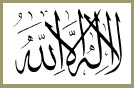
The image to the left is artistic rendering of the Arabic translation of the First Commandment.

Ed. Note: This is the first post in a series of ten which will be presented as a "count-up" to Shavuot. The text comes from TBS congregant Rob Spiegel who presented these words at a special congregational meeting celebrating the passage of our new By-Laws. Please join the conversation by adding your personal reflection of the 1st Commandment as a comment to this post. What does the 1st commandment mean today? Given the recent changes in Egypt, what does it mean to remember that we were "brought out of the land"? Where do you feel most at home?

I, Adonai your God, (am the one) who brought you out of the land of Egypt, from a slave house.


In performing this text study, we are looking forward to Shavout and the adoption of new bylaws for TBS. But, for a moment, allow me to look back to Pesach and ask how is this Commandment different from the other commandments. Are we being told by God to do something or refrain from doing something? Or, are we being told to believe? Is it possible for God to command belief?

Commentators differ, and we could discuss this point for hours, not the couple of minutes I have now. But, as we are reminded at Pesach, we were each individually and together as a community brought by God out of Egypt, out of a slave house. Consider the drama of the situation of the people actually there at the time. Having been slaves and having seen the plagues, hastily prepared to leave Egypt, crossing the sea into the desert, and watching Moses bring the tablets from Sinai, this commandment served to inform them, and continues to remind each of us and our community as a whole, who is responsible for freedom and who therefore has the authority to give the law.

When I was in college, I spent a semester abroad in Israel. Like so many, being in Israel was a deeply meaningful experience and I felt more connected to the Jewish people. During that semester I did a week-long side trip to Egypt. My feeling of connection to our people was even greater when I returned to Israel. When I returned, I felt at home, maybe more a part of our people than ever before or since in my life.

We here continue to be part of this community, and here at TBS we are a community within a larger Jewish Community. In accepting the nomination to serve on the Board of Trustees, I hope to continue to work to build community within the TBS community/communities.

-Rob Spiegel

Friday, May 27, 2011

The Ten Commandments and Shavuot: An Introductory Post by Rabbi Todd Markley

The image to the left is one of artist Keith Haring's version of the 10 Commandments. Comment with a link to your images of one or more of the 10 commandments for possible inclusion in a future entry.

Ed. Note: For the next 10 days as we approach the holy day of Shavuot, we will be sharing personal reflections from several members of the congregation on each of the 10 commandments. The congregants who will be sharing their words in the next 10 days are members of our nominated slate for the Board of Trustees for the 2011-2012 year. Each member was invited to share their D'Var Torah at our historic congregational meeting in which we passed the new TBS By-Laws.

We invite you to participate in this dialogue by offering your personal reflections on each of the commandments.


Dear Temple Family,

In just eleven short days, Shavuot, the second of the major "pilgrimage festivals" (those holidays when all of the people would flock to Jerusalem in ancient days), will be upon us. This cycle begins with Passover, the time of our people's going out from slavery and bondage in Egypt. Shavuot, celebrated seven weeks later, commemorates the next phase of our people's journey...the moment of God's revelation to the Israelites at Mount Sinai. In the fall, we will mark the third of these pilgrimage festivals, Sukkot, a season which invites us to leave the comfort of our homes and to live in temporary booths as our ancestors did on their travels from Mount Sinai to the Promised Land.

At Temple Beth Shalom, we mark this major milestone moment in the Jewish calendar by celebrating our Confirmation students on the eve of Shavuot, as they affirm their commitment to Torah, Jewish learning, and engagement with our community. In that way, they are, in fact, reliving that moment at Sinai when Torah was shared with our entire people, and we are so excited to hear them offer words of prayer, Torah, and song with us as we celebrate this festival. Please do join us for our Erev Shavuot Confirmation service on Tuesday, June 7th at 7:30 PM. This is the perfect way to mark this holiday season and to rejoice in the accomplishments of our extraordinary teens. If you are not able to be with us that night, do join us for our Shavuot morning minyan service at 7:00 AM on Wednesday, June 8th - our Yizkor service of remembrance will be read.

In his Guide for the Perplexed, the great Jewish teacher and scholar, Moses Maimonides reflected on the meaning of celebrating the giving of the commandments in the wilderness:

Shavuot is the anniversary of the revelation on Mount Sinai. In order to raise the importance of this day, we count the days that pass since the preceding festival, just as one who expects his most intimate friend on a certain day counts the days and even the hours. This is the reason why we count the days that pass since [Passover,] between the anniversary of our departure from Egypt and the anniversary of the giving of the law. The latter was the aim and object of the exodus from Egypt.


As the memories of family seder tables fade into the recesses of our minds, let us recall that the aim of the freedom we celebrated in April was the ability to live lives of sacred meaning and purpose, grounded in covenant with our people. We were freed so that we might be be bound not to taskmaster but rather to one another in shared practice, ritual, and pursuits as a group of people charged with bringing a little extra light to our world. May this Shabbat ahead, and the upcoming season of Shavuot, prove to be opportunities to do just that.

Michele, Mia, and Adam join me in wishing you a Memorial Day weekend filled with reverence for those whose memories we call to mind during these days, and a Shabbat that is set apart for its relaxation, its comfort, and its warmth.

Shabbat Shalom!

Todd

Sunday, May 1, 2011

A Relay For Life Testimonial


In May 2004, my family and I took part in our very first Relay For Life of Needham, Dedham and Wellesley. Temple Beth Shalom had invited congregants to participate in this important community event, and I felt it would be a wonderful opportunity for my family to honor my mother, who was undergoing cancer treatment at the time, and to support others who were fighting the disease.

Having never attended a Relay, I was overwhelmed by the emotional impact of the experience. Watching my mom walk around the track during the ‘Survivor’s Lap’ was truly moving and inspirational. At dusk, along with other participants, we lit ‘luminarias,” paper sacks filled with sand and candles that stretched around the walking track. I remember getting the chills as I stood looking at the hundreds of luminarias, each one representing someone who had been lost to cancer, who was fighting the disease or who had survived the illness. I thought about the courageous five-year battle that my mother had been waging against cancer and felt grateful to be there with her, sharing in a very special event with our family, our temple and the local community.

The following year my family and I participated in the Relay again, only then we were walking in memory of my mother, who had lost her valiant fight against cancer. More than ever, I truly understood the devastation that cancer can cause, not only to those who battle this horrible disease but also to their loved ones.

In 2008, I joined the Relay For Life Planning Committee to honor my mother, to take a more active role in the fight against cancer and to inspire others to do the same. Unbelievably, that same year, my friend Adam May was diagnosed with prostate cancer and began intensive treatment. Adam and I formed our first Relay team that winter, and it was a life-changing experience for us both. With other friends, we proudly raised nearly $35,000 for the programs and services of the American Cancer Society. And at the Relay, we found healing, comfort and support from others who have faced cancer or who have lost a loved one to the disease. We’ve stayed actively involved in the Relay ever since.

This year, Adam and I wanted to share our passion for Relay with TBS in the hope of involving even more members of our community in this sacred effort. As Rabbi Markley explained in a Shabbat Shalom email a few months ago, “Our Rabbis reminded us of why our involvement in causes like this one is so very important:

For this reason Adam, the first human being, was created as a single person, to teach you that anyone who destroys one soul is described in Scripture as if he destroyed an entire world, and anyone who sustains one soul is described as if he sustained an entire world… (Mishnah Sanhedrin 4:5)

Our efforts at this year’s Relay may, indeed, make possible the research, the learning, the wisdom, and the understanding that will save not just one, but hundreds and thousands of worlds in the years ahead.”

This year’s Relay will take place on May 14–15 at the Newman Elementary School in Needham. We invite you to register to join the TBS and Friends team, or if you prefer, to support us with a donation or the purchase of a luminaria. To do so, please visit www.bit.ly/TBSRelay.

Also, plan now to join us and other Relay participants for a special Havdallah service at on Saturday, May 14 at 8 pm, which will be led by Rabbi Markley. We’ll be meeting near the Newman tennis courts, on the side near the track.

For more details about the Relay For Life, please visit the TBS website at http://www.tbsneedham.org/social_action/social_action.php?page=15289.

I hope you'll join Adam, me, Rabbi Markley and other temple members and friends at the Relay on May 14.

-Sabra Sherry