This post originally appeared on the TBS Children's Center Blog on October 29, 2013
Adam was so excited to share with Kohavim, that his dad, Rabbi Todd, was getting a really big award! He wasn't sure if his dad would be getting a trophy when he accepted his prize, so he decided he would make one for him. He looked through the art closets and selected different materials. He chose blue foam shapes, a bag of marker caps, a green Jewish star, and gold plastic caps. Joshua and Josie asked to help him construct the trophy. Adam shared his plan with them and they got to work. They first glued the gold plastic caps together in a stack. Then Adam wrote, "I love you" on one side of the star and Joshua wrote, "Good Job" on the other side. They attached purple marker caps to the top of the trophy because Adam explained his dad really loves the color purple. They then secured the star at the top. Lastly, they glued the pieces of blue foam together to create a base. Adam and the children in kohavim were so proud to make a trophy to celebrate Adam's Dad!
Rabbi Todd was selected by the Covenant Foundation as one of four honorees from across the country to receive the prestigious Pomegranate Prize, which recognizes outstanding emerging Jewish educators. Click here to read more about this amazing accomplishment! Mazel Tov Rabbi Todd!
Showing posts with label Rabbi Todd Markley. Show all posts
Thursday, October 31, 2013
A Trophy for Dad!
Labels:
Dad,
Pomegranate Prize,
Rabbi Todd Markley
Tuesday, October 1, 2013
Rabbi Todd: Taking Responsibility Beyond Our Own
![]() |
| Rabbi Todd Markley |
I am standing in the kitchen of our home cleaning the dishes just following meal time when the yelling begins from the other room. They were playing together so nicely just five seconds ago…what on earth happened? Here come the 4 and 7-year old. They’re pointing at one another. Each is a prosecutor with case prepared about why it – whatever it was…I may never know – was entirely the other one’s fault.
And so it is at the outset of the Torah. As we begin our annual Torah reading cycle anew on this Shabbat we find two stories that bespeak the childlike state of humanity just following the stories of Creation. First, Adam and Eve eat the fruit of the Tree of Knowledge, and then ashamed, try to hide from God.
Side note: This was a rookie parenting move on God’s part…you can have anything you want in all of the Garden, just don’t touch the fruit on this tree? Come on! Any parent knows that this is the tree they’re running for first!
Seemingly not yet self-reflective enough to recognize this, God asks Adam from on high, “Ayeka…Where are you?” Of course, the Divine Being who just made Creation happen knows where these two are…the question is a spiritual and psychological one. One I might ask of my own children from my stance at the kitchen sink…Who are you? Is this really how you want to behave? What did you do?!? How do Adam and Eve respond? Adam blames Eve. Eve blames the snake. Their children are, fittingly perhaps, fruit that does not fall far from the proverbial tree.
Their sons Cain and Abel each offer up their own sacrifices to God, and in yet another highly questionable parenting moment in God’s earliest days at this, God very publicly favors one child’s gift over the other’s. The result? Cain kills Abel out of jealousy and when confronted asks, “Am I my brother’s keeper?”
Rabbi Jonathan Sacks points out that there is a commonality between these two narratives: an unwillingness to take personal responsibility for one’s own actions. In the case of Adam and Eve, they were wrapped up in the blame game…it wasn’t me! In the case of Cain, he couldn’t fathom the possibility that he was responsible for anyone’s wellbeing beyond his own. Humanity has come a long way, and yet, sadly perhaps, we still know these behaviors all too well…in our children, in our co-workers, in our friends and neighbors, and in ourselves.
We can sometimes fall prey to our earliest forebears’ lines of thinking, not just as individuals but as communities. We experience what psychologists call “In group, Out Group” effect. We assume that our own cultural, ethnic, religious, geographic, or communal group must be better than the others. Sometimes this moves us to do good. As our Sages taught, Kol Yisrael Aravim Zeh b’Zeh…all the people of Israel areresponsible for one another, and this teaching has yielded countless examples of Jewstaking care of one another, insuring one another’s safety, well being, and peace.
On the other hand, whenever we begin dividing the world up into groups we run the risk of becoming Adam and Eve…blaming the other groups for our problems, or worse yet, of becoming Cain…not being able to imagine that we are actually responsible for the well being of others beyond our own group. Of course, throughout our history from Torah through the present day, great Jewish thinkers have sought to remind us that our people is no better than any other and that we have a unique responsibility to be a light to the entire world, not just to ourselves. Yet, we have not always been able to live up to this sacred task.
Recently, we were blessed to have a great model of such explicit and thoughtful reaching beyond faith boundaries in none other the new leader of the Catholic Church, Pope Francis. I have been loving much of what this Pope has shared so far, and his stock only rose with me when, earlier this week, I attended a meeting of our Needham Clergy Association. Muslim representative to the group, Abdul Cader Asmal, shared aloud this letter which Pope Francis wrote to the Muslim communities of the world to mark the end of their festival of Ramadan.
He wrote, “This year, the theme on which I would like to reflect with you and with all who will read this message is one that concerns both Muslims and Christians: Promoting Mutual Respect through Education.
“Respect” means an attitude of kindness towards people for whom we have consideration and esteem. “Mutual” means that this is not a one-way process, but something shared by both sides.
What we are called to respect in each person is first of all his life, his physical integrity, his dignity and the rights deriving from that dignity, his reputation, his property, his ethnic and cultural identity, his ideas and his political choices. We are therefore called to think, speak and write respectfully of the other, not only in his presence, but always and everywhere, avoiding unfair criticism or defamation. Families, schools, religious teaching and all forms of media have a role to play in achieving this goal.
…We are called to respect the religion of the other, its teachings, its symbols, its values.
…We have to bring up our young people to think and speak respectfully of other religions and their followers, and to avoid ridiculing or denigrating their convictions and practices.
We all know that mutual respect is fundamental in any human relationship, especially among people who profess religious belief. In this way,” concludes Pope Francis, “sincere and lasting friendship can grow.”*
Wow! Until only fifty years ago, the Catholic church embraced a supercetionist philosophy, meaning that – according to official church doctrine – the covenant between Catholics with God was superior to, and even came to replace, those of any other people in the world. Now the leader of that faith tradition is actively seeking to bridge those divides, not only for our generations, but for the children who will grow to represent our faith communities. Wouldn’t it be wonderful if his invitation was received by open hearts and open minds within the Muslim world? By his own followers in the Catholic church and their sister Christian denominations. Would it be incredible if we, as Jewish communities, could engage in this effort as well?
We are in the season of beginning our Torah anew with our stories of Creation…reminders that, according to our faith tradition, all of humanity is one large family which began with just a single person…the culmination of a Creation process which began with light. May this new year’s Torah cycle see us follow the Pope’s lead…recommitting ourselves not only to service of our own people but to knowledge of, understanding of, and service of the whole…reminding ourselves not only of our stories but those of our sister faith communities as well…taking responsibility not only for the physical, emotional, and spiritual well being of our own people but for all peoples. In so doing we can be more enlightened and can, individually and collectively, be a light to the world. Amen.
* (MESSAGE OF POPE FRANCIS TO MUSLIMS THROUGHOUT THE WORLD FOR THE END OF RAMADAN ('ID AL-FITR): http://www.vatican.va/holy_father/francesco/messages/pont-messages/2013/documents/papa-francesco_20130710_musulmani-ramadan_en.html )
Monday, April 22, 2013
Words from Rabbi Todd - Friday, April 19, 2013
![]() |
| Rabbi Todd Markley |
Acharei Mot – Kedoshim
Our 6-year-old, Mia, walked into the den this afternoon where I was working. “Daddy, since none of us have school today, can you come play with us?” “I can’t right now, sweetie. I need to prepare for services tonight. A lot has happened this week, and I want to speak with the people at temple about it all tonight.” Mia glanced at the TV on the other side of the room that was running the same looped video feed of police cruisers and beleaguered reporters stalling by re-sharing the same information over and over again. She turned back to me with a look of pity on her face. “Well, it looks like you only have bad things to talk about, so…” – then she shrugged her shoulders and walked out of the room. Thank you, Sweetie.
It has, indeed, been an awful week, made all the more numbing by the juxtaposition of such seemingly opposite emotions. A day of great pride and celebration was, without warning, turned into one of shock and terror. An event meant to celebrate strength and endurance forced us to confront our own mortality and vulnerability. Lives filled with promise and future cut tragically short with only memories left behind. A Patriot’s Day meant to celebrate our freedom now haunted by a stark reminder of the price we sometimes pay for committing to the laudable goal of extending freedom to all…those with good will and those with malevolent intentions.
In some respects, these contrasting experiences echo those lived by our brothers and sisters in Israel this week. For them, Monday was Yom Hazikaron – the day of remembrance for all who have given their lives defending the Jewish State. Tuesday, the very next day, was Yom Ha’atzma’ut - Israel’s Independence Day celebration filled with rejoicing. Memory and freedom. Mourning and celebration. Grief and joy. Life often asks us to hold onto both at once. The past several days have been a profound and unsettling reminder of that reality.
Fitting, perhaps, that our two Torah portions this week reflect this very theme. The first is entitled Acharei Mot – meaning “after the death,” referring to the untimely demise of Aaron’s two sons as they assumed their roles as priests in last week’s Torah reading. The second of this week’s portions is Kedoshim – The Holiness Code – Torah’s “Cliff Notes” on what it means to live a holy life imbued with goodness, sanctity, and respect for fellow humans and God. Acharei Mot…Kedoshim…after death can follow holiness. Sanctity can be found – even in the wake of loss and pain.
Can we really hold onto both realities simultaneously? Our Jewish tradition teaches that we can. Let me be clear…I do not understand Judaism to seek meaning in anguish. Pain is awful and is not one of life’s goals. Grief is not a desired path to redemption nor is suffering a preferred gateway to the Divine. The vicious attacks that occurred at Monday’s Boston Marathon should never have taken place, and their victims were undeserving of this torment. Our task is not to find God’s hand in the bombs and their makers – two men who gave way to an inclination to make evil manifest in our world. Rather, our task, having born witness to this wickedness, is to keep faith that the human drive towards good can and will overcome that evil, that light can and will cast out darkness, that justice can and will outweigh sin and transgression, and that love can and will conquer hate. Two men committed a horrible crime. In response, hundreds of thousands have reached out helping hands to others in need.
Acharei Mot – Kedoshim – even in the wake of death and loss there is holiness. There was holiness in the first responders – police, medics, and compassionate citizen-heroes - who ran towards the explosions rather than away from them to lend support to the injured. There was holiness in the resilience of the surgeons, and physicians, and nurses and medical staff who worked around the clock to tend to the wounds which often required two and three surgeries in as many days. There was holiness in the runners who completed their 26.2 mile race, and – rather than collapsing in understandable exhaustion – ran two more miles to the hospital to give blood for the injured. There was holiness in calls from our political leaders to refrain from vigilante justice before we knew the identity of the criminals – to temper our desire to lash back in violence and instead to heed the words of this week’s Torah portion that we should not “hate our kinsfolk in our hearts…nor shall we take vengeance or bear a grudge against them, rather, [we should] love our neighbors as ourselves.” There was holiness in our Needham interfaith community coming together at the Congregational Church last night – Jews, Christians, Ba’hai, Quakers, and Muslims – united in our commitment to stand side by side in comfort, support, and hope.
Acharei Mot – Kedoshim – After there is loss there can be holiness. We see that tonight as we come together to recite kaddish – a word rooted in “holiness” just like kedoshim – for those whose lives were lost. Even in our grief and our pain, we seek out the holy – reflections of God’s light and God’s goodness found in the faces, the tears, and the actions of our neighbors and loved ones.
My colleague, Rabbi Karyn Kedar, penned these words in the wake of Monday’s attack:
Suddenly,
in the light of day
darkness was revealed.
We are in shock. Stupefied. Angry. Sad.
God, If the heart of every living being is good,
and if the soul you have given us is pure,
how does evil appear?
Hear our prayer!
Help us to have faith when there is doubt.
Bring healing to those in pain.
Comfort us in our grief.
Give us courage in our confusion.
Grant us strength
to look straight into the darkness,
defiant and determined
to pursue peace and establish safety
in our fractured world.
Oseh shalom bimromav
You who makes peace in the high heavens
Help us find the ways to make peace here on earth.
And so we pray…
Friday, September 14, 2012
10 Questions for 10 Days of Reflection in 5773
![]() |
| Rabbi Todd Markley |
But this is challenging. Quite frankly, I can't remember what I had for breakfast yesterday morning (though, our daughter Mia tells me that I had cereal, and she's usually right about these sorts of things). Am I really supposed to be able to remember all the way back to this time last year? What were the goals I set for myself then? What was my reality as 5772 was arriving? About what was I excited, anxious, concerned? What was I trying to work on then, and how did I do at achieving those goals over these past twelve months?
While the rapidly developing technology in our lives brings with it the potential for both blessing and curse, I have discovered an online tool that has made this process of cheshbon hanefesh - an annual accounting of my soul - much more meaningful for those of us who have a challenging time recalling last year's goals and resolutions. Last year, Ellen Dietrick, our Director of Early Childhood Learning, suggested that I visit http://www.doyou10q.com/. I created a free username and password, and during the Ten Days of Awe between Rosh Hashanah and Yom Kippur, I was invited to answer one question each day. Biggies like "Describe a significant experience that has happened in the past year. How did it affect you? Are you grateful? Relieved? Resentful? Inspired?" or "Is there something that you wish you had done differently this past year? Alternatively, is there something you're especially proud of from this past year?" Each day I shared real and heartfelt reflections on the question of the day. Going through that process itself was renewing, cathartic, and transformative for me, but that's not even the best part. The website then "locked my answers away in their secure vault" for an entire year, and this past week they e-mailed last year's answers back to me. I had an immediate and real time reminder of where I was one year ago - how I've grown and how I haven't, where I've achieved and where I have not. Soon, a new set of questions will begin to arrive, and this year's reflection process, informed by last year's, will begin again. Whether you use the http://www.doyou10q.com/ as a tool or not (and I recommend it highly!) I encourage each of us to engage in a similar ritual as we welcome a new year. As Rabbis Byron Sherwin and Seymour Cohen teach:
"One of the most popular and regularly observed rituals in America is the annual medical checkup. Each year, millions of people are examined, tested, and evaluated in order to determine the state of their physical health and well-being...When sickness is diagnosed, a regimen is prescribed to help restore health. What may be ascertained during the examination period can lead to a change of life-style for the rest of the year, indeed, for the remainder of one's life. During the High Holiday season, Jews undergo a kind of 'spiritual checkup.'" (Sherwin and Cohen, How to be a Jew, p. 59)
As you engage in your own rituals of spiritual checkup, may your memories of this past year inspire new growth, strengthened resolve, and fresh hope for the upcoming months of 5773.
Michele, Mia, and Adam join me in wishing you and your family a peaceful Shabbat and a new year that is filled with blessings and sweetness!
Shabbat Shalom v'L'shanah Tovah,
Todd
Labels:
5773,
Questions,
Rabbi Todd Markley,
Reflections,
Rosh Hashanah,
Yom Kippur
Friday, June 10, 2011
In Preparation for the Annual Congregational Meeting: A Review of the Temple Finances
Ed. Note: This article appeared in this month's Scroll and is repeated here with color charts for ease of review. As we approach the upcoming congregational meeting on June 15th, we would like to ensure that every member of the congregation has an understanding of the Temple's financial position. This article invites your feedback and ideas. We also hope to see you on June 15th at 7:30 for our Congregational celebration.
Please click on any chart below to open a larger version for ease of viewing.
Dear Temple Beth Shalom Family
All year we write and talk with you about the sacred goings on in our building – about our innovative programming, as well as the exciting ventures of our transforming professional staff. While we are blessed with a rich and ever-growing community, we need always to ensure its sustainability and development.
Because all of our members are sacred partners in the building of our community, it is important that everyone understand clearly the fiscal realities which sustain us as we continue to grow and thrive. It is our intention that this article will become an annual tradition of June reports on the financial health of our congregation.
Our Composition:

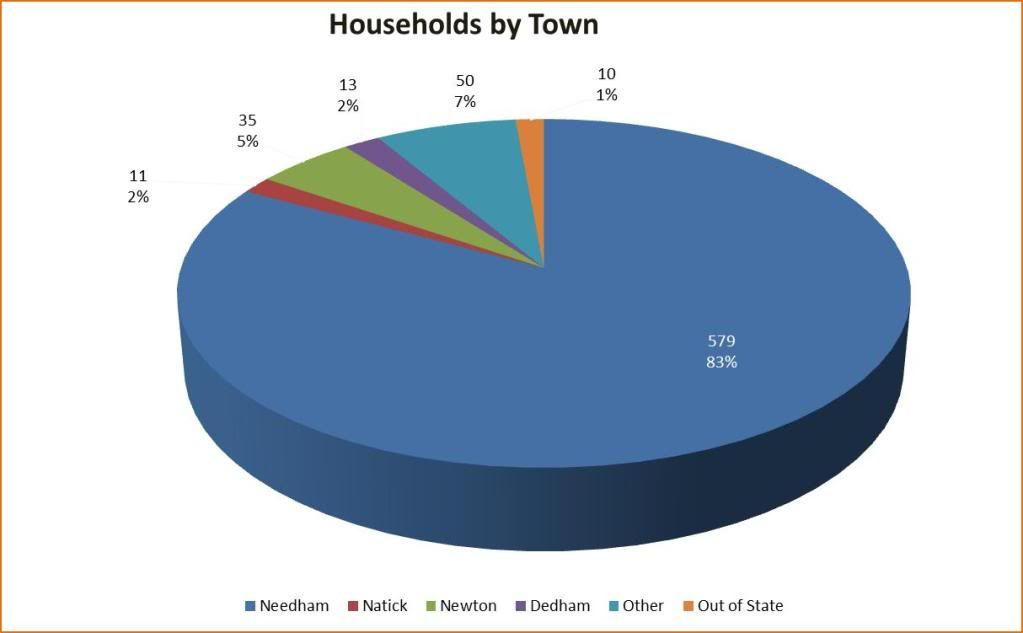
We celebrate the diversity of our community in all of its aspects. While our membership is certainly primarily based in Needham, (83% of our households), the remaining 17% of our households come from Natick, Newton, Dedham, Dover, and other neighboring communities, as well as from out-of -state.
We also have a diverse population by age (of oldest family member): 50% of our households have an oldest family member between 40 and 55 years old, 7% have an oldest family member in the 30 - 39 year old age range, and 43% have an oldest family member in the 55 years of age and older.
As a complete picture of our membership, we have grown from a congregation of 540 households eight years ago to one of over 700 households today. When we utilize comparative data from the Synagogue Council of Massachusetts, we sit in the category of synagogues with the largest number of members (500 and above) regardless of denomination (from the Union for Reform Judaism, URJ, we sit in the next-to-largest category of congregations, 500 to 1000 households).
We should be proud of how our congregation has grown in size while maintaining its warm and welcoming nature. We continue to celebrate our diversity in all of its aspects, from gender and sexual orientation to religious upbringing and ritual observance.
Our Sources of Financial Support:

Our TBS Vision reads: “Membership in our congregation and education for our children are accessible to all, regardless of financial circumstance.” It is our belief in this community that each household will contribute towards dues the amount they are able. Of the total amount of dues assessed in 2010-11, 84% were collected. The remainder of the dues was subsidized by the operating budget. This financial support is a fundamental lifeline for families who would not otherwise have sufficient resources to become or remain a part of our congregation. This fiscal reality also requires that we grow other income sources as we cannot simply forgo revenue and continue to provide excellent programming and services to our members.

The total amount of net dues accounts for 49% of the Temple’s annual operating budget. Our next largest income source stems from Teen Programs, Religious School, and Children’s Center tuitions, which amount, collectively, to 37% of all income. Additionally, we secure 4% of our annual operating income from fundraising (Taste of the Town, our Golf and Tennis Fundraiser, Elijah’s Table, High Holy Day Pledges, Fund donations), 1% from house rental, and 9% from all other sources combined (Scroll advertising, Membership Directory advertising, grant income, program fees, etc.).
Our Operating Expenses:

The largest portion of our operating expense is the 64% which funds salary for all of our staff, including clergy, professional and support staff (both full and part-time), as well as employee benefits. Building and Operations (which includes custodial services, building and outdoor maintenance, utilities, etc.) comprises 9% of operating expenses. Programming accounts for 7% of our annual operating expenses, whether fully funding or subsidizing costs for events such as our Scholar-in-Residence Weekend, Teen Programming, Oneg receptions following services, and Shabbat dinners. Other expense categories are organizational dues (a required cost in support of our parent URJ organization) at 6%, interest on our mortgage debt at 3%, contractors (consulting or contributing outside educators and musicians) at 2%, telecommunications (technology and phone costs) at 1%, and finally 8% of other miscellaneous expenses, including advertising, office supplies, printing, books, professional development, equipment, insurance and legal fees, among others.
Sustainability and Financial Implications:
In order for us to move forward as an organization, we need to not only benchmark where we are, but also to complete our analysis of what financial resources will be required to move us toward our TBS Vision, adopted last year. As our Strategic Planning work is underway, we have begun to review the information outlined above, and to create big picture assessments of the gaps between our existing structures and our vision for ourselves. So too we are actively determining strategies to help us to bridge our gaps.
To that end, we will continue to help congregants thoughtfully grow and refine their giving relationships with Temple Beth Shalom. As part of this effort, within the next months we will be unveiling a cyclical calendar of giving. These regular giving opportunities have been designed to afford people ample chance throughout the year to share their gifts and blessings. We share this calendar with you now so that you can best anticipate the ways and times at which you want to offer support:
Invitation:
With this information in front of you, we invite you to offer feedback on this blog post that can then be utilized in our strategic planning assessment and goal-setting. As well, please mark your calendars to join us at the Annual Congregational Celebration on Wednesday, June 15th at 7:30 pm for a comprehensive Annual Report, an election of the slate of nominees for the Board of Trustees, a vote to approve our 2011-12 budget, and a celebration (with refreshments and music) of the year’s work. AND for the first time, this evening will include a ritual of welcome to our new temple leadership: we will be installing our new officers and trustees in the sanctuary at 8:45 pm. We look forward to seeing you there and we thank you for your ongoing partnership in building a sacred community of which we can all be proud, and within which we can all find our spiritual home.
Rabbi Todd Markley
Beth Pinals
Daniel Barkowitz
Please click on any chart below to open a larger version for ease of viewing.
All year we write and talk with you about the sacred goings on in our building – about our innovative programming, as well as the exciting ventures of our transforming professional staff. While we are blessed with a rich and ever-growing community, we need always to ensure its sustainability and development.
Because all of our members are sacred partners in the building of our community, it is important that everyone understand clearly the fiscal realities which sustain us as we continue to grow and thrive. It is our intention that this article will become an annual tradition of June reports on the financial health of our congregation.
Our Composition:
We celebrate the diversity of our community in all of its aspects. While our membership is certainly primarily based in Needham, (83% of our households), the remaining 17% of our households come from Natick, Newton, Dedham, Dover, and other neighboring communities, as well as from out-of -state.
We also have a diverse population by age (of oldest family member): 50% of our households have an oldest family member between 40 and 55 years old, 7% have an oldest family member in the 30 - 39 year old age range, and 43% have an oldest family member in the 55 years of age and older.
As a complete picture of our membership, we have grown from a congregation of 540 households eight years ago to one of over 700 households today. When we utilize comparative data from the Synagogue Council of Massachusetts, we sit in the category of synagogues with the largest number of members (500 and above) regardless of denomination (from the Union for Reform Judaism, URJ, we sit in the next-to-largest category of congregations, 500 to 1000 households).
We should be proud of how our congregation has grown in size while maintaining its warm and welcoming nature. We continue to celebrate our diversity in all of its aspects, from gender and sexual orientation to religious upbringing and ritual observance.
Our Sources of Financial Support:
Our TBS Vision reads: “Membership in our congregation and education for our children are accessible to all, regardless of financial circumstance.” It is our belief in this community that each household will contribute towards dues the amount they are able. Of the total amount of dues assessed in 2010-11, 84% were collected. The remainder of the dues was subsidized by the operating budget. This financial support is a fundamental lifeline for families who would not otherwise have sufficient resources to become or remain a part of our congregation. This fiscal reality also requires that we grow other income sources as we cannot simply forgo revenue and continue to provide excellent programming and services to our members.
The total amount of net dues accounts for 49% of the Temple’s annual operating budget. Our next largest income source stems from Teen Programs, Religious School, and Children’s Center tuitions, which amount, collectively, to 37% of all income. Additionally, we secure 4% of our annual operating income from fundraising (Taste of the Town, our Golf and Tennis Fundraiser, Elijah’s Table, High Holy Day Pledges, Fund donations), 1% from house rental, and 9% from all other sources combined (Scroll advertising, Membership Directory advertising, grant income, program fees, etc.).
Our Operating Expenses:
The largest portion of our operating expense is the 64% which funds salary for all of our staff, including clergy, professional and support staff (both full and part-time), as well as employee benefits. Building and Operations (which includes custodial services, building and outdoor maintenance, utilities, etc.) comprises 9% of operating expenses. Programming accounts for 7% of our annual operating expenses, whether fully funding or subsidizing costs for events such as our Scholar-in-Residence Weekend, Teen Programming, Oneg receptions following services, and Shabbat dinners. Other expense categories are organizational dues (a required cost in support of our parent URJ organization) at 6%, interest on our mortgage debt at 3%, contractors (consulting or contributing outside educators and musicians) at 2%, telecommunications (technology and phone costs) at 1%, and finally 8% of other miscellaneous expenses, including advertising, office supplies, printing, books, professional development, equipment, insurance and legal fees, among others.
Sustainability and Financial Implications:
In order for us to move forward as an organization, we need to not only benchmark where we are, but also to complete our analysis of what financial resources will be required to move us toward our TBS Vision, adopted last year. As our Strategic Planning work is underway, we have begun to review the information outlined above, and to create big picture assessments of the gaps between our existing structures and our vision for ourselves. So too we are actively determining strategies to help us to bridge our gaps.
To that end, we will continue to help congregants thoughtfully grow and refine their giving relationships with Temple Beth Shalom. As part of this effort, within the next months we will be unveiling a cyclical calendar of giving. These regular giving opportunities have been designed to afford people ample chance throughout the year to share their gifts and blessings. We share this calendar with you now so that you can best anticipate the ways and times at which you want to offer support:
- Summer membership renewal will include opportunities to give the gift of sustaining membership for those undergoing financial hardship.
- Celebrate the start of our school year in the fall by contributing to scholarship funds for our Education Programs through our Golf and Tennis Fundraiser.
- During the Days of Awe, our High Holy Day appeal will allow us to practice tzedakah… a most fitting way to start a new year together.
- At Chanukah, we will offer an opportunity to pledge to our scholarship endowment as we celebrate our teachers and educators who bring enlightenment to our students.
- At Pesach, we will revitalize Elijah’s Table to spiritually provide sustenance through Temple membership for those who hunger for, yet require assistance with, the associated costs.
- Finally we will spring forward into the hope of new visions for our youth funded by our Taste of the Town evening of fun and celebration, which help defray the operating costs for all our learning programs.
Invitation:
With this information in front of you, we invite you to offer feedback on this blog post that can then be utilized in our strategic planning assessment and goal-setting. As well, please mark your calendars to join us at the Annual Congregational Celebration on Wednesday, June 15th at 7:30 pm for a comprehensive Annual Report, an election of the slate of nominees for the Board of Trustees, a vote to approve our 2011-12 budget, and a celebration (with refreshments and music) of the year’s work. AND for the first time, this evening will include a ritual of welcome to our new temple leadership: we will be installing our new officers and trustees in the sanctuary at 8:45 pm. We look forward to seeing you there and we thank you for your ongoing partnership in building a sacred community of which we can all be proud, and within which we can all find our spiritual home.
Rabbi Todd Markley
Beth Pinals
Daniel Barkowitz
Friday, May 27, 2011
The Ten Commandments and Shavuot: An Introductory Post by Rabbi Todd Markley
Ed. Note: For the next 10 days as we approach the holy day of Shavuot, we will be sharing personal reflections from several members of the congregation on each of the 10 commandments. The congregants who will be sharing their words in the next 10 days are members of our nominated slate for the Board of Trustees for the 2011-2012 year. Each member was invited to share their D'Var Torah at our historic congregational meeting in which we passed the new TBS By-Laws.
We invite you to participate in this dialogue by offering your personal reflections on each of the commandments.
Dear Temple Family,
In just eleven short days, Shavuot, the second of the major "pilgrimage festivals" (those holidays when all of the people would flock to Jerusalem in ancient days), will be upon us. This cycle begins with Passover, the time of our people's going out from slavery and bondage in Egypt. Shavuot, celebrated seven weeks later, commemorates the next phase of our people's journey...the moment of God's revelation to the Israelites at Mount Sinai. In the fall, we will mark the third of these pilgrimage festivals, Sukkot, a season which invites us to leave the comfort of our homes and to live in temporary booths as our ancestors did on their travels from Mount Sinai to the Promised Land.
At Temple Beth Shalom, we mark this major milestone moment in the Jewish calendar by celebrating our Confirmation students on the eve of Shavuot, as they affirm their commitment to Torah, Jewish learning, and engagement with our community. In that way, they are, in fact, reliving that moment at Sinai when Torah was shared with our entire people, and we are so excited to hear them offer words of prayer, Torah, and song with us as we celebrate this festival. Please do join us for our Erev Shavuot Confirmation service on Tuesday, June 7th at 7:30 PM. This is the perfect way to mark this holiday season and to rejoice in the accomplishments of our extraordinary teens. If you are not able to be with us that night, do join us for our Shavuot morning minyan service at 7:00 AM on Wednesday, June 8th - our Yizkor service of remembrance will be read.
In his Guide for the Perplexed, the great Jewish teacher and scholar, Moses Maimonides reflected on the meaning of celebrating the giving of the commandments in the wilderness:
Shavuot is the anniversary of the revelation on Mount Sinai. In order to raise the importance of this day, we count the days that pass since the preceding festival, just as one who expects his most intimate friend on a certain day counts the days and even the hours. This is the reason why we count the days that pass since [Passover,] between the anniversary of our departure from Egypt and the anniversary of the giving of the law. The latter was the aim and object of the exodus from Egypt.
As the memories of family seder tables fade into the recesses of our minds, let us recall that the aim of the freedom we celebrated in April was the ability to live lives of sacred meaning and purpose, grounded in covenant with our people. We were freed so that we might be be bound not to taskmaster but rather to one another in shared practice, ritual, and pursuits as a group of people charged with bringing a little extra light to our world. May this Shabbat ahead, and the upcoming season of Shavuot, prove to be opportunities to do just that.
Michele, Mia, and Adam join me in wishing you a Memorial Day weekend filled with reverence for those whose memories we call to mind during these days, and a Shabbat that is set apart for its relaxation, its comfort, and its warmth.
Shabbat Shalom!
Todd
Subscribe to:
Posts (Atom)