Tuesday, August 9, 2011

Social Justice in the Social Media Age - A Crosspost from eJewish Philanthropy


Ed. Note: Today we feature a cross-post from eJewish Philanthropy, a daily newsletter focused on the Jewish Philanthropic world.

This post, written by Florence Broder, Chief Operations Officer for israelgives.org, explores how the use of social media is shaped by your community. She uses the backdrop of the current protests in Israel as a case study on the successful use of social media.

What do you think about the challenge the article lays out for us? In what way can our community at TBS embrace the vision of using social media "to reawaken the complacent into action"?

Special thanks to Florence Broder for permission to cross-post her article to the Temple Beth Shalom blog.


When Allison Fine was in Israel in May, she said Israelis have so much to say, it can’t fit into 140 characters. Yet Israelis are a population that live for text messaging – it’s even how they pay their parking meter. I constantly try to make sense of the disparity between the two Israels: one being the hi-tech center of the world; the other, a country not that can’t use the tools to communicate. During June’s Israeli Presidential Conference, everyone applauded the great coverage on Twitter, but I couldn’t help but ask why was it all in English? Where were all the Israeli Hebrew tweeters?

However, the developing protests in Israel paint a different picture. The need to communicate has made tweets a catalyst for change and a revolutionary spirit. Empowered by social media, the Israeli public has been galvanized in the quest for social justice, the mantra of the movement. The Tent Protesters quickly launched a WordPress site designed by Code Patuach that has the elements that we all want – a social, interactive site, with a clear call-to- action, and consistent branding.

The site homepage offers you photos, videos and blogs. If it’s community you are looking for, there is a Hebrew and English Twitter feed and you can follow the #J14 hashtag. (In case you were wondering, it’s J14 because the movement began on July 14th, which is also Bastille Day.) There is a Facebook page which allows fans to identify with the movement by offering them badges and other opportunities to get involved. Want to leave a comment about a newspaper article? You can do it right from the homepage. There is even a live chat feature so you can talk to protesters right on the spot! And if you want to support the movement financially, the is a clearly labeled donate button.

The protesters have been so successful because they have been strategic in how they have empowered the public to get involved. They have created clear and consistent messaging to propel the public forward. They have leveraged social media to give a voice to people who thought they were voiceless. They have created community for people who felt alone in their plight. As the movement grows, so does the reawakening of the Israeli public who are starting to actually believe that they can effect change and re-envision a different future for Israel.

As you consider issues in your own community, reflect on the success of social media in bringing together Israelis from all walks of life. Think about how the tools can do the same for your community. Take a fresh look at your organization’s website and think about how you too can integrate social media into your website to reawaken the complacent into action.

By Florence Broder

Wednesday, August 3, 2011

Sam Moller's Sinai Statement: Celebrating Confirmation and Tikkun Olam

Ed. Note: The third in our series of our Confirmand's Sinai Statements comes from Sam Moller. Sam talks about his views on Tikkun Olam and how his trip to the RAC during his confirmation year has helped shape these views.

Throughout my life I have always been drawn to perform Tikkun Olam, the Jewish principle of repairing our world through acts of social justice. Throughout my time at The Rashi School, I was under the impression that most of the people in our society were involved in social justice projects. After my trip to the Religious Action Center this winter my impression of Tikkun Olam completely changed. I realized from my trip to the RAC that very few people participate in social justice projects or have a clue about the injustices in our world. The trip also showed me that people should give back to their community and the people who have given to them. As Judaism says “Love thy neighbor as thyself”.

On the trip we covered many different social issues that have a great effect on this country, such as poverty, LGBT rights, America’s relationship with the State of Israel, family abuse, global warming and many more. By going into deeper learning around these topics I realized that there are more than one or two common views on these matters. There are hundreds. The phrase, “Two Jews, Three Opinions”, came into play on the trip countless times.

After I returned from our time at the Religious Action Center, I reflected on my experience and I realized that besides the friends that I made, I discovered a strong passion for the social justice projects that we worked on during the trip. I then came to the conclusion that I want to pursue a career in bringing greater justice to our world. Some people have come up to me since the trip and have asked what I want to be when I get older, and I have responded to them that I want to work in social justice. Some have said that, that it is very commendable, however the majority of the people have responded in saying that, my thought about my career is foolish because there is no money involved. Yes it is true that working in social justice is not a “get rich quick” occupation, however the enjoyment that I get from doing good is priceless.

--Sam Moller

Tuesday, July 19, 2011

SOFTBALL: A Reflection, in Seven Innings

1

Baseball and softball have always been important parts of my life. I grew up playing catch with my dad and my mom, and all summer long my older brother John (a good hitting lefty and an above-average fielder) and I would ride our bikes to a nearby field where anywhere from four to twenty kids would play baseball until it was too dark to see the ball. In high school my temple’s NFTY group had no softball team, so I also joined the local BBYO to play softball with the AZA team. I played intramural softball with John during the one semester we were at college together, and I have been playing softball – and occasionally helping coach little league – ever since.

2

A few years ago, Jon Cohan pitched the idea of starting a TBS Brotherhood softball team. He gathered a group of interested players, found a league for us to play in, and undertook the thankless task of organizing us into a softball team. Not very easy, given the unruly, opinionated, and vocal group of players – myself included - who joined the team. The diversity in age, athletic ability, softball experience, and temperament was extraordinary, but that first season we managed to practice once or twice without suffering too many injuries, field a team each week without forfeiting, and have a lot of fun while getting to know each other. Within a couple of years, the roster grew to more than 25 players, and when it became apparent that those of us hitting 22nd or 23rd in the order risked going an entire season with only one at-bat per game, the team was divided into two.

3

Softball is played with 10 fielders, and between 12 and 14 players usually show up for our games. It’s not so few that we lack variety of skills and personalities, but not so many that we lose our close connections with each teammate: it is a good size. It takes 10 to form a minyan – wasn't there something about Abraham trying to field a 10-man team of innocents so Sodom could be saved (Genesis 18:32) - and Moses sent 12 tribal leaders to scout the home team when the Israelites first approached the Promised Land (Numbers 13:2). Groups of this size are common: most juries have 12 members, and the basic fighting unit of many armies is the squad, usually consisting of 10 to 12 soldiers. It has been suggested that 12 “was a natural size for a hunting party of the Stone Age, and that men were predisposed to feel comfortable in a group of about that size” (Neal Stephenson, Anathem, Harper (2009), p. 346). Literary examples include Tolkien’s 9-member Fellowship, and the 11 courageous pioneers, led by the heroic rabbit Hazel, who went forth from their native land to establish a new home on Watership Down.

4

How many connections with classmates, friends and Temple members have I made over my decades of playing softball? Too many to count. When someone asks if I know a lawyer with a particular area of expertise, the first people I think of are my law school softball teammates. Most of the men I know best at Temple are guys I first got to know playing softball. Softball buddies Morris Porter and Richard Atkind were instrumental in setting up our employment assistance program; I have shared terrific music with some teammates; I’ve worked on Temple boards and committees with others; and I have led shiva services at the homes of some of my softball friends after the death of a parent.

5

Every summer Sunday morning after I graduated from law school, I played in a long-standing pick-up game in Brookline. (A few of the other regulars were Orthodox, and I enjoyed watching their fringes fly as they ran the bases). I stopped playing in that game in the mid-1980s after moving to Needham, but one Sunday morning about 3 or 4 years ago, I decided to see whether the Brookline game was still going. When I arrived at the field, I recognized three or four of the players, and a couple of them saw me and yelled, “Hey, Kenny – we need a second baseman.” Two decades absent, and they welcomed me as if it had been two weeks. Clearly, there is some intangible bond that forms on the softball field. (Or maybe they just really, really needed someone to play second base).

6

Reflecting on Brotherhood softball compels me to point out a serious problem with the Mens Shul Softball League: women are not allowed to play. I believe that this ban is in deference to Orthodox players’ concerns about forbidden physical contact with a woman not one’s wife or close relative. For its adherents this may be a matter of religious observance, but its effect is discriminatory. Women cannot play on our TBS team, solely on the basis of their gender. When I first heard of this rule, it bothered me, but I rationalized my concerns away somehow, and it did not bother me enough to protest - or to quit the team. Our 2011 season is now over. Writing this has made me think more seriously about this problem, and I do not know whether I will choose to play again next year.

7

Softball brings back great memories and allows me to meet and get to know other Temple members. It can even be an occasion for hearing good things about our Temple. Last summer, before a game with Mishkan Tefillah’s team, one of their players came over to me and said, “I was at a B’nai Mitzvah service at Temple Beth Shalom recently, and I want to tell you what a great place it is.” I started talking about the sanctuary renovation, and how the space is now so much more open and light, and he interrupted me: “I wasn’t talking about the physical structure – I was talking about how warm and welcoming the people are at your Temple.” I thanked him, and walked away feeling proud of TBS and the impression we had made on this visitor. And I felt even better after we won the game by a dozen runs.

Tuesday, July 5, 2011

Maimonides - Then and Now

In contemporary culture today, the name Maimonides stands for the mainstream Jewish Orthodoxy. Chabad (Lubavich Hasidic) sends in regular messages on line with special references to Maimonides’s books for daily study. A prominent Orthodox private school, called Maimonides, continues to have a great academic reputation in Boston, MA.

That was not always the case in the medieval period when the great philosopher lived, first in Cordoba, Spain and then in Fustat, Egypt. Moses Maimonides (1135-1204; called for short, Rambam) was deeply influenced by the teachings of Aristotle, and attempted to show that Judaism, too, with some restrictions, could be understood in light of Greek philosophy. Through his books, such as The Guide to the Perplexed, and the Commentary to the Mishnah, the rabbi-philosopher spoke of God as pure intellect, and insisted that God’s attributes were metaphors, which were understood and expressed only by our limited human minds.

Though Maimonides had many supporters, some of his contemporaries strongly disagreed with his rationalistic interpretation of Judaism. Soon, an anti-Maimonidean movement developed in southern France and Cataluña, which shook the foundations of the Jewish communities in the Mediterranean basin. Spearheaded by the Ravad of Posquieres (12th cent) and supported even by some of the great rabbinic luminaries, such as Solomon b. Abraham of Montpellier and Jonah b. Abraham of Girondi, the anti-Maimonidean movement declared the Rambam a heretic, and was instrumental in having his books publicly burned in Montpellier, southern France in 1233. As time went on, however, this negative attitude against Maimonides abated, and, in our time, few remember the fierce intellectual battles that medieval rabbis fought about this great Jewish-Spanish philosopher.

In our time, a new intellectual battle is raging between the Jewish rationalists and anti-rationalists -- each claiming that it best represents the Jewish tradition. Regrettably, the anti-rationalists appear to be denigrating the other possible approaches in Judaism. This would be a big mistake, because there is room within our tradition for both approaches, and no one should claim that it has the ultimate truth. As a rationalist myself, I would be very sad if this reality is ignored in the modern Jewish world.

Rifat Sonsino

This post originally appeared on Rabbi Sonsino's blog, “From Istanbul to Boston”

Friday, July 1, 2011

Thirty Conversions In Barcelona

I have been in the rabbinate for more than four decades but never before have I participated in a group conversion of 30 individuals (24 adults and 6 children, ages 4 to 12) until now. This historic event took place in Barcelona, Spain on June 8 and 9, 2011.

The entire project was coordinated by Rosina Levy of Bet Shalom of Barcelona, a small congregation I have been helping out on and off for the last four years with its programs and services, and which now belongs to the European Region (ER) of the World Union for Progressive Judaism (WUPJ). When word got out that Bet Shalom was ready to present its candidates to the ER’s Beth Din (“rabbinic court”), other liberal Jewish communities around Spain asked that they be allowed to send in their own as well.

A duly authorized progressive Beth Din of three rabbis and a lay secretary came in from London. The European custom is that the local Rabbi (in this case, me) is not an official member of the court. However, I was invited to attend all the sessions and became a full member when one of the rabbis had to return to London for Shabbat services.

The candidates came from many parts of Spain: Barcelona (the majority from Bet Shalom but a few also from Atid), Asturias, Galicia, Seville, Cordoba, and Madrid. They were prepared for this transition by local teachers for a period of a year or more, and the men had to bring a certificate of circumcision as required by Jewish law and the European custom. (In the States, some Reform Rabbis do not require this procedure from adult males). The participants demonstrated proficiency in Jewish history, customs, religious festivals, and life-cycle events; and they were all involved in their own synagogue life.

It is estimated that there are about 20,000 to 25,000 Jews in Spain today, most of them coming from North Africa, France and surrounding countries, but there is a great pool of local people with vivid Jewish memories going back to the times of the Inquisition. Now these people want to reclaim their Jewish identity and wish to become officially part of the people of Israel.

After the exams, we issued two types of certificates: a formal conversion certificate but also, upon request, a certificate of return. We heard incredible stories: their parents, and more often their great or great-grand parents, told them that they carried Jewish blood, that it was the family tradition to cover the mirrors during the period of mourning, that many lit candles on the Sabbath Eve, some knowing exactly what they are doing, others attributing the practice to vague family traditions of ages gone by with no particular knowledge of their significance.

The culminating event took place on Friday, June 9, in the afternoon, when all the candidates (with the Beth Din supervising the procedure) went to the beach for the tevilah, the ritual immersion, with women on one side and men on the other of the pier. It was drizzling that day in the morning but fortunately for us, when we arrived at the beach, the rain stopped and the sun appeared for a short while. There was a mad dash into the tepid waters. After reciting the blessings together, they all came out triumphantly proclaiming their new Jewish identity.

That night, during the Sabbath service, I, as the officiating Rabbi, gave each Jew-by-choice his/her certificate, and the next day during the morning worship I called them up to the Torah for their ever first aliyah. There was joy and celebration in the congregation. They could not thank us enough for confirming what they felt a very long time. And we, at the rabbinic court, were thrilled to make this happen a reality for them. For next year, many are already planning an adult Bar/t Mitzvah.

This conversion program not only propelled Bet Shalom onto the front lines of progressive Judaism in Spain but is now a model for other small congregations, which have learned what can be accomplished with enthusiasm, dedication and the support of the European Region of the WUPJ. This made me really proud.

Rabbi Dr. Rifat Sonsino, Emeritus

Boston College, USA

This post originally appeared on Rabbi Sonsino's blog, “From Istanbul to Boston”

Thursday, June 16, 2011

Needham 300 and Temple Beth Shalom 55

The Town of Needham is celebrating it's 300th birthday in 2011. Last Saturday night my wife Julie and I had the pleasure of attending Needham 300 Night at the Pops. Symphony Hall was full with 2500 Needhamites (and only Needhamites!) who had journeyed into Boston. As I sat in the balcony and looked at the many animated faces before the concert started, I noted the many Temple Beth Shalom members who were present.

Needham has been an exceptionally good home for Temple Beth Shalom for our 55 years in the town. We are blessed to have it as our congregational home. It is a good community of citizens who are actively involved in town government and other town activities. So too has our community been good for the Town of Needham. Our members populate the Board of Selectmen, Town Meeting and many, many community organizations.

As Needham celebrates its birthday this year, let's pause and reflect with gratitude on this long-standing and wonderful relationship that we share with our broader community.

Monday, June 13, 2011

Jacqueline Agranat's Sinai Statement: Celebrating Confirmation and TBS Teen Programs

Ed. Note: This second in our series of our Confirmand's Sinai Statements comes from Jacqueline Agranat. Jacqueline talks about her experience during this confirmation year, and shares her perspective on shalom.

Shalom everyone. This one word, “shalom,” has multiple meanings. The main three meanings are "hello, goodbye, and peace." In Hebrew, however, "shalom" is related to the word, "shleimut" which means "wholeness, health, and contentment." Being a part of this temple allows me to feel all the different parts that Shalom can offer. School cannot compete with the environment that this synagogue provides. In school we are taught facts, and forced to memorize them in order to do well on the upcoming test. In Confirmation, however, we are taught stories, lessons, and facts as well, but we do not need to memorize them for a test. We discuss these teachings and share what they mean to us. Each commandment from our Torah tradition impacts each individual differently. Confirmation class allows each of us to be our own person, rather than just another student in a class. We have come to understand that we are part of a larger tradition of adding our own voices to Torah, making it speak to our lives today.

As I was growing up, going to temple was a mandatory activity in my busy life. After everyone became Bar or Bat Mitzvah, in many families, it was the kid’s decision whether or not they should continue learning at temple. After observing how much my older brother Josh enjoyed his time here, I was willing to continue with it. Now I can see why he enjoyed it so much. This place, this beautiful synagogue, makes me feel secure. It wouldn’t be the same without the people that are here with me. Each member of the Confirmation Class of 2011 is a unique individual. It has been incredibly refreshing to spend time with the members of Confirmation and get to know them better. I know we all can relate when I say that the sharing circle before each class, during which we can check in about one another’s lives, is something we all enjoy. We are able to speak our minds and know that everyone’s support is present. Confirmation is one of the few places where I feel comfortable enough to really speak my mind without being judged, and I thank you all for allowing this shleimut, this wholeness, to be possible.

--Jacqueline Agranat

Friday, June 10, 2011

In Preparation for the Annual Congregational Meeting: A Review of the Temple Finances

Ed. Note: This article appeared in this month's Scroll and is repeated here with color charts for ease of review. As we approach the upcoming congregational meeting on June 15th, we would like to ensure that every member of the congregation has an understanding of the Temple's financial position. This article invites your feedback and ideas. We also hope to see you on June 15th at 7:30 for our Congregational celebration.

Please click on any chart below to open a larger version for ease of viewing.

Dear Temple Beth Shalom Family

All year we write and talk with you about the sacred goings on in our building – about our innovative programming, as well as the exciting ventures of our transforming professional staff. While we are blessed with a rich and ever-growing community, we need always to ensure its sustainability and development.

Because all of our members are sacred partners in the building of our community, it is important that everyone understand clearly the fiscal realities which sustain us as we continue to grow and thrive. It is our intention that this article will become an annual tradition of June reports on the financial health of our congregation.

Our Composition:


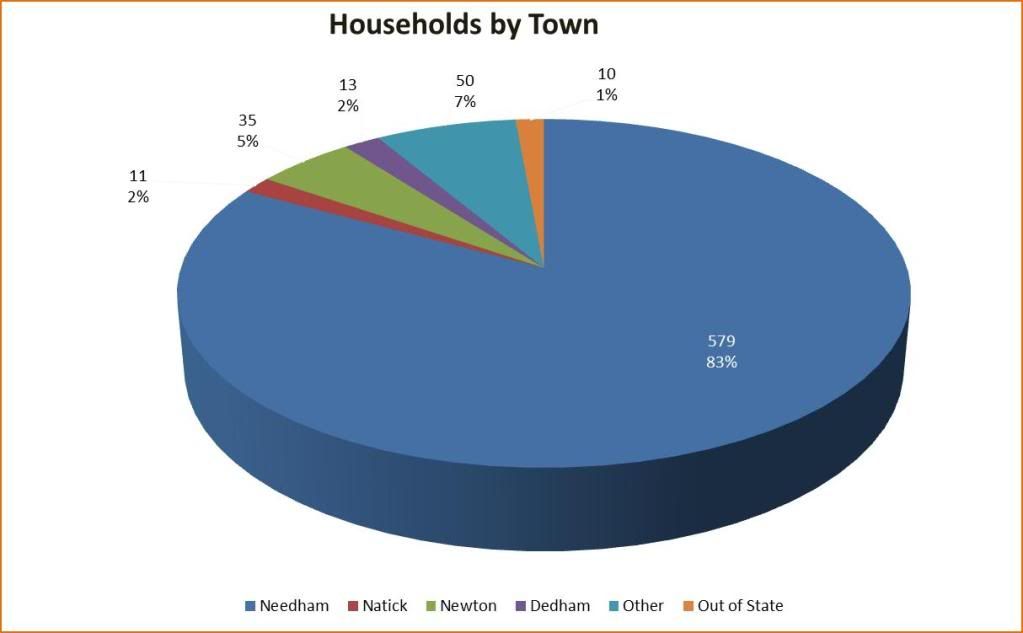
We celebrate the diversity of our community in all of its aspects. While our membership is certainly primarily based in Needham, (83% of our households), the remaining 17% of our households come from Natick, Newton, Dedham, Dover, and other neighboring communities, as well as from out-of -state.

We also have a diverse population by age (of oldest family member): 50% of our households have an oldest family member between 40 and 55 years old, 7% have an oldest family member in the 30 - 39 year old age range, and 43% have an oldest family member in the 55 years of age and older.

As a complete picture of our membership, we have grown from a congregation of 540 households eight years ago to one of over 700 households today. When we utilize comparative data from the Synagogue Council of Massachusetts, we sit in the category of synagogues with the largest number of members (500 and above) regardless of denomination (from the Union for Reform Judaism, URJ, we sit in the next-to-largest category of congregations, 500 to 1000 households).

We should be proud of how our congregation has grown in size while maintaining its warm and welcoming nature. We continue to celebrate our diversity in all of its aspects, from gender and sexual orientation to religious upbringing and ritual observance.

Our Sources of Financial Support:


Our TBS Vision reads: “Membership in our congregation and education for our children are accessible to all, regardless of financial circumstance.” It is our belief in this community that each household will contribute towards dues the amount they are able. Of the total amount of dues assessed in 2010-11, 84% were collected. The remainder of the dues was subsidized by the operating budget. This financial support is a fundamental lifeline for families who would not otherwise have sufficient resources to become or remain a part of our congregation. This fiscal reality also requires that we grow other income sources as we cannot simply forgo revenue and continue to provide excellent programming and services to our members.


The total amount of net dues accounts for 49% of the Temple’s annual operating budget. Our next largest income source stems from Teen Programs, Religious School, and Children’s Center tuitions, which amount, collectively, to 37% of all income. Additionally, we secure 4% of our annual operating income from fundraising (Taste of the Town, our Golf and Tennis Fundraiser, Elijah’s Table, High Holy Day Pledges, Fund donations), 1% from house rental, and 9% from all other sources combined (Scroll advertising, Membership Directory advertising, grant income, program fees, etc.).

Our Operating Expenses:


The largest portion of our operating expense is the 64% which funds salary for all of our staff, including clergy, professional and support staff (both full and part-time), as well as employee benefits. Building and Operations (which includes custodial services, building and outdoor maintenance, utilities, etc.) comprises 9% of operating expenses. Programming accounts for 7% of our annual operating expenses, whether fully funding or subsidizing costs for events such as our Scholar-in-Residence Weekend, Teen Programming, Oneg receptions following services, and Shabbat dinners. Other expense categories are organizational dues (a required cost in support of our parent URJ organization) at 6%, interest on our mortgage debt at 3%, contractors (consulting or contributing outside educators and musicians) at 2%, telecommunications (technology and phone costs) at 1%, and finally 8% of other miscellaneous expenses, including advertising, office supplies, printing, books, professional development, equipment, insurance and legal fees, among others.

Sustainability and Financial Implications:

In order for us to move forward as an organization, we need to not only benchmark where we are, but also to complete our analysis of what financial resources will be required to move us toward our TBS Vision, adopted last year. As our Strategic Planning work is underway, we have begun to review the information outlined above, and to create big picture assessments of the gaps between our existing structures and our vision for ourselves. So too we are actively determining strategies to help us to bridge our gaps.

To that end, we will continue to help congregants thoughtfully grow and refine their giving relationships with Temple Beth Shalom. As part of this effort, within the next months we will be unveiling a cyclical calendar of giving. These regular giving opportunities have been designed to afford people ample chance throughout the year to share their gifts and blessings. We share this calendar with you now so that you can best anticipate the ways and times at which you want to offer support:
  • Summer membership renewal will include opportunities to give the gift of sustaining membership for those undergoing financial hardship.

  • Celebrate the start of our school year in the fall by contributing to scholarship funds for our Education Programs through our Golf and Tennis Fundraiser.

  • During the Days of Awe, our High Holy Day appeal will allow us to practice tzedakah… a most fitting way to start a new year together.

  • At Chanukah, we will offer an opportunity to pledge to our scholarship endowment as we celebrate our teachers and educators who bring enlightenment to our students.

  • At Pesach, we will revitalize Elijah’s Table to spiritually provide sustenance through Temple membership for those who hunger for, yet require assistance with, the associated costs.

  • Finally we will spring forward into the hope of new visions for our youth funded by our Taste of the Town evening of fun and celebration, which help defray the operating costs for all our learning programs.


Invitation:

With this information in front of you, we invite you to offer feedback on this blog post that can then be utilized in our strategic planning assessment and goal-setting. As well, please mark your calendars to join us at the Annual Congregational Celebration on Wednesday, June 15th at 7:30 pm for a comprehensive Annual Report, an election of the slate of nominees for the Board of Trustees, a vote to approve our 2011-12 budget, and a celebration (with refreshments and music) of the year’s work. AND for the first time, this evening will include a ritual of welcome to our new temple leadership: we will be installing our new officers and trustees in the sanctuary at 8:45 pm. We look forward to seeing you there and we thank you for your ongoing partnership in building a sacred community of which we can all be proud, and within which we can all find our spiritual home.

Rabbi Todd Markley
Beth Pinals
Daniel Barkowitz

Thursday, June 9, 2011

Ben Grebber's Sinai Statement: Celebrating Confirmation and the Ten Commandments

Ed. Note: This past Tuesday night, our Confirmands shared their "Sinai Statements" with those of us who attended their Erev Shavuot service of Confirmation. Over the next several weeks, we will be sharing many of their statements. At the service, all 15 of the Confirmands read from the book of Exodus. The Torah scroll from which they read has special meaning. Read on to learn why.

When God passed the Torah down from Mount Sinai, it was given to Moses to share with the Jewish people. They, in turn, were now responsible to learn it, teach it, and pass it down through the generations. This created the strong heritage that we share today. After having a very special guest stay at our home, I now understand that heritage and what the Torah means to our people and to me.

During the Temple renovation some years back, my family kept a Torah from our sanctuary in our house for several months. We kept it free from dust and potential harm. We were a surrogate ark! At first, having the Torah in our house was cool but I was somewhat indifferent to it.

As the months went by, our new “house guest”, the Torah, took on a different meaning to me. The Torah became a member of our family as odd as that sounds. I passed it every day on my way to the kitchen. I checked on it to make sure that it was covered and protected.

The Torah was always a talking point when we had Jewish guests at the house. I realized that to a Jewish person, the Torah is immediately identifiable and even the least observant person seems to revere it as being something special, almost royal. I began to see the Torah as representing something greater than just a borrowed “thing” from our Temple.

After a few months of “Torah babysitting”, the Temple renovations were complete and the Torah had to be returned to its rightful place. My family was devastated. The Torah had become a part of our family, and it was sad to see it go.

The following Hanukah though, we were surprised yet again when my parents gave us a Torah of our own. Now we truly had a family Torah.

Once we put our new Torah in the infamous family room Torah Ark, I learned more about our Torah. I came to understand the Torah’s age, how fragile it is, and that it holds the Five Books of Moses. In my Holocaust class, I learned that many Torahs were destroyed by the Nazis and that some were actually secretly carried by my ancestors to America from places far away. For many of my ancestors, getting the Torah to a new and safe land was just as important as getting their families there. This was similar to the story of our Torah which came from Poland during the Holocaust.

Having our special Family Torah, I began to understand that when God instructed Moses to give the Torah to the Jewish people to pass its lessons and teachings down to future generations, God was instructing me to do the same. So I started asking questions about what stories the Torah contains. I took a greater interest in its teachings. Is this how the Jewish people felt at Mt. Sinai? Was it just an object given to them by Moses or did they see it as something more? Did they know that it would link future generations of Jews to them?

Even more important, over those months that the Temple’s Torah was in our house followed by the arrival of our Family Torah, I began to understand how the Torah links me to past generations. My Jewish ancestors learned the stories and teachings contained in the Torah just as I have throughout my religious school education. Through the strength and perseverance of the Jewish people, even in times of great hardship and war, the Torah is here today for me. I am a link in that chain of possession. My great-grandparents read from a Torah in Russia; my grandparents read from the Torah in America. My parents read from the Torah too – my father right here in this sanctuary. The Torah allows me to share that link in our heritage with all of them. It’s what binds us all together as Jews and as one family.

Just as Moses did on Mt. Sinai, we, too, will pass our family Torah from generation to generation. Like the Jewish people in Poland who read from our Torah years ago, I read from our sacred Torah when I became a Bar Mitzvah. My sister followed me by reading from it when she became Bat Mitzvah and my brother will follow our footsteps when he becomes a Bar Mitzvah. Like Moses, we will pass our family Torah from generation to generation, sharing the stories that go along with it, linking our future family generations with our current generation today. This is what keeps our history so strong. That is what identifies us as Jews and makes me who I am. I am proud that my Confirmation classmates and I will read from this sacred scroll tonight as we affirm our connections to Torah, to Temple Beth Shalom, and to one another.

--Ben Grebber

Tuesday, June 7, 2011

Congratulations to TBS and Needham High School Graduates by BESTY President Matt Lerner

Ed. Note: The following speech was delivered at Shabbat Services several weeks ago at which we offered congratulations to our graduating seniors. The words of blessing were delivered by Matt Lerner, current and incoming BESTY president. In recognition of yesterday's Needham High School graduation ceremonies, we offer Matt's words below.

Everyone loves ice cream. (For those of you who are lactose intolerant, my apologies, please cover your ears)… You know…I scream, you scream, we all scream for ice cream. Everyone loves to eat ice cream in their own way-cup or cone, shake or split, sprinkles or fudge. But whether you would vote for chocolate, vanilla or maybe cookie dough, we can all agree that it’s a great dessert.

As it happens, I know quite a bit about this tasty treat. (Stay with me here, I promise to get back to our graduates…) I spend the majority of my weekends scooping ice cream, often getting more on me than in the cup. Working at an ice cream store, I have to opportunity to observe the differences in how people prefer this iconic frozen dessert.

One day, a small child and his grandmother came into the store together. It’s a big store, so it took them a while to get their bearings, checking out all of the flavors and toppings. (Folks come in all the time and get overwhelmed by all of the choices. They end up settling on a flavor based on a catchy title, pretty color, or they go with what they know.) But this little boy was SO excited, he couldn’t decide on just one. He wanted EVERYTHING! The flavors, the toppings, in a cup with a cone… and by the time he was done, it was falling out of the cone, dripping everywhere. It was not a pretty sight. He had a scoop of black raspberry ice cream, with a scoop of peanut butter as well. He wanted marshmallow and strawberries and kit-kats on top. He just kept adding things while his grandmother stood by in shock.

When he was finally done, and it was his grandmother’s turn to order, she chose a small cup of mint chocolate chip. No toppings needed.

And as I watched this, I realized that as a child you want everything. You need to try all the flavors and combinations to find the ones you really love. As you grow older, you learn what you like most. And that’s the beauty of it… Some day that child will grow up, and bring his grandkids to get ice cream - hopefully I won’t still be there - and he will look on with a knowing smile as his grandchildren order everything on the menu.

And so now, as you move on from TBS, NHS, and this phase of your life, I want to offer you good luck in creating your own perfect ice cream Sundae, no matter what shape it takes. You will be constantly adding to it, changing it, altering the flavors as you grow and learn about yourself.

Keep in mind that there is only so much room in your cup - and be sure to keep the important things in there - your loved ones, memories, and your Jewish identity. Although you’re not all going to be together next year, remember that TBS will always be a common ingredient in your Sundae. Regardless of cup or cone, remember that this experience we’ve had at TBS is always with you - even if it gets buried underneath the other flavors.

Enjoy the chance to taste all that life has to offer: Good luck and we will miss you. Shabbat Shalom.

--Matt Lerner